
 Worksheets
Plate Tectonics
Total questions: 12
Worksheet time: 4mins
Name
Class
Date
1.
Who is the German Scientist that came up with the theory of the Continental Drift?
a)
Albert Einstein
b)
Ms. Stukel
c)
Galileo
d)
Alfred Wegener
2.
Originally the Continental drift theory was not well received by other scientist. Why?
a)
There was a competing theory at the time that was more believable.
b)
There was no data showing the continents ever moved.
c)
The scientists did not know the force responsible for moving the continents.
d)
The scientist presenting the data was unreliable.
3.
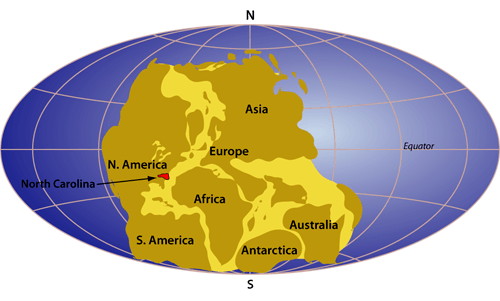
What is this a picture of?
a)
plate tectonics
b)
continental drift
c)
pangea
d)
glacier scaring
4.

Identify the Major Plate labeled B
a)
African Plate
b)
Antarctic Plate
c)
Pacific Plate
d)
Eurasian Plate
5.
Identify the Major Plate labeled I
a)
African Plate
b)
Antarctic Plate
c)
Pacific Plate
d)
Eurasian Plate
6.
Identify the Major Plate labeled N
a)
African Plate
b)
Antarctic Plate
c)
Pacific Plate
d)
Eurasian Plate
7.
Which of these explains that Earth's outer layer is broken into large slowly moving pieces?
a)
Plate Tectonic Theory
b)
Continental Drift
8.
Which explains that the continents were once joined together and over time they broke up and then drifted apart?
a)
Plate Tectonic Theory
b)
Continental Drift
9.
Pangaea was an ancient supercontinent made up of...
a)
America, Greenland, and Europe.
b)
Antarctica, India, and America.
c)
all of Earth’s continents.
d)
South Africa, India, Australia, and South America.
10.
Peer scientists reviewing Wegener’s hypothesis of continental drift rejected his notion because
a)
His evidence was too few to make a valid conclusion
b)
He did not explain how continents move and what moves them
c)
His evidence was not clear in showing how continents were joined
d)
He lied by including false evidence
11.
The rejection of Mr. Wegener's hypothesis teaches us that
a)
Indirect evidence is not sufficient to prove a hypothesis
b)
Direct evidence is hard to find
c)
Hypotheses are hard to prove
d)
Scientists of the early 1900s were not smart enough
12.
Evaluating the relationship between scientific laws, theories, and hypothesis, one can say
a)
Scientific hypothesis can became laws
b)
Scientific theories can became laws
c)
Scientific laws can be changed
d)
Scientific hypothesis can became theories
100 %

