wayground logo

Free Printable Worksheets

NEW

Font size

S
M
L
XL
Worksheets

Intro to Chemistry

Total questions: 30

Worksheet time: 25mins

Name
Class
Date
1.

All matter is made of what

a)

energy

b)

atoms

c)

electrons

d)

compounds

2.

The positive particles of an atom are

a)

electrons

b)

positrons

c)

neutrons

d)

protons

3.
The positive particles of an atom are 
a)
Electrons 
b)
Positrons 
c)
Neutrons 
d)
Protons 
4.
The central region of an atom where its neutrons and protons are is its _______.
a)
Nucleus 
b)
Electron cloud
c)
Core 
d)
Center 
5.
An atom with atomic number 6 would have how many protons?
a)
6
b)
12
c)
3
d)
Cannot be determined 
6.
An atoms overall charge is _____.
a)
Positive 
b)
Depends on its mood 
c)
Neutral 
d)
Negative 
7.

Why is the overall charge of an atom neutral (0)?

a)

They have the same number of protons and neutrons.

b)

They have the same number of protons and electrons.

c)

They have the same number of electrons and neutrons.
8.
What is the mass number?
a)
the number of protons
b)
the number of protons and neutrons
c)
the number of neutrons
d)
the number of protons and electrons
9.
What type of bond forms when 2 or more electrons are SHARED?
a)
Covalent bond
b)
Incomplete bond
c)
Ionic bond
d)
Metallic bond
10.
An ionic bond forms when atoms ___________ electrons.
a)
gain
b)
share
c)
increase
d)
transfer
11.
How many electrons can the first level or ring hold? 
a)
2
b)
c)
d)
8
12.
How many electrons can the second level or ring hold? 
a)
2
b)
4
c)
6
d)
8
13.
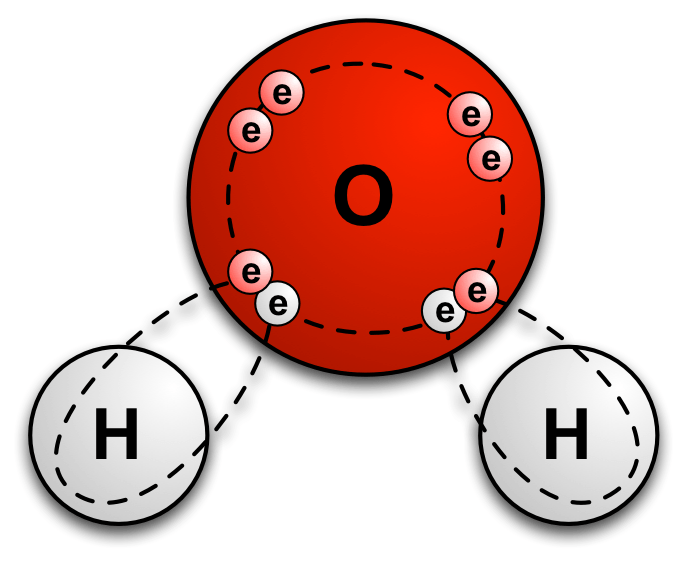
What would you name this molecule?
a)
SNa3
b)
H3O
c)
NaCl
d)
H2O
14.

What kind of molecule is water?

a)

Ionic

b)

Polar Covalent

c)

Nonpolar Covalent

d)

Metallic

15.

Which part of a water molecule has a Positive Charge?

a)

The Hydrogen

b)

The Oxygen

c)

The Top

d)

The Bottom

16.

Which part of a water molecule has a Negative Charge?

a)

The Hydrogen

b)

The Oxygen

c)

The Left

d)

The Right

17.

Which of the following is an example of COHESION?

a)

water sticking to water

b)

water sticking to glass

c)

oil sticking to plastic

d)

hydrogen sticking to oxygen

18.

Which of the following is the CORRECT list of water's properties?

Read Carefully!

a)

adhesion, cohesion, high specific heat, universal solvent

b)

adhesion, cohesion, low specific heat, universal solvent

c)

adhesion, no cohesion, low specific heat, universal solute

d)

no adhesion, cohesion, high specific heat, universal solute

19.

You body sweats to help prevent you from overheating. How does water regulate temperature?

a)

it lets heat pass through it

b)

it absorbs a lot of heat, then decreases in temperature

c)

it absorbs a lot of heat, but only increases a little in temperature

d)

heat is afraid of water and avoids it

20.
The substance being dissolved in a solution.
a)
sands
b)
solute
c)
solvent
d)
alloy
21.
The substance in which a solute is dissolved
a)
sands
b)
solvent
c)
alloy
d)
negative particles
22.
Solutions are composed of __________ .
a)
salts and solutes
b)
solvents and salts
c)
solutes and alloys
d)
solutes and solvents
23.
In a sample of salt water, NaCl would be considered the ______.
a)
Solution
b)
Solute
c)
Solvent
d)
Solvation
24.
If we are making Kool-aid with sugar, Kool-aid powder, and water, which part is the solvent?
a)
water
b)
powder
c)
sugar
d)
powder and sugar
25.
Which of these solutions is an acid?
a)
Dish Soap: pH of 12
b)
Tomato Soup: pH of 4
c)
Baking Soda: pH of 9
d)
Drain Cleaner: pH of 14
26.

From which point to which point in the pH scale is Base

a)

7.1- 14

b)

0- 6.9

c)

6.2- 9.1

d)

12- 14

27.
Acids produce _________ ions when they break down or dissocciate. 
a)
Hydroxide (OH-)
b)
Water
c)
Chlorine (Cl-)
d)
Hydrogen (H+)
28.
Bases release ____________ ions when they break down or dissociate. 
a)
Hydrogen (H+)
b)
Hydroxide (OH-)
c)
Chlorine (Cl-)
d)
no
29.
Water is neutral because the number of hydrogen and hydroxide ions is _________.
a)
the same
b)
different
30.
A(n) ______ is a substance with a pH less than 7
a)
Acid
b)
Alkaline
c)
Base
d)
Buffer