
 Worksheets
Osmosis and Water Potential (Form 4)
Total questions: 20
Worksheet time: 20mins
Name
Class
Date
1.
The movement of water molecules out of a cell and into an environment with high salt concentration is
a)
facilitated diffusion
b)
osmosis
c)
phagocytosis
d)
exocytosis
2.

Is it safe to drink salt water?
a)
Yum, so salty!
b)
No, you could die of dehydration.
3.
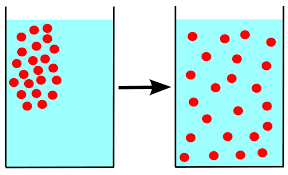
The picture below is an example of _________________.
a)
osmosis
b)
isotonic
c)
diffusion
d)
active transport
4.
Osmosis is the movement of _____ across a membrane.
a)
food
b)
energy
c)
oxygen
d)
water
5.
When both inside and outside of a cell have the same amount of water it is said that the cell has reached a state of ___________.
a)
osmosis
b)
equilibrium
c)
diffusion
d)
hypertonic
6.
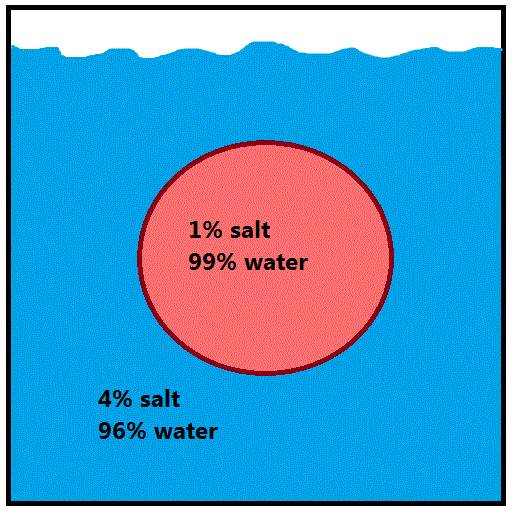
The cell is 99% water. The surrounding is salty. Where will the water go?
a)
Into the cell
b)
Out of the cell
c)
Equally in & out
7.

_______ regulates what enters and leaves a cell.
a)
Cell Membrane
b)
Nucleus
c)
Mitochondria
d)
Cytoplasm
8.
What is the definition of Equilibrium?
a)
the process that brings LARGE particles INTO the cell through the cell membrane
b)
The movement of molecules from an area of high concentration (where the molecules are more crowded together) to a area of low concentration (where molecules are more spread apart)
c)
the state where molecules are equally concentrated (balanced) on both sides of the cell membrane.
d)
the movement of WATER molecules across the cell membrane.
9.
In the given scenario what will happen to the organism: salt is poured onto eggplant.
a)
Water will move out of the eggplant cells and the cells will shrink.
b)
Water will move out of the eggplant cells and the cells will swell.
c)
Water will move into the eggplant cells and the cells will swell.
10.
In the given scenario what will happen? An egg is placed in pure water for 48 hours.
a)
The egg will gain water and swell.
b)
Water will move in and out of the cell equally, and the cell with neither shrink nor swell.
c)
The egg will lose water and shrink.
11.
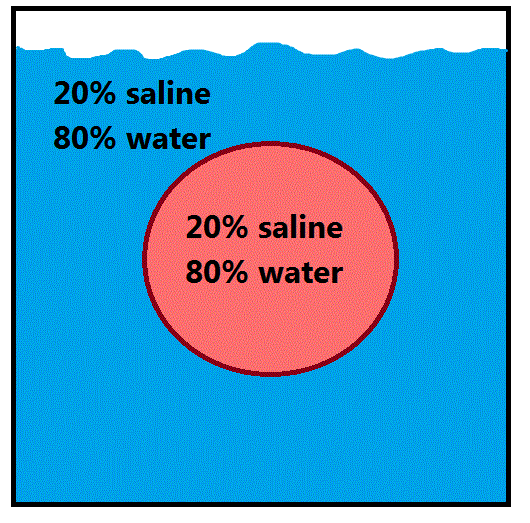
A blood cell is placed into the jar, as seen. Where will the water go?
a)
Into the cell
b)
Out of the cell
c)
Equally in & out - it's isotonic
d)
The water is a lie
12.
An animal cell placed in a hypertonic (salty) solution will
a)
Stay the same
b)
Shrink- get smaller
c)
Swell- get bigger
13.
If you looked at red blood cells under a microscope and saw the blood cells exploded, what would you say happened?
a)
The cells were placed in a hypotonic solution.
b)
the solution was isotonic.
c)
The solution was hypertonic.
14.
An animal cell placed in a hypertonic (salty) solution will
a)
Shrink
b)
Swell
c)
Stay the same
15.

Where is there a low concentration of dye?
a)
at the bottom of cup
b)
in the color
c)
at the top of cup
d)
no concenteraion gradient
16.
An animal cell that is surrounded by fresh water will burst because the osmotic pressure causes
a)
water to move into the cell
b)
water to move out of the cell
c)
solutes to move into the cell
d)
solutes to move out of the cell
17.
If a cell is placed in a HYPOTONIC solution, water will move _________ of the cell, causing it to ___________.
a)
into, swell
b)
out of, shrivel
c)
in and out of the cell, stay the same
18.

What type of solution is this red blood cell in?
a)
Isotonic
b)
Hypertonic
c)
Hypotonic
19.
Which type of molecules can diffuse across a cell membrane without using energy?
a)
H2O, only
b)
H2O, O2, and CO2
c)
proteins and polysaccharides
d)
H2O and amino acids
20.
What does “high concentration area” mean?
a)
Spread out
b)
Tightly packed together
c)
Uncrowded
d)
Spacious
100 %

