Worksheets
refraction and total internal reflection
Total questions: 50
Worksheet time: 50mins

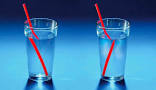
Why does the pencil appear bent?
Light rays travelling from parts of the pencil above the water bend away from the normal and appear closer to the horizontal surface, thus making the pencil appear broken.
Light rays travelling from parts of the pencil above the water bend towards from the normal and appear closer to the horizontal surface, thus making the pencil appear broken.
Light rays travelling from parts of the pencil under the water bend away from the normal and appear closer to the horizontal surface, thus making the pencil appear broken.
Light rays travelling from parts of the pencil under the water bend towards from the normal and appear closer to the horizontal surface, thus making the pencil appear broken.

What does part #2 in the system represent?
Light signals are what carries information in fiber optics
Digital signals are sent through fiber optic cables
Total internal reflection keeps the light inside of the cable
Lasers are the source of light that we send in fiber optics
Glass or plastic fiber optic cables carry information as light

What is the refractive index of a fibre optic pipe if the critical angle is 30 degree?
Outside is air.
2.0
1.7
2.4

Which one is true for the formation of a mirage?
The light first goes through TIR and then passes through the colder layers of air to hotter layers. (TIR is total internal reflection)
The light first goes through TIR after passing through the colder layers of air to hotter layers.
The light first goes through TIR and then passes through the hotter layers of air to colder layers.

What happens to light during total internal reflection?
The angle of incidence is greater than the critical angle.
The angle of reflection is the same as the critical angle.
The angle of refraction is less than the critical angle.
The angle of incidence is zero.
Fiber optic cables work because of the principle of _____.
total internal refraction
incomplete internal refraction
total internal reflection
partial internal reflection

_____ cables transmit beams of light without allowing any of the light to escape until it gets to the end of the cable.
Ethernet
Fiber optic
Armored
Coaxial
Which of the following statement about optical fibre is incorrect?
Light is totally internally reflected down the fibre.
It is used in medical (endoscope).
It is used in fibre optic communication.
Angle of incidence of light in optical fibre must less than critical angle.
What is total internal reflection
Where a wave is refracted at the boundary between a dense medium and a less dense medium when the angle of incidence is greater than the critical angle.
Where a wave is refracted at the boundary between a dense medium and a less dense medium when the angle of incidence is smaller than the critical angle.
Where a wave is reflected at the boundary between a dense medium and a less dense medium when the angle of incidence is greater than the critical angle.
Where a wave is reflected at the boundary between a dense medium and a less dense medium when the angle of incidence is smaller than the critical angle.

Light travels through a glass block as shown. Which angle is the critical angle for light in the glass?
A
B
C
D
When the angle of refraction is 90 ° the angle of incidence is called the...
Angle of incidence
Critical angle
Angle of total internal reflection
Angle of refraction

The figure below is an optical phenomenon caused by the refraction of light. What is this effect called?
Dispersion
Mirage
Rainbow
Diffraction
The critical angle is the angle of refraction in denser medium in which the angle of incidence in less dense medium is 90º.
True
False
If the angle of incidence is larger than the critical angle of a medium, total internal reflection occurs.
True
False
The refractive index of a glass prism is 1.9. Determine its critical angle.
23o
30o
32º
35o

see image
A
B
C
D
If the angle of incidence is larger than the critical angle of a medium, total internal reflection occurs.
True
False
If the angle of incidence is larger than the critical angle of a medium, total internal reflection occurs.
True
False

Which diagram correctly describes the critical angle c for air-water surface?
A
B
C
D
Total Internal Reflection can only occur when light is traveling from a high index to a low index
True
False
If Total Internal Reflection occurs the light will bounce back at the same angle it came in
True
False
If light hits at an angle larger than the critical angle it will refract and pass through the material
True
False
Light travels from air to water (n=1.33), what is the critical angle?
48.8
46.4
52.4
not possible
Refraction occurs when light changes mediums, but does not change speeds
True
False
The higher the index of refraction, the faster light travels in that medium
True
False
Light traveling from a low index of refraction to a higher index of refraction will get slower and bend away from the normal (refract at an larger angle)
True
False
What is the speed of light in ice (n=1.309)
2.29 * 10^8 m/s
2.43 *10^ 8 m/s
4.36 * 10^-9
4.36 *10^8 m/s
When angle of incident (i) equals to critical angle (c) if light is traveled from a denser medium to a less dense medium,
total internal reflection occurs.
angle of refraction is equal to 90 degree.
light is refracted out
light travel in straight line
Chose the TWO conditions are NOT correct for total internal reflection to take place
The incident angle should be less than the critical angle
The incident angle should be greater than the critical angle
Light should travel from a denser to a lighter medium
Light should travel from a lighter to a denser medium

see image
A
B
C
D

see image
A
B
C
D


In which diagram is the path of the light ray NOT correct?
(Determine if the light ray is correctly bending towards or away from normal at each boundary)
P/S: Perspex is acrylic plastic.
A
B
C
D

Give a reason why the signal changes direction at A
its a flat surface
the density of the glass is greater than the density of the air
the angle of incidence is more than 90 degrees
The density of the glass is less than the density of the air
Choose the correct statement that describes what happens to the ray of light if the critical angle is 48o and the angle of incidence is 48o
refract
totally internally reflect
travel along the boundary
A ray of light travels from glass to air with an angle of incidence of 35o. If the critical angle is 42o what will happen at the boundary?
refract
totally internally reflect
travel along the boundary
reflect
A ray of light travels from air to glass with an angle of incidence of 45o. If the critical angle is 42o what will happen at the boundary?
refract
totally internally reflect
travel along the boundary
reflect