
Font size
 Worksheets
Population Ecology Practice
Total questions: 27
Worksheet time: 17mins


The growth of a population is shown in the graph below. Which letter indicates the carrying capacity of the environment for this population?
A
B
C
D

Ten breeding pairs of rabbits are intorduced onto an island with no natural predators and a good supply of water and food. What will most likely happen to the rabbit population?
It will remain relatively constant due to equal birth and death rates
It will die out due to an increase in the mutation rate.
It will increase until it exceeds carrying capacity.
It will decrease and then increase indefinitely.
What does abiotic mean?
living
nonliving
artificial
manmade

The average number of people per square mile is...
Birth rate
Land area
Population density
too many
The number of individuals per unit area.
distribution
carrying capacity
density
none of the above

This is the most commonly seen distribution pattern. Example: wolves. This is usually because there are resources found in particular areas and the organisms need more space to survive.
Random
Uniform
Clumped
Ueven
What are the three types of distribution patterns?
uniform, clumped, random
uniform, uneven, random
uneven, clumped, random
uniform, clumped, uneven
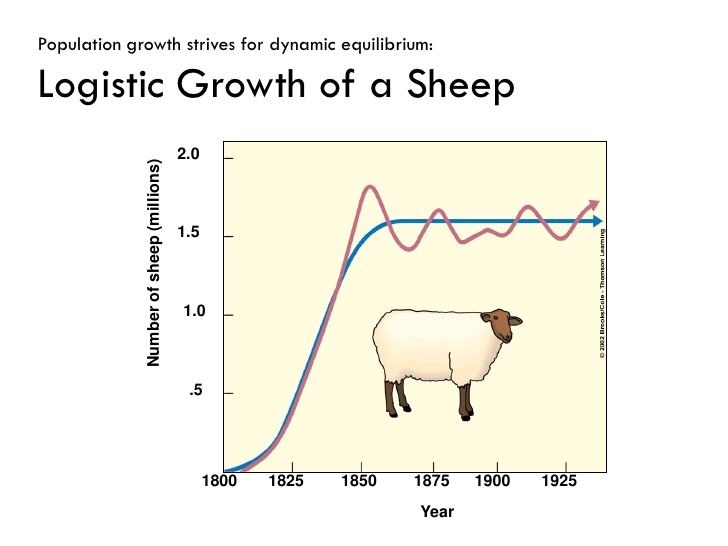
This type of growth happens when an organism reaches its carrying capacity.
Exponential growth
Logistic growth
infinity growth
none of the above
Any factor(s) that controls/ limits the size of a population.
Density dependent limiting factors
Limiting factors
Density independent limiting factors
Environmental Resistance
Which of the following would not be an example of a density dependent limiting factor?
fire
disease
lack of food
space
Which of the following is a density independent factor?
competition for resources
predation
disease
natural disasters
Which of the following is NOT an outcome of high population density?
mortality increase
predators tend to ignore prey that is overabundant
reduction in births
decreased resource availability
A population’s emigration in one month totaled 2 individuals. During the same period, immigration was 12 individuals. Natality (births) was 8, and mortality was 15 due to a parasite infection. What was the net effect on the population size?
+5
+3
0
-4
What type of measurement is it when I take the population of one sample classroom and multiply it by the number of classrooms?
Estimate by Sampling
Count every Individual
Mark and Recapture
Population Density
What type of population measurement is it when a census is taken?
Estimate by sampling
Count each Individual
Mark and recapture
Population Density
What is the maximum population size that can be supported by the available resources?
Population Density
Dispersion
Carrying Capacity
Maximum amount

