
 Worksheets
Pre UPS - Chapter 6 Circular motion
Total questions: 20
Worksheet time: 20mins
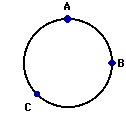
Angular velocity, ω defined as the rate of change of _________________
angular distance
uniform speed
angular displacement
A) No, if the speed is constant then the acceleration is equal to zero. B) No, an object can accelerate only if there is a net force acting on it.
C) Yes, although the speed is constant, the direction of the velocity can be changing.
D) Yes, if an object is moving it can experience acceleration
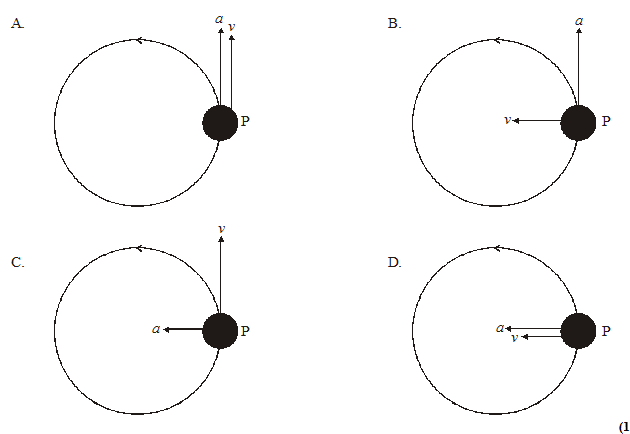
A) Both vectors point in the same direction.
B) The vectors point in opposite directions.
C) The vectors are perpendicular.
D) The question is meaningless, since the acceleration is zero
A) in the same direction as the velocity vector.
B) in the opposite direction of the velocity vector.
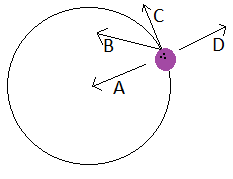
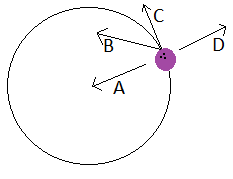
C) is directed toward the center of the circular path. D) is directed away from the center of the circular path.
A) free fall
B) constant acceleration
C) linear acceleration
D) centripetal acceleration
B) in the opposite direction of the motion of the object.
C) is directed toward the center of the circular path. D) is directed away from the center of the circular path.
A 10kg car travels at a constant speed of 20.0 m/s around a horizontal circular track. Which diagram correctly represent the direction of the car's velocity (v) and the direction of the centripetal force (Fc) acting on the car at a particular moment?



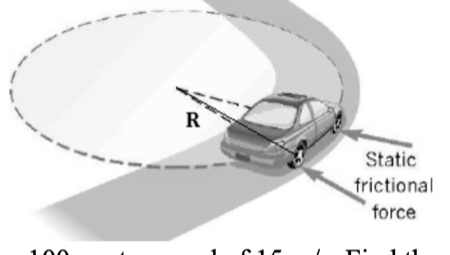
During its trip a car of mass 1500kg is traveling around a corner as shown in the picture. What actual force is equivalent to the centripetal force in this situation?
Tension
Friction
Centrifugal force
gravity
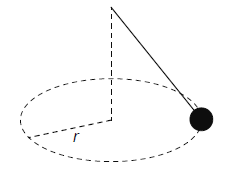
The mass at the end of a pendulum is made to move in a horizontal circle of radius r at constant speed. The magnitude of the net force on the mass is F.
What is the direction of F during half a revolution?
towards the centre of the circle
away from the centre of the circle
along a tangent to the circle
in a circle
The maximum speed with which a car can take a circular turn of radius R is v. The maximum speed with which the same car, under the same conditions, can take a circular turn of radius 2R is
2v
v√2
4v
2v√2

Two particles, X and Y, are attached to the surface of a horizontally mounted turntable.
The turntable rotates uniformly about a vertical axis. The magnitude of the linear velocity of X is v and the magnitude of its acceleration is a. Which of the following correctly compares the magnitude of the velocity of Y and the magnitude of the acceleration of Y with v and a respectively?
Y velocity = v
Y acceleration < a
Y velocity > v
Y acceleration < a
Y velocity = v
Y acceleration > a
Y velocity > v
Y acceleration > a

