wayground logo

Free Printable Worksheets

Font size

S
M
L
XL
Worksheets

Particles and their behaviour

Total questions: 38

Worksheet time: 28mins

Name
Class
Date
1.

Which are 2 properties of a substance in a solid state

a)

you cannot compress it and it flows from place to place

b)

it flows from place to place and you cannot compress it

c)

its shape is fixed unless you apply a force and you cannot compress it

d)

it take the shape of the bottom of the container and you cannot compress it

2.
State of matter with no definite shape or volume.
a)
solid
b)
liquid
c)
gas
d)
Mississippi
3.
What state of matter does the picture best describe?
a)
Solid
b)
Liquid
c)
Gas
4.
Which State of Matter does the diagram best represent?
a)
Solid
b)
Liquid
c)
Gas
5.
What is happening when my ice cream changes from a solid to a liquid?
a)
freezing
b)
melting
c)
burning
d)
evaporation
6.
What happens when my glass of water is sitting in the sun and disappears into a gas?
a)
evaporation
b)
burning
c)
melting
d)
freezing
7.
Boiling
a)
liquid to gas
b)
gas to solid
c)
gas to liquid
d)
solid to liquid
8.
What is condensation?
a)
gas to solid
b)
gas to liquid
c)
liquid to solid 
d)
solid to liquid 
9.
Made of atoms
a)
solid
b)
liquid
c)
gas
d)
solid, liquid and gas
10.
Sublimination
a)
Solid to Liquid
b)
Liquid to Gas
c)
Gas to Solid
d)
Solid to Gas
11.

Which is the order of increasing melting point (lowest first)

a)

Silver gold silicon cooper nickel iron

b)

silver gold cooper silicon nickel iron

c)

gold silver silicon cooper iron nickel

12.

A scientist measure the melting point of a metal at 1500 degrees Celsius, name the metal.

a)

Iron

b)

Nickel

c)

Copper

d)

Silicon

13.

Name a metal with a melting point between 1400 and 1500 degrees Celsius

a)

Silicon

b)

Iron

c)

Nickel

d)

Gold

14.

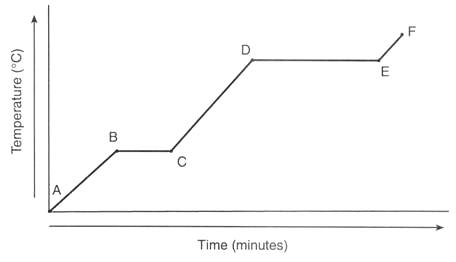
A beaker of ice was heated over a period of time. The changes in temperature are shown in the graph.


Which of the following correctly matches the processes to the parts of the graph?

a)

Melting: AB Boiling: BC

b)

Melting: AB Boiling: CD

c)

Melting: BC Boiling: AB

d)

Melting: BC Boiling: CD

15.
A solid compound X was heated steadily for 20 minutes. The graph below shows the change in temperature of X with time. At what temperature did X melt?  
a)
20°C
b)
40°C
c)
90°C
d)
100°C
16.
A solid compound X was heated steadily for 20 minutes. The graph below shows the change in temperature of X with time. What is the boiling point of X?
a)
20°C
b)
40°C
c)
90°C
d)
100°C
17.
What is/are the physical state(s) of X at 100°C?
a)
Solid
b)
Solid and liquid
c)
Gas
d)
Liquid and gas
18.

Between which points is the substance changing state?

a)

A-B only

b)

A-B, C-D, E-F

c)

B-C only

d)

B-C, D-E

19.
What line segment represents only the solid state?
a)
A-B
b)
B-C
c)
C-D
d)
D-E
20.
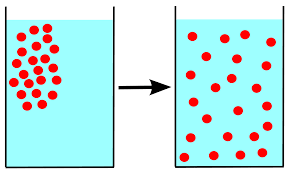
Which diagram best shows the end result of diffusion?
a)
F
b)
G
c)
H
d)
J
21.
A student put a few drops of lemon juice into an uninflated balloon.The student tied a knot in the balloon, placed it in a shoe box, and covered it with a lid. The following day, the student opened the box and was able to smell lemon in the box. Through what process were molecules able to pass through the balloon?
a)
respiration
b)
fermentation
c)
osmosis
d)
diffusion
22.

Diffusion is the movement of molecules from an area of _____ concentration to an ______ concentration

a)

High, low

b)

Low, high

c)

Low, low

d)

High, high

23.

The picture below is an example of _________________.

a)

osmosis

b)

isotonic

c)

diffusion

d)

active transport

24.

How does an increase in temperature affect diffusion?

a)

Diffusion speeds it up

b)

Diffusion slows it down

c)

Diffusion has no effect

25.
Why is having a control in experiments important?
a)
It makes sure the independent variable is the reason for the results
b)
To know what you originally started off with
c)
To add another group of results making sure there's more data
26.
How does distance affect diffusion?
a)
Shorter the distance the faster the rate
b)
The bigger the distance the faster the rate
c)
It doesn't matter - molecules will always diffuse at the same rate
27.
The more times that an experiment is repeated and the same results obtained, the more likely the results are _________. 
a)
better
b)
observed
c)
valid
d)
used
28.
An experiment generally tests how one _________ is affected by another.
a)
Variable
b)
test
c)
scientist
d)
option
29.
The affected variable is called the __________ variable.
a)
independent
b)
dependent
c)
changed
d)
numerical
30.
A good experiment usually tests a(n) __________. 
a)
variable
b)
scientist
c)
opinion
d)
hypothesis
31.
This symbol represents what rule  
a)
Will be using electricity
b)
Substance is flammable
c)
Substance is safe to eat
d)
Substance is toxic
32.
The process of gathering information
a)
analyzing
b)
hypothesizing
c)
inferring
d)
observation
33.

A pupil does an investigation and decides to repeat it 3 times and take an average. They did this to make the experiment

a)

Valid

b)

Correct

c)

Reliable

d)

Controlled

34.

The pressure inside the balloon will:

a)

Decrease

b)

Increase

c)

Remain the same

d)

Not enough information to formulate an answer

35.

The pressure of the gas in the balloon in the ice water will be:

a)

Greater than that of the balloon in the boiling water.

b)

Less than that of the balloon in the boiling water.

c)

The same as that of the balloon in the boiling water.

d)

Not enough information to answer the statement.

36.

The pressure inside the syringe will decrease if we move the plunger in:

a)

Direction A

b)

Direction B

c)

We don't have to move the plunger as the pressure will change on its own.

d)

None of the above answers.

37.

The reason gases can be compressed is because:

a)

The particles are very close together.

b)

The particles are merely vibrating.

c)

The particles are unable to move.

d)

The particles are very far apart.

38.

Describe in detail what happens when water boils - describe it in terms of energy, particles and changes of state.

4 lines