wayground logo

Free Printable Worksheets

Font size

S
M
L
XL
Worksheets

Law of Conservation

Total questions: 15

Worksheet time: 35mins

Name
Class
Date
1.
What is the Law of Conservation of mass?
a)
Mass is created in a chemical reaction
b)
Mass is created in a physical change
c)
New chemicals formed from a chemical reaction have a larger overall mass than the original reactants
d)
Mass is never created or destroyed
2.
In a reaction A + B ----> C,  reactant A has 5g and product  C has 9g. How many grams does reactant B should have? 
a)
4g
b)
5g
c)
9g
d)
14g
3.
Matter can not be created nor destroyed: it can only be
a)
Destroyed a little bit
b)
Invisible
c)
Transformed, changed
d)
None of the above
4.
If a reaction starts with a total 75g of reactants it should produce 
a)
a total of 40g of products
b)
a total of 75g of products
c)
a total of 180 g of products
d)
None of the above
5.
In the reaction AB-----> A + B reactant AB has 12g and product B has 5g. How many grams should product A have?
a)
17g
b)
2g
c)
7g
d)
None of the above
6.
In the reaction shown by the equation, 252 grams of FeCl2 and 70 grams of Clare consumed.
2FeCl2+ Cl2--> 2FeCl3 
How many grams of FeClare produced? 
a)
161 grams
b)
182 grams
c)
322 grams
d)
392 grams
7.
24 g of magnesium reacts with 38 g of fluorine to produce _____ g magnesium fluoride
a)
62 
b)
38
c)
24
d)
14
8.

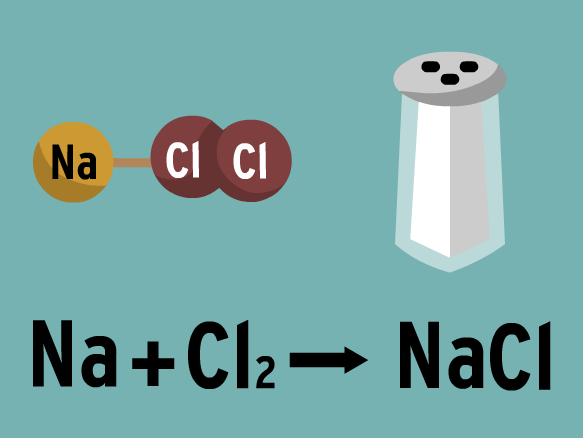
Sodium and chlorine combine to form sodium chloride, or table salt. Sodium and chlorine are:

a)

Producers

b)

Products

c)

Reactionaries

d)

Reactants

9.

4 grams of hydrogen and 32 grams of oxygen will combine to form:

a)

36 grams of water

b)

28 grams of hydroxide

c)

32 grams of oxygen

d)

36 grams of deuterium

10.

In a chemical reaction, 4 grams of sodium must combine with how many grams of chlorine to produce 10 grams of table salt?

a)

4 grams

b)

6 grams

c)

8 grams

d)

10 grams

11.

What is the part of the chemical equation in green called?

Fe + S → FeS

a)

products

b)

reactants

c)

yield

d)

input

12.
A chemical equation tells us 
a)
the reactants and the products.
b)
the elements that make up the reactants and the products.
c)
the number of atoms that make up the reactants and the products.
d)
All of the above.
13.

What do we call the chemicals that result from a chemical reaction?

a)

reactants

b)

products

c)

subscripts

d)

coefficients

14.

According to the Law of Conservation of Mass, what happens to the wood and oxygen when it is burned?

a)

The wood disappears.

b)

It stays the same chemically.

c)

The atoms in the wood and oxygen rearrange and form smoke and ash.

d)

Nothing.

15.
12g of Carbon react with 16g of Oxygen, how much carbon monoxide (CO) is formed? 
a)
28 g
b)
4g
c)
30g
d)
12g