
 Worksheets
STRUCTURE OF THE ATOM
Total questions: 30
Worksheet time: 2hrs 30mins
Name
Class
Date
1.
What is at the center of every atom?
a)
An electron
b)
A compound
c)
A molecule
d)
A nucleus
2.
Which two particles make up the nucleus of an atom?
a)
Protons and Electrons
b)
Protons and Neutrons
c)
Molecules and Compounds
d)
Neutrons and Electrons
3.
In an atom, what is the number of protons equal to?
a)
The number of electrons.
b)
The number of neutrons.
c)
The number of molecules.
d)
The number of nuclei.
4.

The particles with no charge in an atom are the _______.
a)
electrons
b)
neutrons
c)
protons
d)
protons and neutrons
5.

The positively charged particles of an atom are the ________.
a)
electrons
b)
protons
c)
neutrons
d)
protons & neutrons
6.

The negatively charged particles of an atom are the ______.
a)
electrons
b)
protons
c)
neutrons
d)
protons & neutrons
7.
An electron has this charge
a)
positive
b)
negative
c)
neutral
8.
A neutron has this charge
a)
negative
b)
positive
c)
neutral
9.
A proton has this charge
a)
negative
b)
positive
c)
neutral
10.
A particle that moves around the nucleus is a(n)...
a)
Proton
b)
Neutron
c)
Electron
d)
Quark
11.

What does the nucleus of an atom contain?
a)
Electrons and neutrons
b)
Protons and neutrons
c)
Neutrinos and positrons
d)
DNA and RN
12.
What is the mass number?
a)
the number of protons
b)
the sum of the number of protons and the number of neutrons in the nucleus of an atom
c)
the number of electrons
d)
the number of neutrons
13.
What is the atomic number?
a)
number of protons
b)
number of neutrons
14.
The three subatomic particles are
a)
proton, neutron, electron
b)
proton, nucleus, electron
c)
protein, neutron, electricity
d)
proton, neutral, electives
15.
If a neutral atom has 8 protons, how many electrons does it have?
a)
7
b)
8
c)
9
d)
10
16.
A chemical symbol represents the _________ of an element.
a)
name
b)
structure
c)
reaction
d)
type
17.
What did jj thomson discover
a)
proton
b)
nucleus
c)
electron
d)
neutron
18.

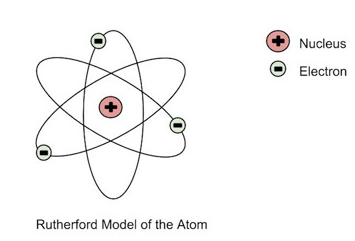
who made this model
a)
john dalton
b)
niel bohr
c)
jj thomson
d)
ernest rutherford
19.
A proton is an atomic particle that has
a)
one positive charge (1+)
b)
one negative charge (1-)
c)
one neutral charge (1)
20.
Rutherford's gold foil experiment provided evidence that...
a)
negative and positive charges are spread evenly throughout the atom.
b)
alpha particles have a positive charge.
c)
gold is not a dense as previously thought.
d)
there is a dense positively charged nucleus at the center of an atom.
21.

Ernest Rutherford discovered that atoms were mostly _________________.
a)
negatively charged
b)
positively charged
c)
electrons
d)
empty space.
22.

The Gold Foil experiment was done by __________.
a)
Chadwick
b)
Bohr
c)
Rutherford
d)
Thomson
23.
Carbon
a)
C
b)
Ca
c)
Cu
d)
Cr
24.
Neon
a)
No
b)
Na
c)
Ne
d)
Ni
25.
Sodium
a)
Ne
b)
S
c)
Na
d)
Mg
26.
Sulfur
a)
S
b)
Sn
c)
Na
d)
Sr
27.
Ar
a)
Aluminum
b)
Argon
c)
Radon
d)
Oxygen
28.
K
a)
Tungsten
b)
Fluoride
c)
Krypton
d)
Potassium
29.
What is the maximum number of electrons in the second energy level?
a)
18
b)
8
c)
32
d)
2
30.
Identify the element with the electron arrangement 2,8,8
a)
Neon
b)
Argon
c)
Helium
d)
Chlorine
100 %

