
NEW
Font size
 Worksheets
QUIZIZZ: US Expansion and Imperialism
Total questions: 21
Worksheet time: 11mins
Who was President during the Spanish-American War?
William McKinley
Theodore Roosevelt
Woodrow Wilson
William Howard Taft
Yellow Journalism is....
The Loudoun Sun Times
Exaggerated News Reports
Yellow Paper Reports
Nonfiction News Reports
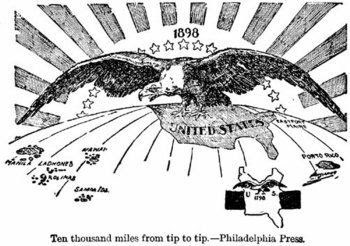
This political cartoon best supports the idea that, after the Spanish American War, the United States became a...
World Power
"Woke" Power
Head of the United Nations
Conquered Nation
What event was the most immediate cause of the Spanish American War?
The sinking of the USS Maine
The election of Francisco Franco
Yellow Journalism
The Cuban Revolution
What 4 territories did the United States gain at the end of the Spanish American War?
Puerto Rico, Cuba, Spain, Nicaragua
Spain, Cuba, Guam, Hawaii
Marianas Islands, Philippines, Russia, Guam
Philippines, Guam, Puerto Rico, Cuba
The extension of a nation's authority by territorial conquest or establishing economic and political domination of other nations.
annexation
imperialism
nationalism
isolationism
What did the US propose to avoid further conflict and ensure free trade in China?
Open Door Policy
Manifest Destiny
Federal Reserve Act
Island Hopping
Why was the US initially interested in Hawaii?
sugar plantations were very valuable
an abundance of oil was discovered
to develop a military base
to learn the culture of the natives
Fake news is the modern term for what during the 1890s?
yellow journalism
red journalism
investigative journalism
negative journalism
Which of the following foreign policies was used to acquire the land necessary to build a canal in Panama?
Big Stick Policy
Dollar Diplomacy
Moral Diplomacy
Treaty of Paris
What was the name given to President William Howard Taft's approach to foreign policy?
Dollar Diplomacy
Big Stick
Moral Diplomacy
Taft Corollary
After resigning his post as Assistant Secretary of the Navy, he was responsible for organizing a volunteer cavalry unit, became a national hero at the Battle of San Juan Hill and became president only 3 years later.
Leonard Wood
Teddy Roosevelt
William Howard Taft
John Pershing
Which of the following was true about Roosevelt’s "Rough Riders"?
They captured Cemetery Ridge and drove the Cubans back to Havana
They were a unit made up of cowboys, miners, college students, native Americans, outlaws, and policemen
They were an all black cavalry unit that helped win the war
They were formed by Lt. General Custer but taken over by Roosevelt during the war


The Spanish-American War (1898) marked a turning point in American foreign policy because the United States-
developed a plan for peaceful coexistence
emerged as a new world power with an overseas empire
pledged neutrality in future European conflicts
refused to become a colonial power

In the late 1800s, an increased demand for raw materials and a desire for new markets contributed to the United States adopting a policy of
isolationism
collective security
imperialism
pacificism

As a result of the Spanish-American War, the United States saw the need to build the Panama Canal because
new colonies had been acquired in Africa
Spanish opposition to the canal had ended
the United States navy could then move more quickly between oceans
United States railroads could not transport enough manufactured goods

President Theodore Roosevelt's Big Stick Policy was closely associated with-
friendly relations with China after the Boxer Rebellion
the conservation of natural resources
court actions to oppose business monopolies
intervention in the affairs of Latin American nations
Why was American Imperialism important?
It allowed people to return to Great Britain and be a subject again.
It opened up the West to the Native Americans again.
It increased the influence of the US in world affairs.
It encourage massive immigration to the US.

