
 Worksheets
Unit 1: Origins of life Quiz 2 Enzymes Review
Total questions: 21
Worksheet time: 23mins
Name
Class
Date
1.
How does an enzymes shape relate to its function?
a)
the shape of the enzyme has no relation to its function
b)
the enzyme is shaped specially for certain substrates to perform a specific reaction
c)
the enzyme shape acts as a receptor to certain products
d)
the enzyme shape can fit into specific substrates to cease a reaction
2.
What can affect enzyme ability? (select all that apply)
a)
temperature
b)
pH
c)
products
d)
enzyme potential
3.
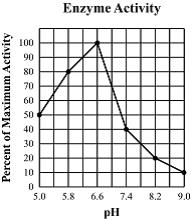
Which of the following conclusions can be drawn from this graph?
a)
The optimum pH of the enzyme is 6.6.
b)
The optimum pH of the enzyme is 5.8
c)
The enzyme’s activity increases as pH increases 5.0 to 9.0
d)
The enzyme’s activity is greater around pH of 8.0 .
4.
Enzymes are...
a)
nucleic acids
b)
proteins
c)
lipids
d)
carbohydrates
5.
What is the function of an enzyme?
a)
enzymes break themselves into small pieces
b)
enzymes slow down chemical reactions
c)
enzymes speed up chemical reactions
d)
enzymes combine products to form reactants
6.
What happens when enzymes are heated to a high temperature?
a)
The enzymes die.
b)
The shapes of the enzyme are altered denature
c)
The enzymes' amino acid sequence changes.
d)
The enzymes remain the same
7.
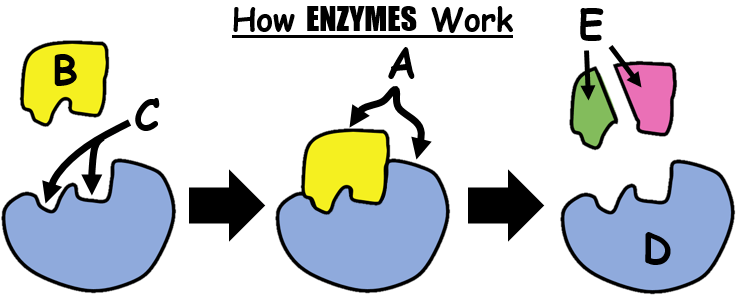
Letter D...
a)
active site
b)
enzyme
c)
substrate
d)
products
8.
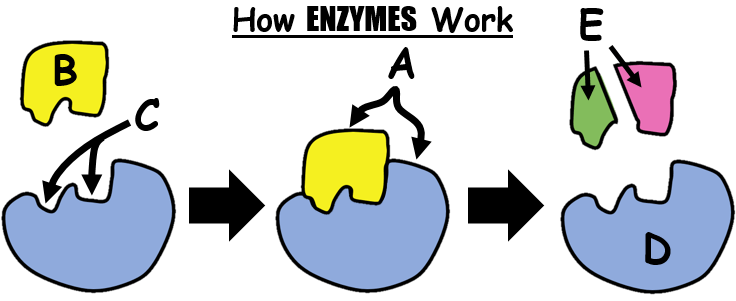
Letter B...
a)
active site
b)
enzyme
c)
substrate
d)
products
9.
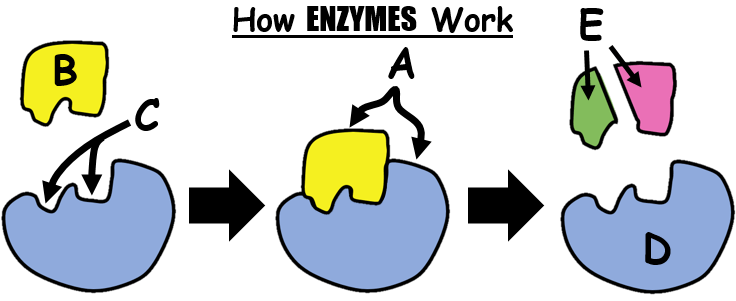
Letter C...
a)
active site
b)
enzymes
c)
substrate
d)
products
10.
What is a substance called if it speeds up a chemical reaction?
a)
reusable
b)
catalyst
c)
specific
d)
fragile
11.
What happens when enzymes are heated to a high temperature?
a)
The enzymes die.
b)
The shapes of the enzyme are altered denature
c)
The enzymes' amino acid sequence changes.
d)
The enzymes remain the same
12.
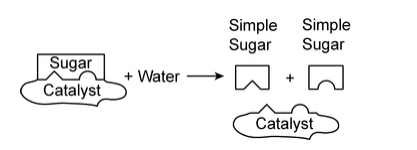
The diagram below illustrates a biochemical process that occurs in organisms. What is another name for the substance labeled "catalyst"?
a)
Enzyme
b)
inorganic compound
c)
Hormone
d)
Antibody
13.
Which of the following best explains why enzymes are necessary for many cellular reactions?
a)
Enzymes supply the oxygen necessary for the reactions
b)
Enzymes change reactants from solid to liquids during the reactions.
c)
The reactions take up too much space in the cell if the enzymes are missing.
d)
The reactions are too slow to meet the needs of the cell if enzymes are missing.
14.
What will most likely happen if an appropriate enzyme is added to a chemical reaction?
a)
The reaction rate will increase.
b)
The equilibrium of the reaction will be maintained.
c)
The reaction rate will decrease.
d)
The reaction will stop.
15.
The human body maintains a temperature of around 98.6 degrees at all times. Enzymes are involved in almost every chemical reaction in the body. Which of the following describes the connection between these two statements?
a)
Enzymes function best at a specific temperature.
b)
The body needs to be warm to prevent hypothermia.
c)
The body is kept relatively warm to prevent too much enzyme action.
d)
There is no connection between the two statements.
16.
The "lock and key hypothesis" attempts to explain the mechanism of?
a)
Vacuole formation
b)
Pinocytosis
c)
Sharing of electrons
d)
Enzyme specificity
17.
What macromolecule includes enzymes?
a)
Lipids
b)
Carbohydrates
c)
proteins
18.
Enzymes need certain environmental conditions in order to function properly. What happens when enzymes are heated to a high temperature?
a)
they die
b)
they denature
c)
they change their amino acid sequence
d)
they work better
19.
What makes an enzyme substrate specific?
a)
Size
b)
Shape
c)
Name
d)
Location it is found in
20.

Which substrate would this enzyme catalyze?
a)
Δ
b)
σ
c)
∅
d)
μ
21.
Enzymes are made from ________________, and they are proteins
a)
oxygen molecules
b)
simple sugars
c)
biological catalyst
d)
amino acids
100 %

