wayground logo

Free Printable Worksheets

NEW

Font size

S
M
L
XL
Worksheets

Atomic Theory, Grade 10

Total questions: 27

Worksheet time: 26mins

Name
Class
Date
1.

This particle is found in the nucleus and has no charge

a)

Neutron

b)

Proton

c)

Electron

d)

Orbital

2.

This is a negatively charged particle found outside the nucleus

a)

Electron

b)

Proton

c)

Neutron

d)

Orbital

3.

Rutherford's gold foil experiment provided evidence that...

a)

Negative and positive charges are spread evenly throughout the atom.

b)

Alpha particles have a positive charge.

c)

Gold is not a dense as previously thought.

d)

There is a dense positively charged nucleus at the center of an atom.

4.
J.J. Thomson provided evidence that an atom...
a)
is the smallest particle of matter
b)
contains negatively and positively charged particles
c)
has an overall negative charge
d)
has an overall positive charge
5.

What are atoms with the same number of protons but different numbers of neutrons?

a)

electrons

b)

protons

c)

neutrons

d)

isotopes

6.

an element will always have the same number of

a)

neutrons

b)

protons

c)

isotopes

d)

atoms

7.

Which particle does not contribute mass to the atom?

a)

Proton

b)

Neutron

c)

Electron

d)

Nucleus

8.

An atom has 10 protons and a mass of 18. It has __ neutrons

a)

10

b)

18

c)

28

d)

8

9.

The mass number of an element that has18 protons, 18 electrons, and 19 neutrons is _____.

a)

12.5

b)

13

c)

25

d)

37

10.

How many neutrons does uranium-239 have

a)

92

b)

147

c)

239

d)

331

11.
How many neutrons will an atom have it has an atomic number of 26, an atomic mass of 58 and a charge of +3?
a)
26
b)
58
c)
32
d)
3
12.

How many electrons are in an atom that has an atomic number of 34, an atomic mass of 74 and a charge of -2?

a)

34

b)

36

c)

2

d)

40

13.
What charge does an atom have if it GAINS an electrons?
a)
Positive (+)
b)
Negative (-)
14.
How many neutrons does the isotope of lithium have?
a)
8
b)
3
c)
4
d)
5
15.

Four isotopes of lead include lead-204, lead-206, lead-207, and lead-208. The average atomic mass of lead is 207.2. Which isotope of lead is likely to be the most abundant.

a)

204

b)

206

c)

207

d)

208

16.
A neutral atom of the isotope 2612Mg would consist of
a)
12 protons, 26 neutrons, 26 electrons
b)
26 protons, 12 neutrons, 26 electrons
c)
26 protons, 14 neutrons, 14 electrons
d)
12 protons, 14 neutrons, 12 electrons
17.
Which of the subatomic particles is the lightest
a)
all have the same mass
b)
protons 
c)
neutrons 
d)
electrons
18.
subatomic particles found on the outermost shell & responsible for the atom's reactivity
a)
neutrons
b)
valence electrons
c)
isotopes
d)
ions
19.
A charged atom
a)
Ion
b)
Isotope
c)
Electron Cloud
d)
Quark
20.

What is the mass number?

a)

the number of protons in the nucleus

b)

the number of protons and neutrons in the nucleus

c)

the number of neutrons in the nucleus

d)

the number of protons and electrons in the atom

21.

The color of emitted light with the LONGEST wavelength is

a)

violet

b)

green

c)

red

d)

indigo

22.

The color of emitted light with the HIGHEST frequency is

a)

violet

b)

green

c)

red

d)

indigo

23.
Emission of light from an atom occurs when an electron
a)
drops from a higher to a lower energy level.
b)
   jumps from a lower to a higher energy level.   
c)
   moves within its atomic orbital.
d)
falls into the nucleus.
24.
Why are line emission spectra of elements called "atomic fingerprints"?
a)
They are all the same
b)
They are all unique
c)
They are all similar
d)
They all contain colored light
25.

The frequency of UV radiation is is 1.5 x 10¹⁴ Hz. What is its wavelength?

a)

2.0 x 10⁶ m

b)

2.0 x 10⁻⁶ m

c)

4.5 x 10⁶ m

d)

2.25x10²³ Hz

26.
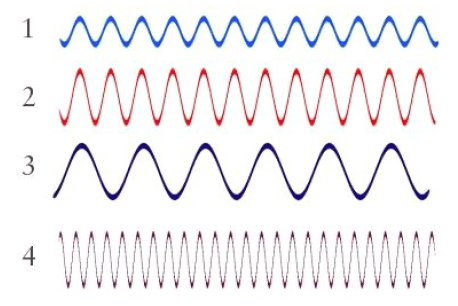
Which wave in the diagram has the greatest wavelength?
a)
1
b)
2
c)
3
d)
4
27.

Violet light has a wavelength of

4.0 x 10⁻⁹ m. What is the frequency?

a)

1.2 x 10⁻³ Hz

b)

7.5 x 10¹⁶ Hz

c)

1.2 x 10¹² Hz

d)

7.5 x 10⁻¹⁶ Hz