Wayground logo

Free Printable Worksheets

Font size

S
M
L
XL
Worksheets

Basic Economic Concepts (AP Micro)

Total questions: 41

Worksheet time: 32mins

Name
Class
Date
1.
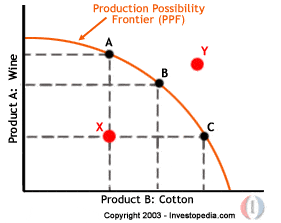
What is the opportunity cost of moving from point B to C on the curve?
a)
30 tons of wheat
b)
30 tons of steel
c)
5 tons of wheat
d)
5 tons of steel
2.
Ford can produce 200 Mustangs or 400 Escapes in their factory. What is the opportunity cost of making each Mustang?
a)
1/2 Escape
b)
1/2 Mustang
c)
2 Escapes
d)
2 Mustangs
3.
Comparative advantage is determined by what?
a)
output
b)
benefit
c)
opportunity cost
d)
total cost
4.
If total utility increases from 150 to 210 utils after consuming a 4th candy bar, then what's the marginal utility per dollar of the 4th candy bar if the price is $2?
a)
60 utils per dollar
b)
110 utils per dollar
c)
30 utils per dollar
d)
75 utils per dollar
5.

WHAT IS LABOR?

a)

work people do for wages to produce good and services

b)

actions people do for other people

c)

any physical object

d)

The money people get for inheritance

6.

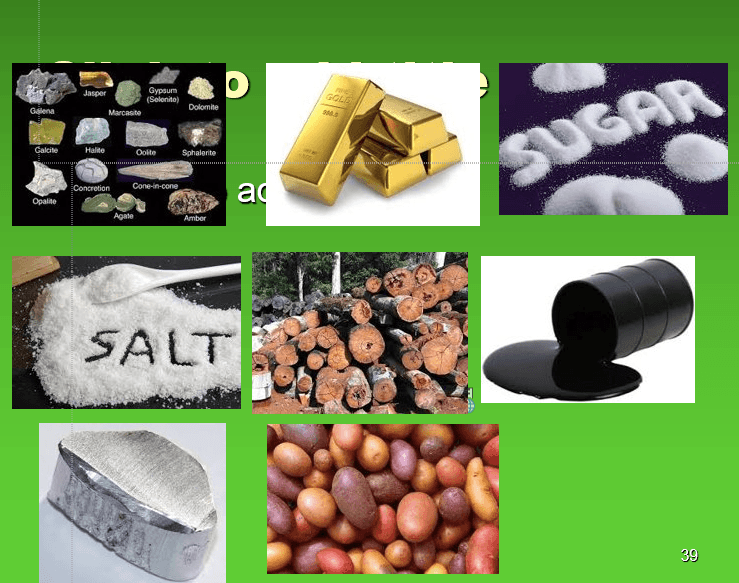
Which factor of production is this?

a)

capital

b)

entrepreneur

c)

land

d)

labor

7.
Which factor of production would you consider a lawn mower?
a)
Land
b)
Labor
c)
Capital
d)
Entrepreneur
8.
If a natural disaster strikes, the production possibilities curve can shift
a)
No shift
b)
To the left
c)
To the right
d)
Outward on one axis only
9.
What does point Y represent on the PPC?
a)
Efficiency
b)
Unattainable / impossible
c)
Inefficency
d)
Nothing
10.
What does point B represent?
a)
Production at greater than the country's minimum potential
b)
Production is less than the country's minimum potential
c)
Productive inefficiency
d)
Productive efficiency
11.
The inability to satisfy all wants at the same time
a)
Scarcity
b)
choice
c)
opportunity cost
d)
resources
12.
Which of the following constitute the fundamental questions every economic system must answer?
a)
I, III, V only
b)
I, II, and IV only
c)
I, II, and V only
d)
II, IV, and V only
13.
Two alternative production possibility frontiers for apples and wheat are shown in the figures. As more wheat is produced, how will the opportunity cost of producing wheat, as represented in Figures 1 and 2, be affected? 
a)
Figure 1: Decrease / Figure 2: Increase
b)
Figure 1: Increase / Figure 2: Decrease
c)
Figure 1: No Change / Figure 2: Increase
d)
Figure 1: No Change / Figure 2: Decrease
14.
If nations specialize according to their comparative advantage and engage in trade with each other, each nation can:
a)
Consume outside its production possibilities curve 
b)
Produce outside its production possibilities curve 
c)
Shift its production possibilities curve to the right 
d)
Produce more of all goods 
15.

Linavulu's per unit opportunity cost of producing handicrafts is

a)

2 processed copra

b)

3 processed copra

c)

6 processed copra

d)

1/2 processed copra

16.

Linavulu's per unit opportunity cost of producing handicrafts is

a)

2 processed copra

b)

3 processed copra

c)

6 processed copra

d)

1/2 processed copra

17.

What country has an absolute advantage in the production of steel?

a)

Avagentina

b)

Gianluccistan

18.

Command economies are usually dominated by:

a)

Free market enterprise

b)

Traditions, customs, and beliefs

c)

State-owned enterprise

d)

All of the above

19.

The basic problem of economics is:

a)

resources are limited and wants are limited.

b)

resources are unlimited and wants are limited.

c)

resources are limited and wants are unlimited.

d)

resources are unlimited and wants are unlimited.

20.

The opportunity cost of a good is

a)

its price in dollars and cents.

b)

the value of alternative goods forgone in a decision.

c)

the value of what your first option is.

d)

none of the other options

21.

The law of diminishing marginal utility is best defined as:

a)

As more units are consumed the marginal utility continually falls.

b)

As more units are consumed the marginal utility increases.

c)

As price decreases quantity demanded increases.

d)

As more units are consumed the opportunity cost increases.

22.

Which economic system provides private ownership of property and resources?

a)

Traditional Economy

b)

Free Market Capitalism

c)

Communism

d)

Command Economy

23.
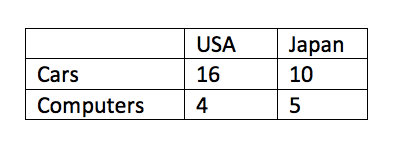
Based on the table provided, which one of the following statements is correct?
a)
Japan has the absolute advantage in producing cars
b)
Japan has the comparative advantage in producing cars
c)
The United States has the absolute advantage in producing both cars and computers
d)
The opportunity cost of producing a car in Japan is 1/2 a computer
24.

As an individual consumes an additional good or servce, their satisfaction decreases

a)

Marginal Utility

b)

Law of Diminishing Marginal Utility

c)

Utility

d)

Negative Utility

25.
Utility is the
a)
benefit or satisfaction that a person gets from the consumption of a good or service
b)
measure of how useful a resource is in the production process
c)
measure of productivity associated with a good or service
d)
economic term for consumption possibilities
26.

As more of a good is consumed, marginal utility

a)

increases

b)

decreases

c)

remains the same

d)

becomes negative and then turns positive

27.

The first four Apples Hassan consumes have total utility of 15, 27, 37, and 45 respectively. What is the marginal utility of the 4th Apple?

a)

124 units of utility

b)

45 units of utility

c)

11.25 units of utility

d)

8 units of utility

28.
Which of the following is true if consuming one unit of a good yields 100 utils and consuming the second unit of the good increases satisfaction by 20 utils?
a)
the MU of the 1st unit is 20
b)
the MU of the 2nd unit is 80
c)
the MU of the 2nd unit is 120
d)
the total utility of consuming 2 units is 120
29.

Definition of Marginal Utility

a)

the satisfaction from consumption

b)

to total satisfaction from consuming a product

c)

the extra satisfaction from the last unit consumed

d)

the extra consumption from last unit consumed

30.

Consumers will maximize satisfaction when

a)

the price of each good is exactly equal to the price of every other good consumed

b)

the price of each good is exactly equal to the total utility derived from the consumption of every other good

c)

the marginal utility of the last dollar spent on each good is exactly equal to the marginal utility of the last dollar spent on any other good

d)

marginal utility is equal to average utility

31.

Total Utility will fall if marginal utility is ?

a)

equal

b)

negative

c)

positive

d)

decreassing

32.

Kenny spends $5 a week on apples and oranges. If the price of both goods is $1 per unit, how many apples and oranges, respectively, does he purchase per week if he wants to maximize his utility?

a)

0 and 5

b)

1 and 4

c)

2 and 3

d)

3 and 2

33.
Chris spent his entire income on two goods. At his current consumption, the marginal utility of Y is 12 and the marginal utility of Z is 4. If the price of Y is $2.00 and the price of Z is $1, then to what should he do to maximize utility?
a)
consume more Y and Z
b)
consume more Z and less Y
c)
consumer more Y and less Z
d)
maintain his consumption
34.
Mrs. Arnold is spending all her money income by buying bottles of soda and bags of pretzels in such amounts that the marginal utility of the last bottle is 60 utils and the marginal utility of the last bag is 30 utils. The prices of soda and pretzels are $.60 per bottle and $.40 per bag respectively. It can be concluded that: 
a)
the two commodities are substitute goods
b)
Mrs. Arnold should spend more on pretzels and less on soda
c)
Mrs. Arnold should spend more on soda and less on pretzels
d)
Mrs. Arnold is buying soda and pretzels in the utility-maximizing amounts
35.
If total utility increases from 150 to 210 utils after consuming a 4th candy bar, then what's the marginal utility per dollar of the 4th candy bar if the price is $2?
a)
60 utils per dollar
b)
110 utils per dollar
c)
30 utils per dollar
d)
75 utils per dollar
36.
Which of the following is a condition for maximizing utility?
a)
marginal utility per dollar is maximized
b)
entire budget is spent
c)
equal quantity of both products
d)
marginal utility is maximized
37.

The principle of diminishing marginal utility can be used to explain:

a)

Why Todd's 2nd soda is more enjoyable than his 1st.

b)

Why Todd's 2nd soda is less enjoyable than his 1st.

c)

Why Amy's 1st soda is more enjoyable than Todd's 1st soda.

38.
Mrs. Johnson spends her entire daily budget on potato chips, at a price of $1 each, and onion dip at a price of $2 each.  At her current consumption bundle, the marginal utility of chips is 12 and the marginal utility of dip is 30.  Mrs. Johnson should
a)
do nothing; she is consuming her utility maximizing combination of chips and dip
b)
increase her consumption of chips until the marginal utility of chip consumption equals 30
c)
decrease her consumption of chips until the marginal utility of chip consumption equals 30
d)
decrease her consumption of chips and increase her consumption of dip until the marginal utility per dollar is equal for both goods
39.

The table shows the dollar value of the total benefit Edward receives from buying various quantities of volleyballs. What is the marginal benefit received from buying the 3rd volleyball?

a)

$20

b)

$30

c)

$35

d)

$125

40.

Butch is currently spending his entire lunch budget on 3 sodas and 4 hot dogs. At his current level of consumption, his marginal utility for sodas is 5 utils and his marginal utility for hot dogs is 10 utils. In order to maximize his total utility, Butch should:

a)

Consume more sodas & fewer hot dogs regardless of prices

b)

Consume more hot dogs & fewer sodas regardless of prices

c)

Maintain current consumption if sodas are $1 each and hot dogs are $2 each

d)

Maintain current consumption if sodas are $2 each and hot dogs are $1 each

41.
Oscar spent his entire income on only two goods: good X and good Y. At his current consumption of the two goods, the marginal utility of X is 8 and the marginal utility of Y is 2. If the price of X is $4.00 and the price of Y is $0.50, then to maximize his total utility, Oscar should have: 
a)
bought more X and more Y
b)
bought more X and less Y
c)
bought less X and more Y
d)
maintained his current consumption