wayground logo

Free Printable Worksheets

NEW

Font size

S
M
L
XL
Worksheets

Quiz Review - Earthquakes, Volcanoes, Tectonic Plates

Total questions: 46

Worksheet time: 22mins

Name
Class
Date
1.

Theory that Earth's crust is divided into plates & the plates move around on the mantle

a)

Seafloor spreading

b)

Plate tectonics

c)

Continental drift

d)

Earthquakes

2.

Boundary between two plates moving toward each other

a)

Transform fault boundary

b)

Divergent boundary

c)

Convergent boundary

d)

Strike-slip fault

3.

Shaking of the ground caused by sudden movement of large blocks of rocks along a fault

a)

Earthquake

b)

Volcano

c)

Tsunami

d)

Surface waves

4.

These waves move along Earth's surface & cause the most damage

a)

Surface waves

b)

Primary waves

c)

Secondary waves

d)

D waves

5.

The point on Earth's surface directly above the focus of an earthquake

a)

Juan de fuca plate

b)

Focus

c)

Seismic wave

d)

Epicenter

6.

In an earthquake, the point underground where the rocks first begin to move

a)

Epicenter

b)

Normal fault

c)

Focus

d)

Reverse fault

7.

Fastest seismic waves, first to reach a location after an earthquake, also called P waves

a)

Secondary waves

b)

Seismic waves

c)

Primary waves

d)

Surface waves

8.

In these faults, blocks of rock move sideways on either side of the fault plane

a)

Reverse faults

b)

Convergent boundary

c)

Normal faults

d)

Strike-slip faults

9.

In these faults, the block of rock above the fault plane slides down relative to the other block

a)

Normal fault

b)

Reverse fault

c)

Backwards fault

d)

Strike-slip fault

10.

Along these faults, the block of rock above the fault plane moves up relative to the other block

a)

Reverse fault

b)

Normal fault

c)

Upside down fault

d)

Strike-slip fault

11.

The 2nd seismic waves to arrive at any particular location after an earthquake, also called S waves

a)

Surface waves

b)

Primary waves

c)

Secondary waves

d)

Tidal waves

12.

Boundary between 2 plates that are moving apart

a)

Convergent boundary

b)

Transform fault boundary

c)

Sideways boundary

d)

Divergent boundary

13.
What are underwater mountain ranges called?
a)
boundaries
b)
mid-ocean ridges
c)
rift valleys
14.
Cracks in the earth's crust are called ________.
a)
tectonic plates
b)
faults
c)
continental shelves
d)
tectonic activity
15.
Large mountains are formed by a ________________ fault.
a)
divergent
b)
convergent collision
c)
transform
d)
secondary
16.
Mid-ocean ridges result from seafloor spreading, which is created by a ________ fault.
a)
divergent
b)
convergent collision
c)
convergent subduction
17.
Most tectonic activity occurs 
a)
along faults
b)
between tectonic plates
c)
on the edge of continents
d)
all of these
18.
The thin rock layer making up the earth's surface is the 
a)
continental drift
b)
crust
c)
mantle
d)
tectonic plates
19.
Name the boundary
a)
convergent boundary
b)
divergent boundary
c)
transform boundary
d)
sergent boundary
20.
Name the boundary
a)
convergent boundary
b)
divergent boundary
c)
transform boundary
d)
sergent boundary
21.
Name the boundary
a)
convergent boundary
b)
divergent boundary
c)
transform boundary
d)
sergent boundary
22.
A collision between two pieces of continental crust at a converging boundary produces a
a)
mid ocean ridge
b)
deep ocean trench
c)
rift valley
d)
mountain range
23.
The scientific theory that the Earth's crust is made of moving plates.
a)
quakes
b)
seismic
c)
plate tectonics
d)
rotation
24.

What features will you find at plate boundaries?

a)

Volcanoes, mountains, earthquakes

b)

Sinkholes, craters, rivers

c)

Spoons, forks, knives

d)

Oceans, lakes, swamps

25.
What happens when Subduction occurs?
a)
Parts of the crust fall into the mantle
b)
Parts of the crust fall into the core
c)
Parts of the crust fall into space
d)
None of these
26.
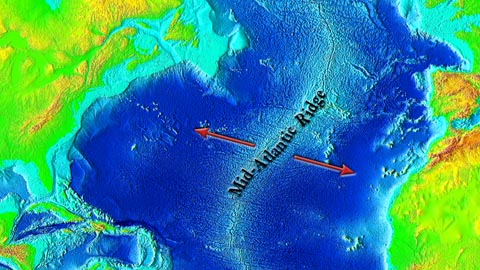
The image shows the Mid Atlantic Ridge. Which type of boundary occurs at this ridge where the ocean floor is spreading apart? 
a)
convergent
b)
divergent 
c)
transform fault
27.
The ____________ is a belt of volcanoes around the rim of the Pacific Ocean.
a)
island arc
b)
Ring of Fire
c)
caldera
d)
hot spot
28.
Where do 75% of active volcanoes occur?
a)
Intraplate
b)
Divergent Boundaries
c)
Convergent Boundaries
d)
Transform Boundaries
29.
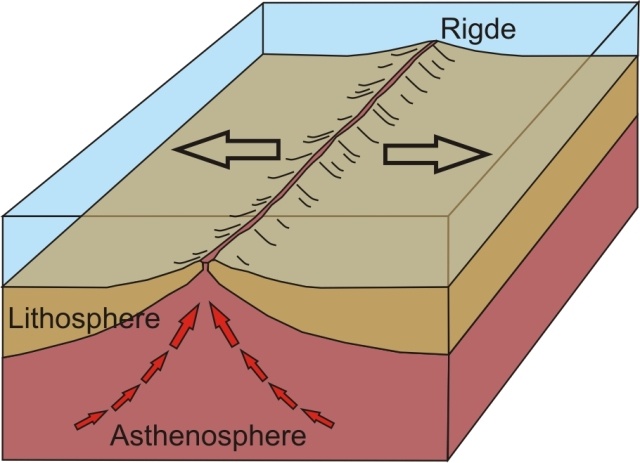
What kind of plate boundary is shown here?
a)
divergent
b)
convergent
c)
transform
d)
subducting
30.
What kind of plate boundary is shown here?
a)
divergent
b)
convergent
c)
transform
d)
submergent
31.
What geologic feature/event you be most likely to find at a transform boundary?
a)
Earthquakes
b)
Volcanoes
c)
Mountains
d)
Rift Valleys
32.
What geologic feature/event would you most likely to find at a convergent boundary between two pieces of continental crust?
a)
Volcano
b)
Mountain
c)
Rift
d)
Island Arc
33.
A subduction zone is formed...
a)
when one tectonic plate sinks below another
b)
at every type of convergent plate boundary
c)
at every type of divergent plate boundary
d)
at transform boundaries
34.
The area where two or more plates meet is called a __________________.
a)
fault
b)
plate boundary
c)
plate edge
d)
ring of fire
35.
Plates slide past one another at ____________ boundaries.
a)
divergent
b)
convergent
c)
transform
d)
submergent
36.
Plates move towards one another at ______________ boundaries.
a)
divergent
b)
convergent
c)
transform
d)
detergent
37.

A _______ is a type of hot spring where water shoots out into a calm pool.

a)

steam explosion

b)

geyser

c)

mudflow

d)

pyroclastic flow

38.

What geologic process probably caused what you see in this image?

a)

Volcanic eruption

b)

Earthquake

c)

Erosion

39.

What geologic process probably caused the damage you see in this image?

a)

Volcano

b)

Weathering

c)

Earthquake

40.

Scientists think that convection currents that move the plates flow in Earth's

a)

Continental crust

b)

Oceanic crust

c)

mantle

d)

outer core

41.
The mantle of Earth is made partly of magma. When magma rises and sinks, this is called ______________. 
a)
a conduction current
b)
a hot spot
c)
a volcanic eruption
d)
a convection current
42.

The San Andreas Fault in California is an example of a ________.

a)

divergent boundary

b)

convergent boundary

c)

transform boundary

d)

subduction zone

43.

Where is the Ring of Fire located?

a)

Atlantic Plate

b)

Pacific Plate

c)

Japanese Plate

d)

North American Plate

44.

What s driving the movement of the tectonic plates?

a)

Gravity

b)

Tides caused by lunar activity

c)

Convection currents deep in the mantle

d)

A giant turtle

45.

What percentage of Earth's volcanoes are found in the Ring of Fire?

a)

10%

b)

25%

c)

50%

d)

75%

46.

Which of these volcanoes is in the ring of fire?

a)

Mount Ebott

b)

Mount Monkey

c)

Yellowstone volcano

d)

Krakatoa