
 Worksheets
Unit III: The West African Kingdoms (2025-2026)
Total questions: 39
Worksheet time: 27mins

Which letter represents the region that was heavily influenced by Islam?
A
B
C
D

Ghana was centrally located on the trade routes. Which of the following are THREE other reasons that Ghana became a wealthy kingdom/empire? (Select THREE)
Had iron weapons
Controlled the gold and salt trade
Maintained control of the Atlantic Coast line
Owned all of the ships used for trade on the Niger River
Had a well trained army

How was West African History originally passed down?
Orally
Through Family Letters
Through Government Documents
Through Historical Books

Which language was the first written language used in West Africa?
Arabic
Urdu
Greek
Latin

How did Islam enter Western Africa?
Military Conquests
Trade
Christian Missionaries
European Exploration

Which of the following was one result of the prosperity that West African kingdoms experienced because of trade?
Merchants began to reduce trade with West Africa
Islamic centers of learning were created
Rulers began to lose their power over their kingdoms
West African began to demand goods from Europe
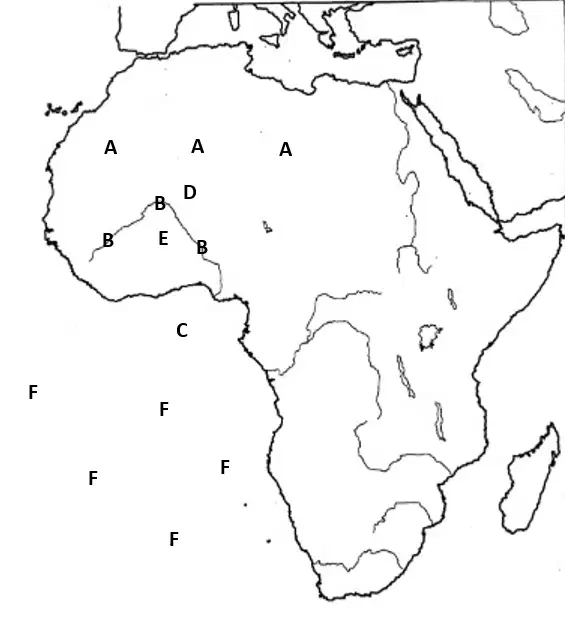
What physical feature is represented by the letter "A" on the map?
Plateau of Tibet
Kalahari Desert
Sahara desert
Ural Mountains

Which letter on the map represents the city of TIMBUKTU?
A
B
C
D
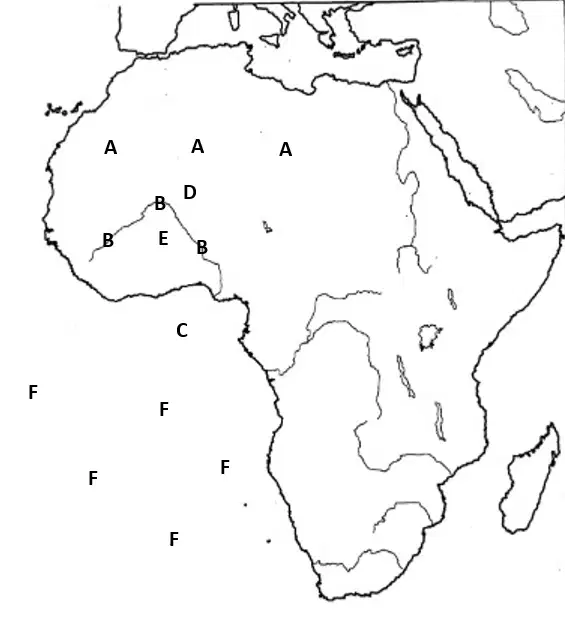
Which body of water is represented by the letter "C" on the map?
The Mediterranean Sea
The Gulf of Guinea
The Persian Gulf
The Caspian Sea
Which of the following statements explains why the cities of Niani and Mali were important to West African society?
Both were port cities on the Atlantic Ocean
Each of the cities was a center of trade
The cities were both the seat of government
The two cities were military training centers

Who in African society would have passed down history through epics such as the Tale of Sundiata Kieta?
Merchants
Griot
Military General
Tribal Leader

Look at the picture. In West African society, what would be the job of this person?
Sultan
Shamaan
Farmer
Griot

Which of the following are other names for the West African Griot? (Select Three)
Religious Priest
Traditional storyteller
Enslaved Worker
Oral Historian
Musician

Which of the following resulted in the increase of trade and wealth in West Africa?
Discovery of the Compass from East Asia
Introduction of the Islamic faith
Advanced sailing techniques
Control of the Gulf of Guinea

Which of the following were two of the effects of the introduction of Islam to Western Africa? (Select TWO)
Increased wealth from trade
Islamic military conquest of the region
Centers of religious learning emerged
Trade increased between Europe and Africa
Europeans refused to trade with West African merchants.

Mansa Musa allowed religious freedom in his Kingdom. Which of the following are THREE of his accomplishments? (Select THREE)
Conquered territories north of the Sahara
Made a famous pilgrimage to Mecca/Makkah
Brought Islamic Scholars to Timbuktu
Encourage the spread of Christianity
Continued the spread of Islam in Western Africa

Which physical feature isolated early West Africa from Northern Africa?
Sahara Desert
The Plateau of Tibet
Ural Mountains
Kalahari Desert

What does the dotted red line on the map represent?
The route of the Umayyad Military Conquest
A European Controlled Trade Route
The Amazon River in Northern Africa
Mansa Musa's Pilgrimage to Mecca

What does the Letter A represent on the Map?
Niani
Timbuktu
Cairo
Mecca/Makkah
What does the Letter B represent on the Map?
Yathrib
Medinah
Cairo
Mecca/Makkah

Which event led to Muslim Scholars being brought to Mali/Timbuktu to spread Islam?
Increased trade between Europe and Africa
Mansa Musa's religious journey to Mecca/Makkah
Military Conquest of West Africa by the Umayyads
Introduction of Greek and Latin texts to West African culture

Under whose rule did Mali experience a "GOLDEN AGE"?
Sundiata Kieta
Ibn Battuta
Mansa Musa
Muhammad Ture

Which of the following describes a "GOLDEN AGE" in any given society/culture/empire?
A time of multiple civil wars and famine
A period of prolonged disorder and rebellion
A time of extreme poverty and religious turmoil
A period of exceptional growth, power, and prosperity

Which of the following describes the city of Timbuktu at the height of the West African Kingdoms' power? (Select 2)
A center of religious learning
A port city
A center of trade
A military training center
The location of "OLD MCDONALD'S" farm

Which religion eventually becomes the dominant religion of the West African kingdoms of Ghana, Mali, and Songhai?
Confucianism
Daoism
Chritianity
Islam

Which of the following were elements of the Traditional African Religions? (select Three)
Music, Masks, and dance
The use of a holy text
The four noble truths and eight fold path
Calling on ancestors for help
Animism: sprits exist in nature

Which of the following words fits this definition: "a book or document written by hand"?
Atlas
Manuscript
Library
Magazine

Visitors to Timbuktu such as Leo Africanus/Al-Zayati wrote accounts of the city. How would they have described the city of Timbuktu?
The most technologically advanced city in the known world
A city that discouraged citizens from practicing any religion
A center of trade and religious learning
The crossroads for the diffusion of Christian ideas

Use of music, masks, and dance, calling on ancestors for help, and belief that spirits exist are all elements of which of the following?
Buddhist religious practices
Elements of Confucianism
Traditional African Relgions
The three primary teachings of Islam

Which Niger River flows into which body of water?
The Mediterranean Sea
The Persian Gulf
The Red Sea
The Gulf of Guinea
Which of the following statements is an example of POLYTHEISM in traditional African religions?
People believed they could call on their ancestors for help.
Griots passed down the history of West Africa orally.
A creator god had many sons that were considered to be lesser gods.
The belief that there is an afterlife after death.
Which of the following statements is an example of ANIMISM in traditional African religions?
People believed they could call on their deceased family members for assistance and they make sacrifices to them in return for help.
Practitioners use music, masks, and dance in ceremonies and celebrations.
A creator god had many sons that were considered to be lesser gods.
The belief that objects have have spiritual significance and that events and nature can be influenced by nature spirits.
Which of the following statements is an example of ANCESTOR WORSHIP in traditional African religions?
People believed they could call on their deceased family members for assistance and they make sacrifices to them in return for help.
Practitioners use music, masks, and dance in ceremonies and celebrations.
A creator god had many sons that were considered to be lesser gods.
The belief that objects have have spiritual significance and that events and nature can be influenced by nature spirits.
Which of the following words means "To Cross the Sahara Desert"?
Trans-Saharan
Semi-Saharan
Sans-Saharan
Sun-Saharan
Which of the following words means "Below the Sahara Desert"?
Trans-Saharan
Semi-Saharan
Sans-Saharan
Sub-Saharan
Which of the following definitions best explains the word COMMERCE?
to obtain something by using force
the activity of buying and selling, especially on a large scale
to go from one place to another, typically over a distance of some length.
a skilled job, typically one requiring manual skills and special training
The empires of Ghana, Mali and Songhai gained their wealth through the gold and salt trade and established Timbuktu as a center of culture and trade. Which of the following statements supports this?
African rulers did not allow their subjects to covert to the Islamic faith.
Trans-Saharan trade routes were controlled by the Chinese.
Sub-Saharan Africa was isolated from other cultures during the Middle Ages
Trade routes across the Sahara helped to establish commerce and centers of learning.
Which of the following would be a primary reason for Mansa Musa's image to be included on the Catalan Atlas as shown on the image?
Mansa Musa set out on Military expedition to conquer territories in Western Europe.
Europeans became interested in trading with Mali/West Africa because of the regions wealth.
Islamic Scholars created the atlas to show Mansa Musa's pilgrimage helped spread the religion of Islam to Europe.
Chinese merchants discovered a sea route to Western Africa to trade with Mansa Musa.
Mansa Musa's pilgrimage from Timbuktu to Mecca resulted in which of the following? (Select TWO answers)
Mali's wealth from the gold trade became well known in Europe.
Northern Africa was conquered by the West African kingdom of Mali.
Western Europe began to convert to the religion of Islam.
New sea routes were established to engage in trade between West Africa and Asia.
Centers of learning were created when Islamic scholars were brought back to Mali.

