wayground logo

Free Printable Worksheets

Font size

S
M
L
XL
Worksheets

iGCSE Chemistry Unit 1 (a) - (c)

Total questions: 30

Worksheet time: 30mins

Name
Class
Date
1.
The positive particles of an atom are 
a)
electrons 
b)
positrons 
c)
neutrons 
d)
protons 
2.
What is the mass number?
a)
the number of protons
b)
the number of protons and neutrons
c)
the number of neutrons
d)
the number of protons and electrons
3.
What is the atomic number?
a)
the number of protons
b)
the number of protons and neutrons
c)
the number of neutrons
d)
the number of protons and electrons
4.

A substance that dissolves in a liquid is called the...

a)

Solvent

b)

Solute

c)

Solution

d)

Salient

5.
Molecules are closest together in a 
a)
Solid
b)
Liquid
c)
Gas
6.

What is diffusion?

a)

when molecules move

b)

when molecules move from a high concentration to a low concentration

c)

no movement

d)

molecules move everywhere

7.
Most of the mass in an atom is concentrated in the...
a)
electrons
b)
nucleus
c)
protons
d)
empty space
8.
What does the nucleus consist of?
a)
Protons + Electrons
b)
Neutrons + Electrons
c)
Atoms
d)
Protons + Neutrons
9.

Isotopes are the atoms of the same element with the same number of.............. but different number of............

a)

electrons/neutrons

b)

neutrons/protons

c)

protons/neutrons

d)

electrons/protons

10.

Elements contain only one type of atoms.

a)

True

b)

False

11.
What is a pure substance made of two or more elements that are chemically combined called?
a)
A. element
b)
B. compound     
c)
C. mixture
d)
D. solution
12.
NaHCO3 is an example of —
a)
an abbreviation
b)
a compound
c)
a mixture
d)
an element
13.

How can you get salt from salty water?

a)

evaporate the water; then crystallisation

b)

condense the water; then crystallisation

c)

Filtration

14.

What is the mass number of magnesium?

a)

2

b)

4

c)

12

d)

24

15.
The particles of the atom you can find by knowing the atomic number.
a)
neutrons
b)
protons and electrons
c)
protons and neutrons
d)
atomic mass
16.
What charge does the nucleus have and why?
a)
positive - the neutrons do not have a charge
b)
positive - the neutrons and protons are positively charged particles
c)
neutral - the neutral charge dominates the positive charge
d)
neutral - electrons cancel out the positive charge of the atom
17.

How many electrons does it have?

a)

197

b)

79

c)

118

d)

none of the above

18.

What do these isotopes of carbon all have in common?

a)

neutrons & mass number

b)

atomic number and neutrons

c)

atomic number

d)

protons, atomic number, and mass number

19.
This picture represents which of the following?
a)
Element
b)
Compound
c)
Mixture
20.

The following is a:

a)

Compound

b)

Element

c)

Mixture of elements

d)

Mixture of compounds

21.

Which of these phrases describes the particles in a solid?

a)

The particles are not in a regular arrangement and can move past each other.

b)

The particles are in a regular arrangement and can move past each other.

c)

The particles are far apart and can move randomly.

d)

The particles are in a regular arrangement and can only vibrate around fixed positions.

22.

If you were using filtration, what would you be trying to separate?

a)

A soluble solid from a liquid

b)

A mixture of two solids

c)

An insoluble solid from a liquid

d)

A mixture of two or more liquids

23.

75% of naturally occurring chlorine is Cl-35. The remaining chlorine is Cl-37. Which of the below equations shows how to calculate the relative atomic mass of chlorine?

a)

(75x37) + (25x35) / 100 = 35.5

b)

(75x35) + (25x37) / 100 = 35.5

c)

(75x37) + (25x35) / 100 = 35

d)

(75x35) + (25x37) / 100 = 37

24.
A pure substance shows ------------------ spot on chromat gram
a)
0
b)
1
c)
2
d)
3
25.
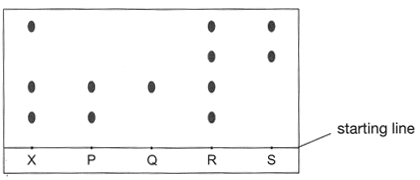
The diagram below shows a chromatogram obtained when a sample X was analysed together with four other known dyes P, Q, R and S. Dye Q was known to cause cancer. Which of the following dye(s) is/are safe for use?
a)
P only
b)
S only
c)
P and S
d)
P and X
26.
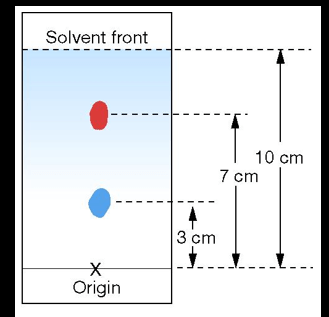
The Rvalue  for the blue component is 
a)
0.3
b)
0.7
c)
10
d)
3
27.

If I dissolve salt in water, what is the solute?

a)

water

b)

salty water

c)

none of the above

d)

salt

28.

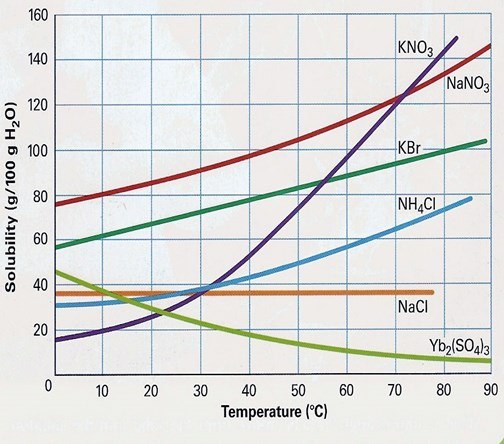
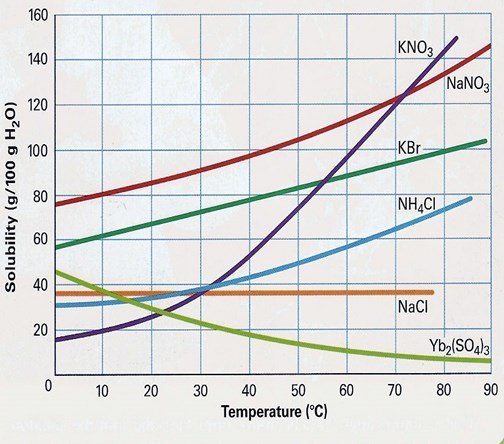
At 30'C, which substance has the lowest solubility?

a)

KNO3

b)

KBr

c)

NaCl

d)

Yb2(SO4)3

29.

At which temperature do KBr and KNO3 have the same solubility?

a)

60

b)

55

c)

50

d)

Never

30.
When a solvent contains as much of the solute as it can hold, the solution is said to be
a)
supersaturated
b)
diluted
c)
saturated
d)
unsaturated