
NEW
Font size
 Worksheets
Byzantine & Islamic Empires
Total questions: 26
Worksheet time: 2hrs 10mins
Which of the following issues divided the Western and Eastern Churches?
practices of animal sacrifices
practices such as scalping
authority of the pope
belief in Jesus
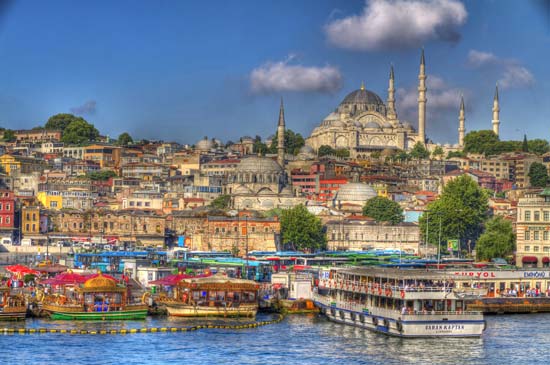
Why was Constantinople such a prosperous city?
located at the crossroads of trade
Great architecture
Strong autocratic rulers
The pope lives there


What emperor had the law code re-written and organized?
Charlemagne
Justinian
Theodora
Constantine
Why was Justinian's Code of laws important?
It established all rules regarding taxation.
It established codes regarding the Eastern Orthodox Church.
It formed the basis of European Law.
It established what entertainment acts were at Hippodrome.
Which language was used by the Byzantine Church?
Italian
Greek
Latin
Russian
What is the title of the head of the Roman Catholic Church?
King
Pope
Tsar
Emperor

What is a basilica?
The emperor's personal bath.
the name given to certain churches granted special privileges by the Pope.
A hall where politicians gathered to debate.
a large oblong hall or building with double colonnades and a semicircular apse, used in ancient Rome as a court of law or for public assemblies.
What are mosaics?
a picture or pattern produced by arranging together small colored pieces of hard material, such as stone, tile, or glass.
a picture that is created on the wall of a a building.
A picture made of many points or dots to create an image.
A picture of Jesus.
Who was the head of the Byzantine orthadox church?
the Patriach
The Emperor
The pastor
None of these.
Calligraphy is
a visual art related to writing. It is the design and execution of lettering with a broad-tipped instrument, brush, or other writing instrument.
a visual art related to drawing. It is the design and execution of lettering with a broad-tipped instrument, brush, or other writing instrument.
a visual art related to writing. that only uses brushes.
none of these
Idolatry is
the worship of idols.
the worship of gods.
the worship of people
the worship of ones self.
Arabesque is
an ornamental design consisting of intertwined flowing lines, originally found in Arabic or Moorish decoration.
an ornamental design consisting of intertwined flowing lines, originally found in Greek decorations.
an ornamental design consisting of intertwined flowing lines, originally found in Byzantine decoration.
an ornamental design consisting of intertwined flowing lines, originally found in Roman decoration.
Monotheism is
the doctrine or belief that there is only one God.
the doctrine or belief that there is many gods.
the doctrine or belief that there is only belief in animals.
the doctrine or belief that there is only belief in nature.
A Mosque is
a Muslim place of worship.
a Buddhist place of worship.
a Christian place of worship.
None of these.
A mihrab is
a niche in the wall of a mosque, at the point nearest to Mecca, toward which the congregation faces to pray.
none of these.
a niche in the wall of a mosque, at the point nearest to Mecca, toward which the congregation faces burn incense.
a niche in the wall of a mosque, at the point nearest to Mecca, which hold statues of prophets
A mihrab is
a niche in the wall of a mosque, at the point nearest to Mecca, toward which the congregation faces to pray.
none of these.
a niche in the wall of a mosque, at the point nearest to Mecca, toward which the congregation faces burn incense.
a niche in the wall of a mosque, at the point nearest to Mecca, which hold statues of prophets

What is this made of?
ivory
marble
plaster
clay

name this
mona lisa
hagia sophia
the louvre
the great mosque

What is this made of?
mosaic tiles and ink on vellum
mosaic tiles only
ink only
pigments

What is this called
arabesque
obilisk
engraved art
none of these

Who is this a portrait of?
Mansa Musa
Musa Mansa
Morgan Freeman
Nelson Mandela

Where is this mosque
Afghanistan
Pakistan
India
Africa

Who is this a mosaic of?
Justinian
Constantine
the pope
Julius Caesar

