wayground logo

Free Printable Worksheets

NEW

Font size

S
M
L
XL
Worksheets

Electrons and The Periodic Table Final Practice and Review

Total questions: 25

Worksheet time: 27mins

Name
Class
Date
1.

The vertical (up and down) columns in the Periodic Table are called

a)

groups

b)

towers

c)

periods

d)

atomic numbers

2.
The Modern Periodic Table of Elements is arranged by
a)
atomic mass
b)
atomic number
c)
valence electrons
d)
number of isotopes
3.
What element is this model showing?
a)
Lithium
b)
Boron
c)
Carbon
d)
Neon
4.
What does an atom's group tell us?
a)
Number of protons
b)
Number of electrons
c)
Number of valence electrons
d)
Number of shells
5.
Electronegativity is...
a)
how good an atom is at attracting electrons
b)
the ability of an atom to lose electrons
c)
the energy required to remove an electron from a specific atom
d)
how easy it is to make friends. 
6.
Ionization energy is...
a)
the energy required to add an electron to a specific atom
b)
how much energy it takes to remove an electron from an atom
c)
the energy required to shield the outer electrons from the nucleus
d)
a measure of the ability of an atom to attract electrons
7.
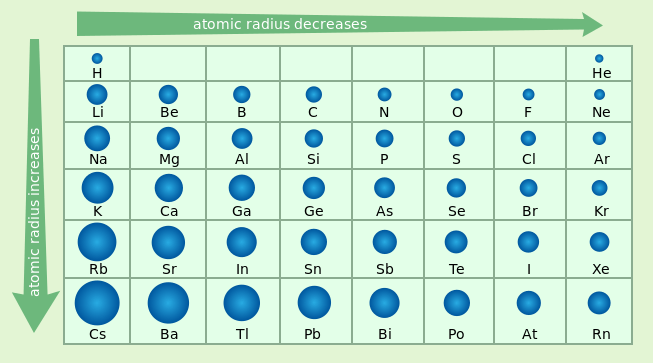
Atomic radius generally increases as we move __________.  
a)
down a group and from right to left across a period 
b)
up a group and from left to right across a period 
c)
down a group and from left to right across a period 
d)
up a group and from right to left across a period 
8.
Which atom has the largest atomic radius?
a)
potassium
b)
rubidium 
c)
francium
d)
cesium
9.

As you move from left to right on the periodic table, the number of valence electrons.......

a)

Increases

b)

Decreases

c)

Remains the same

10.

Which of the following is the term for a substance in which all the atoms have the same number of protons

a)

a compound

b)

An element

c)

a molecule

d)

a solid

e)

a gas

11.
As you move down the periodic table atoms get bigger.  This is because ____________.
a)
The atoms have more mass.
b)
The atoms have more protons.
c)
The atoms have more energy levels
d)
The atoms have more nuetrons
12.
As you move across the periodic table atoms tend to get smaller because, ______________.
a)
the atoms have more mass.
b)
the atoms have less mass
c)
the atoms have more protons.
d)
the atoms have less electrons.
13.

Which element is most likely to have six valence electrons?

a)

Barium (Ba)

b)

Carbon (C)

c)

Oxygen (O)

d)

Americium (Am)

14.

Which has the greater Electronegativity:

Cl or Al?

a)

Cl

b)

Al

15.

The atomic number of aluminum is 13. What is the correct designation of the electron configuration of aluminum?

a)

1s21p62s22p1

b)

1s22s22p63s3

c)

1s22s22p62d3

d)

1s22s22p63s23p1

16.

Flame tests can be used to identify an element. Each element emits characteristic waves of light when it is heated in a flame. What describes how the light is produced?

a)

Protons in the ground state lose energy and give off light.

b)

Protons in the ground state gain energy and are emitted from the nucleus, giving off light.

c)

Electrons in the ground state lose energy and move to an excited state, giving off light.

d)

Electrons in the ground state gain energy, move to an excited state, and give off light when they return to the ground state.

17.

The blue elements are called

a)

metals

b)

nonmetals

c)

metalloids

d)

noble gases

18.

Which color on the image of the periodic table corresponds with the halogens.

a)

red

b)

black

c)

blue

d)

orange

19.
How many electrons can the first energy level hold?
a)
1
b)
2
c)
8
d)
0
20.
Which element is pictured?
a)
neon
b)
fluorine
c)
magnesium
d)
argon
21.
How many p orbitals are there in a sublevel?
a)
2
b)
1
c)
4
d)
3
22.

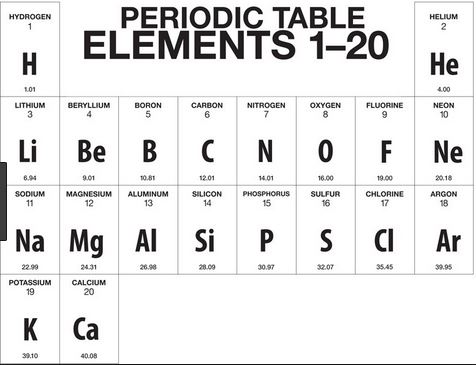
How many valence electrons does Nitrogen Have?

a)

1 Valence electron

b)

2 Valence electron

c)

3 Valence electron

d)

4 Valence electron

e)

5 Valence electron

23.
Which element has the smaller atomic radius: potassium (K) or bromine (Br)?
a)
potassium (K)
b)
bromine (Br)
24.

_________________________ is the distance between a point on one wave and the identical point of the next wave.

a)

Amplitude

b)

Frequency

c)

Crest

d)

Wavelength

25.
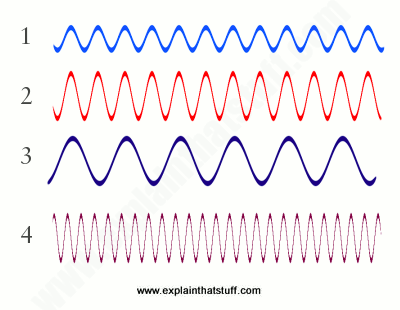
Which wave has the highest frequency?
a)
1
b)
2
c)
3
d)
4