
 Worksheets
Joints Review
Total questions: 21
Worksheet time: 17mins
Name
Class
Date
1.
Carpals and tarsals (flat bones) are examples of this type of joint
a)
condyloid
b)
gliding
c)
hinge
d)
saddle
2.
Ways that articulations are classified
a)
Structurally
b)
Functionally
c)
Both Structurally & Functionally
d)
Neither
3.
Classifying joints as synarthrotic, amphiarthrotic, or diarthrotic represents
a)
location in the body
b)
the composition of the joint
c)
the number of bones that joint affects
d)
degree of movement possible at the joint
4.
Which of the following is a joint that can freely move?
a)
fibrous
b)
cartilaginous
c)
synovial
5.

Moving a part forward (thrusting the head forward).
a)
protraction
b)
retraction
c)
elevation
d)
supination
6.
This type of joint allows the your first two vertebrate to rotate as in shaking your head no
a)
condyloid
b)
gliding
c)
pivot
d)
saddle
7.

What are joints
a)
A place where one bone meets
b)
A place where two bones meet
c)
Bones don't meet
d)
A place where three bones meet
8.
Hip and shoulder have examples of this type of joint
a)
ball and socket
b)
condyloid
c)
hinge
d)
gliding
9.
The elbows, knees and phalanges are examples of this type of joint
a)
ball and socket
b)
condyloid
c)
gliding
d)
hinge
10.

Movement away from the mid-line is called _____________.
a)
abduction
b)
adduction
c)
internal rotation
d)
external rotation
11.

Turning the hand so that the palm is upward or facing anteriorly (in anatomical position).
a)
supination
b)
pronation
c)
flexion
d)
dorsiflexion
12.
Cartilagenous joints are connected by
a)
synovial fluid
b)
fibrous connective tissue.
c)
hyaline cartilage or fibrocartilage
d)
a joint capsule
13.

Moving a part so that its end follows a circular path (moving a finger in a circular motion without the the hand).
a)
circumduction
b)
rotation
c)
opposition
d)
retraction
14.
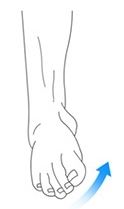
Turning the foot so the plantar surfaces faces medially.
a)
plantar flexion
b)
eversion
c)
inversion
d)
dorsiflexion
15.

Identify the joint action being performed.
a)
Extension
b)
Flexion
c)
Abduction
d)
Adduction
16.

Name this joint
a)
gliding
b)
saddle
c)
condyloid
d)
pivot
17.
Fibrous joints are?
a)
freely moveable
b)
partially moveable
c)
immovable
18.
Bone regions united by fibrous connective tissue
a)
fibrous/suture
b)
cartilaginous/amphiarthrotic
c)
fibrous/symphysis
19.
Joints between skull bones
a)
diarthrotic/synovial
b)
fibrous/suture
c)
amphiarthrotic/epiphyseal disk
20.
all examples are diarthrosis
a)
fibrous
b)
cartilaginous
c)
synovial
21.
All are reinforced by ligaments
a)
fibrous
b)
cartilaginous
c)
synovial
100 %

