
 Worksheets
DNA Replication and Protein Synthesis
Total questions: 25
Worksheet time: 51mins
Name
Class
Date
1.
Which of the following would most likely cause a mutation?
a)
the placement of ribosomes on the endoplasmic reticulum
b)
the insertion of a nucleotide into DNA
c)
the movement of transfer RNA out of the nucleus
d)
the release of messenger RNA from DNA
2.
Which of the following carries amino acids to the site of protein synthesis?
a)
mRNA
b)
rRNA
c)
tRNA
d)
nRNA
3.
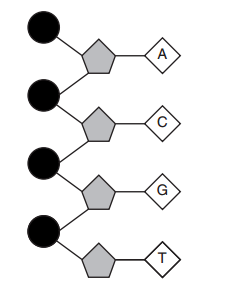
The diagram below represents a portion of a DNA molecule. The letters represent different types of
a)
sugar molecules
b)
nitrogen bases
c)
enzymes
d)
proteins
4.
What is made during translation?
a)
transfer RNA
b)
messenger RNA
c)
Proteins
d)
Spanish Rice
5.
What is assembled during transcription?
a)
transfer RNA
b)
messenger RNA
c)
DNA replication
d)
court proceedings
6.
What monomers are DNA and RNA consisted of?
a)
nitrogen base
b)
nucleotides
c)
sugar-phosphate backbone
d)
blood
7.
DNA has a ______ strand; RNA has a ______ strand.
a)
double/double
b)
double/triple
c)
double/single
d)
single/single
8.
DNA replication is considered _____ because it uses the old strands as templates?
a)
RNA
b)
wasteful
c)
semiconservative
d)
aggressive
9.
What enzyme initiates DNA replication?
a)
DNA polymerase
b)
tRNA
c)
RNA polymerase
d)
mRNA
10.
Identify the complementary DNA strand: ATTACGAT
a)
GAAGTGCA
b)
TAATGCTA
c)
TCTUCAAA
d)
CGGCACG
11.
In RNA, the nitrogen base____ replaces ____ that was present in DNA.
a)
A, U (adenine, uracil)
b)
C, G (cytosine, guanine)
c)
U, T (uracil, thymine)
d)
U, A (uracil, adenine)
12.
What is the transcribed mRNA strand for CATTAA
a)
GUAAUU
b)
GTAATT
c)
AUGGUU
d)
CATTAA
13.
The rungs of the DNA molecules consist of
a)
a pair of nitrogen bases
b)
sugar and phosphate
c)
single strands
d)
single nitrogen bases
14.
Translation occurs in the
a)
nucleus
b)
mitochondria
c)
cytoplasm
d)
golgi apparatus
15.
The codon (set of 3 nitrogen bases) codes for 1 of 20
a)
endoplasmic reticulum
b)
RNA
c)
genes
d)
amino acids
16.
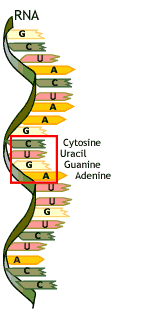
In RNA, Uracil pairs with ______.
a)
cytosine
b)
adenine
c)
guanine
d)
thymine
17.
The process to go from DNA to mRNA is _______
a)
translation
b)
transcription
c)
replication
18.
The process to go from mRNA to a protein is called ____
a)
transcription
b)
rRNA
c)
replication
d)
translation
19.
Choose the nucleotide sequence of the RNA strand that would be complementary to the following strand:
GTAGTCA
GTAGTCA
a)
UATUAGA
b)
ACGACTG
c)
CAUCAGU
d)
CATCAGT
20.
A portion of mRNA is coded CUG. The corresponding DNA is coded
a)
GAC
b)
GTC
c)
CTG
d)
CAG
21.

Who is responsible for producing this image?
a)
Francis Crick
b)
James Watson
c)
Rosalind Franklin
d)
Watson and Crick
22.

From his work with mice and pneumonia-causing bacteria, Frederick Griffith discovered what?
a)
Replication
b)
Transcription
c)
Transformation
d)
Translation
23.

By using radioactive isotopes, Hershey and Chase were able to conclude that _____ is the carrier of genetic information.
a)
DNA
b)
Protein
c)
Carbohydrate
d)
Lipid
24.

The work of Erwin Chargaff allowed Watson and Crick to determine the rules of.......
a)
protein synthesis
b)
transcription
c)
hydrogen bonding
d)
nitrogen base pairing
25.

Who was responsible for the model shown?
a)
Oswald Avery
b)
Watson and Crick
c)
Erwin Chargaff
d)
Rosalind Franklin
100 %

