
 Worksheets
Causes of the American Revolution
Total questions: 46
Worksheet time: 25mins
Name
Class
Date
1.
Which concern of the colonists led to the American Revolution?
a)
opposition to British tax policies
b)
Desire for greater religious freedom
c)
Fear of attacks by American Indians
d)
Increasing immigration from countries other than Britain
2.
Colonists protested the Stamp Act because they believed in what phrase?
a)
Live free or die
b)
All men are created equal
c)
Life, liberty, and pursuit of happiness
d)
No taxation with representation
3.
Sons of Liberty were a group of American colonists who worked to repeal the Stamp Act by doing what?
a)
Taking military action against the British
b)
Forming alliances with the enemies of Britain
c)
Meeting with Parliament in England
d)
Publicly protesting and organizing boycotts
4.
In response to the Tea Act, the colonists threw tea from the British ships into the Boston Harbor. This event is known as:
a)
Boston Tea Party
b)
Boston Riots
c)
Boston Massacre
d)
Boston Market
5.
Who was the King of Britain at the time of the Revolutionary War?
a)
King George III
b)
King George I
c)
King Henry IV
d)
King Henry VIII
6.
Why did the king begin to tax the colonists?
a)
He wanted more money to make England look better
b)
He needed money to pay off war debts from the French and Indian War
c)
He needed money to pay for Boston soldiers
d)
He hated the colonists' guts
7.
An angry crowd of workers surrounded a small group of British soldiers and were fired upon
a)
Boston Massacre
b)
Boston Rebellion
c)
Boston Treaty
d)
Boston Tea Party
8.
What was the name of the meeting of colonial leaders where all the colonies agreed to boycott British goods and wrote a letter to the King voicing their complaints?
a)
Committees of Correspondence
b)
The Declaration of Independence
c)
The Revolutionary War
d)
First Continental Congress
9.
"We hold these truths to be self-evident, that all men are created equal, that they are endowed, by their Creator, with certain unalienable Rights, that among these are Life, Liberty, and the pursuit of Happiness."
- What document is this from?
- What document is this from?
a)
Proclamation of 1763
b)
Charter of 1732
c)
Declaration of Independence
10.
First person killed in the Boston Massacre.
a)
Samuel Adams
b)
Crispus Attucks
c)
Benjamin Franklin
d)
General Wolfe
11.
Paul Revere's engraving of the Boston Massacre is a great example of propaganda.
a)
Truth
b)
False
12.
This act was a tax on everyday household items such as glass, paper, paint, & tea.
a)
Declaratory Act
b)
Stamp Act
c)
Townshend Act
13.
a widespread refusal to buy goods as a form of protest is called a(n):
a)
smuggling
b)
strike
c)
boycott
14.
These acts were passed to punish Massachusetts colony after the Boston Tea Party:
a)
Intolerable Acts
b)
Townshend Acts
c)
Declaratory Act
15.
British law that required colonists to house and supply British soldiers was called the:
a)
Townshend Act
b)
Quartering Act
c)
Declaratory Act
16.
This law forbid the colonists from settling west of the Appalachian Mountains:
a)
Treaty of Paris
b)
Stamp Act
c)
Proclamation of 1763
d)
Townshend Acts
17.
England's law-making group is called:
a)
Congress
b)
House of Representatives
c)
Senate
d)
Parliament
18.
When Parliament repealed the Townshend Act, they got rid of taxes on all other goods except for:
a)
sugar
b)
stamps
c)
molasses
d)
tea
19.
People who supported the king and England were called:
a)
Patriots
b)
Minutemen
c)
Loyalists
d)
militias
20.
People who supported the rebellion of the colonies were called:
a)
Loyalists
b)
Patriots
c)
Minutemen
d)
militias
21.
Which compliant is listed here
"He has dissolved Representative Houses repeatedly, for opposing with manly firmness his invasions on the rights of the people."
"He has dissolved Representative Houses repeatedly, for opposing with manly firmness his invasions on the rights of the people."
a)
quartering soldiers
b)
dissolving legislatures
c)
suspending trial by jury
d)
limiting judicial power
22.
Why is July 4, 1776 an important date in U.S. history?
a)
Common Sense was published.
b)
The Olive Branch Petition sent to King George III.
c)
The American Revolution ends.
d)
The Declaration of Independence is signed.
23.
According to the Declaration of Independence, where does government get its power?
a)
From the King
b)
From the Supreme Court
c)
From God
d)
From the people
24.
The List of Grievances were the part of the Declaration that
a)
detailed the colonists' complaints with King George.
b)
listed a man's natural rights.
c)
introduced the Declaration.
d)
concluded the Declaration, declaring America a free country.
25.
What are our natural rights according to Jefferson? (He got the idea from John Locke)
a)
Freedom of speech, religion, and press
b)
Life, liberty, and property
c)
Life, liberty, and the pursuit of happiness
d)
Voting, rebelling, and health
26.
The Preamble is...
a)
in the beginning of the Declaration...
b)
the conclusion.
c)
in the middle.
d)
not in the Declaration.
27.
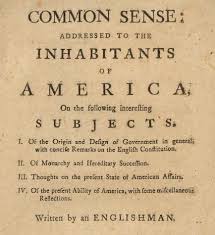
Who wrote a pamphlet called "Common Sense"?
a)
George Washington
b)
Thomas Paine
c)
Thomas Jefferson
d)
Patrick Henry
28.

What is the connection between natural rights and government?
a)
government is meant to provide services
b)
people have the right to alter government
c)
people have certain unalienable rights
d)
government is meant to protect rights
29.
"Unalienable" means:
a)
rights that cannot be taken away
b)
rights that must be earned
c)
rights that belong to the King
d)
rights that can be bought
30.
People establish (make) governments to protect their _______.
a)
rights
b)
land
c)
kings
d)
presidents
31.
People have a right and a duty to change a __________ that violates their ______.
a)
government, rights
b)
government, king
c)
king, government
d)
law, parliament
32.
Thomas Jefferson used ____________ ideas to write the Declaration of Independence.
a)
John Locke's
b)
King George's
c)
George Washington's
d)
Benjamin Franklin's
33.
Thomas Jefferson believed that people have the right to life, liberty, & ________.
a)
property
b)
the pursuit of happiness
c)
penalties
d)
the pursuit of land
34.
The Sugar Act was a tax on sugar and _______
a)
anything with sugar
b)
tea
c)
clothes
35.
The Stamp Act taxed all ________ goods.
a)
paper
b)
plastic
c)
pollution
36.

a)
F
b)
G
c)
H
d)
J
37.

a)
F
b)
G
c)
H
d)
J
38.

a)
F
b)
G
c)
H
d)
J
39.

a)
F
b)
G
c)
H
d)
J
40.

a)
A
b)
B
c)
C
d)
D
41.

a)
F
b)
G
c)
H
d)
J
42.

a)
A
b)
B
c)
C
d)
D
43.

a)
A
b)
B
c)
C
d)
D
44.

a)
F
b)
G
c)
H
d)
J
45.

a)
F
b)
G
c)
H
d)
J
46.

a)
A
b)
B
c)
C
d)
D
100 %

