wayground logo

Free Printable Worksheets

NEW

Font size

S
M
L
XL
Worksheets

MIDTERM IN ELECTRICITY AND MAGNETISM -BSE 2 A

Total questions: 80

Worksheet time: 2hrs 42mins

Name
Class
Date
1.
When you charge an electroscope by touching it with a charged balloon, the process is called _____.
a)
friction
b)
conduction
c)
induction
d)
grounding
2.
The potential difference that causes charges to move in a circuit is ___.
a)
voltage
b)
resistance
c)
current
d)
electric discharge
3.
A circuit that is connected to Earth is said to be _____.
a)
series
b)
parallel
c)
grounded
d)
discharged
4.
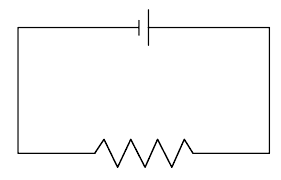
The image on the left is a 
a)
series circuit
b)
parallel circuit
c)
a weird circuit
5.
Which of these could be used as a resistor in a circuit?
a)
pencil
b)
gas engine
c)
rubber eraser
d)
electric motor
6.
If a substance has a higher number of electrons than protons on its surface, what type of charge does it have?
a)
A positive charge.
b)
A negative charge.
c)
A neutral charge
d)
No charge at all
7.
What happens when you touch a metal doorknob after rubbing your shoes on the carpet?
a)
The doorknob sends a burst of electric current into your body
b)
Millions of electrons go from your finger into the doorknob
c)
The doorknob sends millions of electrons into your finger
d)
our finger becomes negatively charged
8.
Which of the following is caused by static electricity?
a)
a stove getting hot when it is turned on
b)
a magnet being attracted to a refrigerator
c)
a lightning strike during a storm
d)
a light bulb coming on when a switch is turned on
9.
If two objects with static charge are attracted, what do you know about them?
a)
They are both positively charged.
b)
They are both negatively charged.
c)
One is positively charged and one is negatively charged, but you won't be able to tell which is which.
d)
One is positively charged and one is negatively charged, and you can tell which is which by looking at them.
10.
Rubbing a balloon on hair is an example of static charge build up created by....
a)
conduction
b)
friction
c)
induction
d)
hairduction
11.
What makes a charged balloon stick to the wall?
a)
Protons transferred to the balloon when it was rubbed on metal.
b)
Extra electrons on the surface of the balloon push away electrons in the wall, leaving a positively charged area.
c)
The rubber in the balloon has a magnetic field that pulls on the wood in the wall.
d)
Electricity in the balloon creates a magnetic field that attracts the metal in the wall.
12.
During a physics lab, a plastic strip was rubbed with cotton and became positively charged. The correct explanation for why the plastic strip becomes positively charged is that ...
a)
the plastic strip acquired extra protons from the cotton.
b)
the plastic strip acquired extra protons from the charging process 
c)
protons were created as the result of the charging process
d)
the plastic strip lost electrons to the cotton during the charging process 
13.
Insulators are different than conductors in that insulators ____.
a)
do not contain electrons or protons 
b)
 do not contain any charge
c)
have a weaker affinity for electrons 
d)
do not allow charge to freely move 
14.
Consider the conduction charging shown. 
a)
Electrons move from the insulating stand into the sphere.
b)
Protons move from the bar into the sphere.
c)
Electrons move from the charged metal bar into the sphere.
d)
Protons move from the sphere into the negatively charged bar.
15.
A glass rod becomes positively charged when it is rubbed with silk. This net positive charge accumulates because the glass rod
a)
gains electrons
b)
loses electrons
c)
gains protons
d)
loses protons
16.
 A balloon is rubbed against a student's hair and then touched to a wall. The balloon sticks to the wall due to
a)
magnetic forces between the particles of the balloon and the particles of the wall
b)
electrostatic forces between the particles of the balloon and the particles of the wall
c)
magnetic forces between the particles of the wall
d)
electrostatic forces between the particles of the balloon
17.
A negatively charged plastic comb is brought close to, but does not touch, a small piece of paper. If the comb and the paper are attracted to each other, the charge on the paper
a)
must be positive
b)
must be negative
c)
may be neutral or negative
d)
may be neutral or positive 
18.
Two electrically charged identical-sized metal spheres, A (charge of -4) and B (charge of +8). If the spheres are brought into contact, which sphere will have a net gain of electrons?
a)
both A and B
b)
neither
c)
only A
d)
only B
19.
When a plastic rod is rubbed with wool, the wool acquires a positive charge because
a)
protons are transferred from the wool to the rod
b)
protons are transferred from the rod to the wool
c)
electrons are transferred from the rod to the wool
d)
electrons are transferred from the wool to the rod
20.
A positively charged rod is held near the knob of a neutral electroscope. What best describes what will happen to the leaves?
a)
the leaves will spread apart and be positive
b)
the leaves will spread apart and be negative
c)
the leaves will stay closed and be positive
d)
the leaves will stay closed and be negative
21.
Two electrically neutral metal spheres, A and B, on insulating stands are placed in contact with each other. A negatively charged rod is brought near, but does not touch the spheres, as shown in the diagram below. How are the spheres now charged?
a)
A is positive and B is positive.
b)
A is negative and B is positive.
c)
A is positive and B is negative.
d)
A is negative and B is negative.
22.
Three charged metal spheres, X, Y, and Z, are on insulating stands. All three spheres are simultaneously brought into contact with each other and then returned to their original positions.
Which statement best describes the charge of the spheres after this procedure is completed?
a)
All the spheres will end up with the same charge
b)
All the spheres are neutral
c)
Sphere Y has a greater charge than spheres X or Z
d)
Each sphere retains the same charge that it had originally
23.
Which of the following is a false statement about electrostatic force.
a)
Bringing charges closer together strengthen the force.
b)
The electrostatic constant remains the same.
c)
The values of the two charges is always the same.
d)
Electrostatic force can be attractive or repulsive
24.
An electrostatic force of magnitude F exists between two metal spheres having identical charge q. The distance between their centers is r. Which combination of changes would produce no change in the electrostatic force between the spheres?
a)
doubling q on both spheres while halving r
b)
doubling q on one sphere while halving r
c)
doubling q on one sphere while doubling r
d)
doubling q on both spheres while doubling r
25.
Two similar metal spheres, A and B, have charges of +2.0 x 10⁻⁶ coulomb and +1.0 x 10⁻⁶ coulomb, respectively. The magnitude of the electrostatic force on A due to B is 4.0N newtons. What is the magnitude of the electrostatic force on B due to A?
a)
2.0N
b)
4.0N
c)
8.0N
d)
1.0N
26.
A negatively charged rod touches the knob of a neutral electroscope. Which  best represents the distribution of charge on the electroscope.
a)
both the knob and leaves become positive
b)
both the knob and leaves become negative
c)
the knob becomes negative and the leaves become positive
d)
the knob becomes positive and the leaves become negative
27.
What size resistor would produce a 3 Amp current flow with a 12 Volt battery
a)
1 Ohm
b)
3 Ohms
c)
4 Ohms
d)
12 Ohms
28.
What is current measured in?
a)
Ω (Ohms)
b)
V (Volts)
c)
A (Amps)
d)
W (Watts)
29.
What is resistance measured in?
a)
Ω (Ohms)
b)
V (Volts)
c)
A (Amps)
d)
W (Watts)
30.
What is Resistance?
a)
The flow of electrons
b)
Electric potential difference
c)
A battery
d)
The ability to reduce the flow of electrons
31.
What is the Voltage of a circuit that has a resistance of 5 Ω and a current of 2 A?
a)
25 V
b)
10 V
c)
2.5 V
d)
0.4 V
32.
The mathematical relationship among Voltage, Current, and Resistance
a)
Faraday's Law
b)
Tesla's Law
c)
Edison's Law
d)
Ohm's Law
33.
Current times Resistance equals
 (I X R)
a)
Power
b)
Voltage
c)
Amperage
d)
Ohm
34.

Voltage divided by Resistance

(V / R)

a)

Current

b)

Power

c)

Ohms

d)

Watts

35.
If the Voltage is increased and the resistance stays the same, Current will
a)
Increase
b)
Decrease
c)
Stay the same
d)
X
36.
If the Voltage stays the same and Resistance is increased, Current will 
a)
Increase
b)
Decrease
c)
Stay the same
d)
X
37.
How many Volts would we need to produce a current flow of 8 Amps through a 6 Ohm resistor
a)
12 volts
b)
24 volts
c)
1.3333
d)
48 volts
38.
This circuit has a 24 volt battery and the resistor is 8 ohms. How many amps are running through the circuit?
a)
3 Amps
b)
192 Amps
c)
2 Amps
d)
4 Amps
39.
What word means how hard it is for electrons to flow through.
a)
Current
b)
Voltage
c)
Resistance
d)
Power
40.
What size resistor would produce a 3 Amp current flow with a 12 Volt battery
a)
1 Ohm
b)
3 Ohms
c)
4 Ohms
d)
12 Ohms
41.

Which factor does not affect resistivity?

a)

Length

b)

Mass

c)

Cross-sectional area

d)

Temperature

42.

The unit of resistivity is

a)

Ω/m

b)

Ω/m2

c)

Ω.m

d)

Ω.m2

43.

Resistance of a material would be equal to resistivity when

a)

l = T

b)

A = l

c)

A = T

d)

l = R

44.

A cylindrical conductor of length l, diameter D, and resistivity ρ has a resistance R. What is the resistance of another cylindrical conductor of length l, diameter D/2 , and resistivity ρ?

a)

8R

b)

4R

c)

2R

d)

R

45.

Resistivity

a)

changes with conditions

b)

relies on dimensions of the material

c)

inversely proportional to resistance

d)

a property of the material

46.
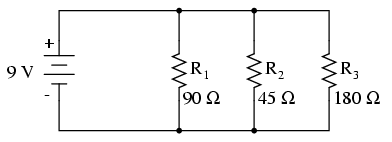
This is an example of a ______ circuit
a)
Series
b)
Parallel
c)
Open
d)
Dihexihedral
47.
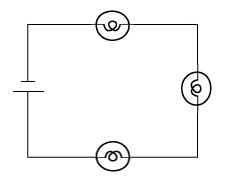
The picture shows an electrical circuit. This circuit is a series circuit because: 
a)
It has 3 light bulbs.
b)
The same current flows through all three light bulbs.
c)
It uses a single battery.
d)
The electrical current is divided between the three light bulbs.
48.
What kind of circuit is this?
a)
series
b)
parallel
49.
A material in which electrons are not able to move easily 
a)
Circuit 
b)
Insulator 
c)
Resistance 
d)
Conductor
50.

Four unequal resistors are connected in series with each other. Which one of the following statements is correct about this combination?

a)

The equivalent resistance is equal to that of any one of the resistors.

b)

The equivalent resistance is equal to average of the four resistances.

c)

The equivalent resistance is less than that of the smallest resistor.

d)

The equivalent resistance is less than that of the largest resistor.

e)

The equivalent resistance is more than the largest resistance.

51.

Draw a circuit with a battery connected to four resistors, R1, R2, R3, and R4, as follows. Resistors R1 and R2 are connected in parallel with each other, resistors R3 and R4 are connected in parallel with each other, and both parallel sets of resistors are connected in series with each other across the battery.

a)
b)
c)
d)
52.

When unequal resistors are connected in parallel in a circuit,

a)

the same current always runs through each resistor.

b)

the potential drop is always the same across each resistor.

c)

the largest resistance has the largest current through it.

d)

the power generated in each resistor is the same.

53.

When unequal resistors are connected in series across an ideal battery,

a)

the same power is dissipated in each one.

b)

the potential difference across each is the same.

c)

the current flowing in each is the same.

d)

the equivalent resistance of the circuit is less than that of the smallest resistor.

e)

the equivalent resistance of the circuit is equal to the average of all the resistances.

54.

As more resistors are added in series to a constant voltage source, the power supplied by the source

a)

increases.

b)

decreases.

c)

does not change.

d)

increases for a time and then starts to decrease.

55.

As more resistors are added in parallel across a constant voltage source, the power supplied by the source

a)

increases.

b)

decreases.

c)

does not change.

d)

increases for a time and then starts to decrease.

56.

The lamps in a string of decorative lights are connected in parallel across a constant-voltage power source. What happens if one lamp burns out? (Assume negligible resistance in the wires leading to the lamps.)

a)

The brightness of the lamps will not change appreciably.

b)

The other lamps get brighter equally.

c)

The other lamps get brighter, but some get brighter than others.

d)

The other lamps get dimmer equally.

e)

The other lamps get dimmer, but some get dimmer than others.

57.

A 9-V battery is hooked up to two resistors in series. One has a resistance of 5 Ω, and the other has a resistance of 10 Ω. Several locations along the circuit are marked with letters, as shown in the figure. Through which resistor is energy being dissipated at the higher rate?

a)

the 10-Ω resistor

b)

the 5-Ω resistor

c)

Energy is being dissipated by both resistors at the same rate.

58.
The power of an appliance is...
a)
the amount of voltage going through it 
b)
the amount of energy transferred per second
c)
the amount of charge that passes through per second
59.
Electrical power can be calculated using
a)
Resistance x Voltage
b)
Voltage x Current 
c)
Voltage ÷ Current
60.
Watts is the same as...
a)
Joules per second
b)
Voltage per second
c)
Current per second
61.
The voltage supplied to a circuit is 17 V and the current running through is 10 A. What is the power generated?
a)
170 W
b)
170 A
c)
1.7 V
d)
1.7 W
62.
Calculate the electric power of an electrical appliance in which 10 A of current is flowing through a resistor of 2 ohms.
 
Remember: V=IR and P=VI
a)
80 W
b)
200 W
c)
2.5 A
d)
22.5 KJ
63.
What will be the current drawn by an electric bulb of 1000 W when it is connected to a source of 220 V?
Remember: I = P/V
a)
4.55 A
b)
28800 J or 28.8 KJ
c)
80 W
d)
200 W
64.

A kilowatt (kW) is how many watts?

a)

10

b)

50

c)

100

d)

1000

65.

The unit of electricity is...

a)

KiloWatt-Hour (kWh)

b)

Watt

c)

Joule

d)

Amp

66.

Calculate the voltage applied when a 60 watt light-bulb uses a current of 5 amps

a)

300 volts

b)

30 volts

c)

12 volts

d)

0.08 volts

67.
What is the power of a 20V bulb with 5A through it?
a)
100W
b)
100V
c)
6.3W
d)
6.3A
68.
How much does it cost to light 6 100 W light bulbs for 6 hours if the price of electrical energy is $0.09/kWh?
a)
$4.00
b)
$6.24
c)
$3.24
d)
$5.24
69.
If the hair dryer and the vacuum cleaner are both on, what is the power used?
a)
2600 watts
b)
400 watts
c)
2200 watts
d)
1100 watts
70.

A circuit breaker is

a)

power factor correcting device

b)

a device to neutralize the effect of transients

c)

a waveform correcting device

d)

a current interrupting device.

71.

Low voltage circuit breakers have rated voltage of less than

a)

220V

b)

400V

c)

1000 V

d)

10,000 V.

72.

To prevent overload and overheating of wires

a)

fuses are used

b)

circuit breakers are used

c)

fuses and circuit breakers are used

d)

fuses and resistor are used

73.

The function of the circuit breaker is

a)

To safeguard the circuit

b)

On and off the circuit

c)

To save human life

d)

None of these

74.

A simple enclosed length of wire that has a low melting point is known as

a)

resistor

b)

fuse

c)

circuit breaker

d)

thermistor

75.

Which of the following is the best description of

a circuit breaker?

a)

Circuit breaker is an electrical switch with different types and rating that can be manually or automatically operated designed to protect an electrical circuit and its components from damage caused by overload or short circuit.

b)

Circuit breaker is a device used to protect the person who are using the electrical circuit.

c)

Circuit breaker is a device that automatically shut off the electric current through the circuit when overload or short circuit happens to protect the loads connected in the system from damage

76.

Which of the following is NOT a function of circuit breaker in electrical circuits?

a)

Protect electrical circuits from damage by too much current

b)

Serve as protection of conductors

c)

Source of electricity of the house wiring

77.

Which of the following is NOT an advantage of the circuit breaker over the fuse?

a)

The circuit breaker acts as a switch aside from its being an over current protective device.

b)

When there is over current, the circuit breaker trips (cut) automatically and after correcting the fault, it becomes readily available for switch on. Unlike the fuses which has to be discarded and replace after it is busted.

c)

Circuit breaker is more expensive than fuse.

78.

The primary function of a fuse is to

a)

Open the circuit

b)

Protect the appliance

c)

Protect the line

d)

Prevent excessive currents from flow through the circuit

79.

Fuses have got advantages of

a)

Cheapest type of protection

b)

Inverse time current characteristic

c)

No Maintenance

d)

Current limiting effect under short-circuit conditions

e)

All of the above

80.

A fuse in a motor circuit provides protection against

a)

Overload

b)

Short-circuit and overload

c)

Open circuit, short-circuit and overload

d)

None of the above