wayground logo

Free Printable Worksheets

NEW

Font size

S
M
L
XL
Worksheets

Solubility

Total questions: 30

Worksheet time: 3600secs

Name
Class
Date
1.
__________ are made up of solutes and solvents.
a)
Solutions
b)
Suspensions
c)
Heterogeneous Mixtures
d)
Pure Substances
2.
If I dissolve sugar in water, what is the solute?
a)
Water
b)
Hydrogen
c)
Sugar
d)
Carbon
3.

Which substance is least soluble at 0 ºC?

a)

KI

b)

KNO3

c)

KClO3

d)

Ce2(SO4)3

4.
What is a solvent
a)
the liquid in which a solute is dissolved to form a solution.
b)
Another word for solution
c)
A thing that make drinks turn colors
d)
Its a metal molecole
5.

How many grams are soluble in 100 g of water at 100 ºC?

a)

300 grams

b)

250 grams

c)

100 grams

d)

50 grams

6.
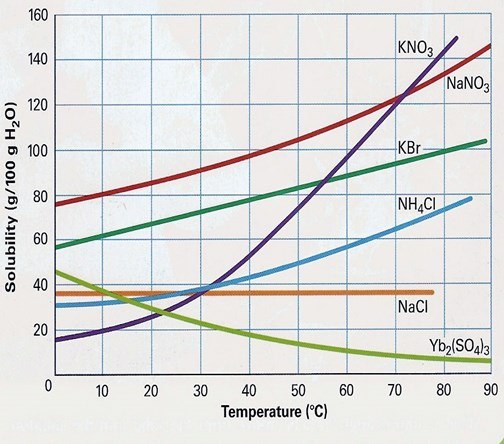
Which solute does not increase in solubility as temperature rises?
a)
NH3
b)
NaNO3
c)
KNO3
d)
NaCl
7.
What will allow more solute to be dissolved in a solvent.
a)
adding more solute
b)
stiring
c)
cooling solution
d)
heat
8.
Which is an example of a solvent?
a)
Salt
b)
Egg whites
c)
Water
d)
Sugar
9.

Define the term soluble.

a)

Can dissolve in water

b)

Cannot dissolve in water

c)

Partially dissolves in water

10.

Define the term insoluble.

a)

Can dissolve in water.

b)

Cannot dissolve in water.

c)

Partially dissolves in water.

11.

At 30'C, which substance has the lowest solubility?

a)

KNO3

b)

KBr

c)

NaCl

d)

Yb2(SO4)3

12.

At which temperature do KBr and KNO3 have the same solubility?

a)

60

b)

55

c)

50

d)

Never

13.
Which solute is the most soluble at 10 ⁰C?
a)
KI
b)
KClO3
c)
NH4Cl
d)
NH3
14.
Which solute is the least soluble at 90 ⁰C?
a)
SO2
b)
KClO3
c)
KI
d)
HCl
15.
Which solute does not increase in solubility as temperature rises?
a)
NH3
b)
NaNO3
c)
KNO3
d)
NaCl
16.
Define solubility
a)
how much pressure is in an object has
b)
Surface Area per Temperature
c)
how much solute can dissolve in a solvent
d)
it is a made up word
17.
Which substance is MOST soluble at 0 ºC?
a)
KI
b)
NaNO3
c)
NaCl
d)
Ce2(SO4)3
18.
Which solute is the most soluble at 10 ⁰C?
a)
KI
b)
KClO3
c)
NH4Cl
d)
NH3
19.
Which solute does not increase in solubility as temperature rises?
a)
NH3
b)
NaNO3
c)
KNO3
d)
NaCl
20.

You can make a solute dissolve more quickly in a solvent by

a)

adding more solute.

b)

adding ice.

c)

heating the solvent.

d)

removing some solvent.

21.

Three 10 g samples of sugar are represented below.


Sample A dissolves in water more slowly than sample B.

Sample B dissolves more slowly than sample C.

Which of the following best explains why sample A dissolves more slowly than the other two?

a)

It has the most volume.

b)

It has the smallest surface area.

c)

It has the largest number of sugar molecules.

d)

It has the fewest bonds between sugar modules.

22.

If I want more sugar to dissolve in water, I should heat the water

a)

true

b)

false

23.

If I want more sugar to dissolve in water, I should stir the water

a)

true

b)

false

24.
Which of the following statements is true about how using smaller salt crystals would affect the rate of making a salt solution in water?
a)
Smaller crystals increase the surface area and slow down dissolving.
b)
Smaller crystals decrease the surface area and speed up dissolving.
c)
Smaller crystals increase the surface area and speed up dissolving.
d)
Smaller crystals decrease the surface area and slow down dissolving.
25.

Which will dissolve faster? Crushed table salt or a cube of table salt. Assume they have an equal mass.

a)

crushed table salt

b)

crystal of table salt

26.

What combination would dissolve a solid solute the fastest?

a)

high temperature, no stirring

b)

no heat, no stirring

c)

sugar cube, no heat

d)

high temperature, stirring

27.

Which of the following actions will NOT

increase the rate of dissolution

(dissolving) for solids?

a)

Stirring the solution

b)

Decreasing the temperature

c)

Increasing the surface area of the

solute

d)

Increasing the temperature

28.

How many Hydrogen atoms does a single water molecule have?

a)

1

b)

2

c)

3

d)

4

29.

What does "polar" mean?

a)

A molecule is cold

b)

A molecule has areas of positive and negative charge

30.

What are the bonds called between a slightly positive hydrogen in a polar molecule and a negatively charged atom?

a)

Hydrogen Bonds

b)

Water Bonds

c)

Covalent Bonds

d)

Bail Bonds