
 Worksheets
Passive Transport
Total questions: 25
Worksheet time: 23mins
Name
Class
Date
1.
A person with swollen gums rinses his mouth with warm salt water, and the swelling decreases. Which of the following has occurred?
a)
The swollen gums have absorbed the saltwater solution.
b)
The saltwater solution lowers the temperature of the water in the gums.
c)
The salt in the solution has moved against the concentration gradient.
d)
The water in the gums has moved out due to the high concentration of salt in the solution.
2.

Look at the diagram of a cross-section of a cell membrane below. The cell membrane controls movement of materials into and out of the cell. The following particles are moving from high concentration to low concentration and are using a carrier protein. How would you describe this type of movement across the membrane?
a)
simple osmosis
b)
active transport
c)
simple diffusion
d)
facilitated diffusion
3.
In pure water, a red blood cell from an animal will swell and burst, but a leaf cell from a plant will not. Which structure in the leaf cell is responsible for this difference?
a)
cell membrane
b)
cell wall
c)
mitochondrion
d)
nucleus
4.
The diffusion of water across a selectively permeable membrane is called
a)
active transport
b)
facilitated diffusion
c)
osmosis
d)
phagocytosis
5.
During diffusion molecules tend to move
a)
up the concentration gradient
b)
from an area of lower concentration to an area of higher concentration
c)
in a direction that doesn’t depend on concentration
d)
down the concentration gradient
6.
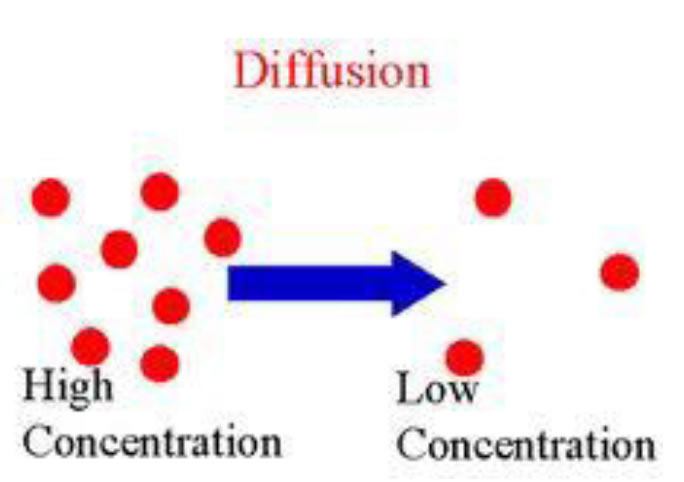
Movement of particles from high to low concentration.
a)
Passive Transport
b)
Active Transport
7.
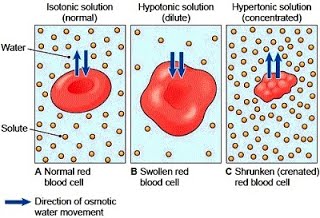
a)
Passive Transport
b)
Active Transport
8.
Osmosis is a form of ______________.
a)
Passive Transport
b)
Active Transport
9.
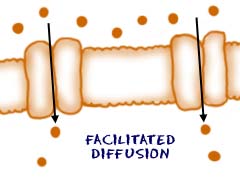
a)
Passive Transport
b)
Active Transport
10.
What is it called when molecules move across the cell membrane from an area of high concentration to an area of low concentration through a carrier protein?
a)
Diffusion
b)
Osmosis
c)
Active Transport
d)
Facilitated Diffusion
11.
The amount of particles in a given space.
a)
diffusion
b)
concentration
c)
permeable
d)
active transport
12.
When the concentration of particles inside of a cell is the same as the concentration of particles outside of the cell.
a)
active transport
b)
concentration
c)
diffusion
d)
equilibrium
13.
A cell membrane has pores that allow certain materials to pass through. This is a type of cell membrane.
a)
Permeable
b)
In high concentration
c)
At equilibrium
d)
In low concentration
14.
What does “high concentration area” mean?
a)
Spread out
b)
Tightly packed together
c)
Uncrowded
d)
Spacious
15.

Which diagram best shows the end result of diffusion?
a)
F
b)
G
c)
H
d)
J
16.
Why is diffusion and osmosis important to cells?
a)
It allows them to take in materials without using energy.
b)
It allows them to reproduce.
c)
It allows them to absorb sunlight.
d)
It allows cells to use all energy.
17.

The picture is an example of _________________.
a)
isotonic
b)
diffusion
c)
osmosis
d)
active transport
18.

Which way will the water molecules move during osmosis?
a)
Out of the cell, so the cell shrinks.
b)
Out of the cell, so the cell swells.
c)
Into the cell, so the cell shrinks.
d)
Into the cell, so the cell swells.
19.

EQUAL AMOUNT OF SOLUTE AND SOLVENT IN AND OUT OF THE CELL
SOLUTE = SOLVENT
a)
Osmosis
b)
Isotonic
c)
Hypotonic
d)
Hypertonic
20.

The amount of SOLVENT > (more than) the amount of SOLUTE
a)
Hypotonic
b)
Hypertonic
c)
Supersonic
d)
Isotonic
21.

The amount of SOLVENT <less than the amount of SOLUTE
a)
Isotonic
b)
Hypotonic
c)
Tonic water
d)
Hypertonic
22.

Is SEAWATER Hypotonic, hypertonic, or Isotonic?
a)
Hypotonic
b)
Hypertonic
c)
Osmosis
d)
Isotonic
23.

Is coca cola Hypotonic, hypertonic, or Isotonic?
a)
Hypotonic
b)
Hypertonic
c)
Isotonic
d)
Osmosis
24.

Is WATER Hypotonic, hypertonic, or Isotonic?
a)
Isotonic
b)
Hypertonic
c)
Hypotonic
d)
Hydrotonic
25.
When the number of water molecules outside of the cell is greater than inside the cell, which will most likely occur?
a)
Molecules of water will NOT MOVE either way.
b)
Molecules of water will move OUT of the cell.
c)
Molecules of water will move INTO the cell.
d)
Molecules of water will EVAPORATE.
100 %

