
NEW
Font size
 Worksheets
Motion and Forces
Total questions: 25
Worksheet time: 20mins
.....................are the pushes and pulls that affect motion.
Forces
Gravity
Mass
Air Resistance
Forces that are equal in size and opposite in direction are called
balanced forces
unbalanced forces
Forces that are unequal in size are called
unbalanced forced
balanced forces
What is the unit for force?
N (Newtons)
lbs (pounds)
g (grams)
m/s (meters per second)
When forces are acting in the same direction they should be added together.
True
False
Forces that are acting in opposite directions should be subtracted from each other.
True
False
What two things determine the gravity of an object?
mass & weight
mass & distance
density & mass
volume & distance
When will the forces of gravity between two objects be the GREATEST?
when the masses of both objects are small and the objects are far apart
when the masses of both objects are large and the objects are close together
when the masses of both objects are small and the objects are close together
when the masses of both objects are large and the objects are far apart
Friction always
(a) opposes the motion
(b) helps the motion
(c) both (a) and (b)
(d) none of these

The more streamlined an object is, the ________.
more air resistance
less air resistance
slower air resistance
faster air resistance

Why would person B have a harder time moving down the hill?
Person B has more friction than person A.
Person B has the same friction as person A.
Person B is out of shape.
Person B has less friction has person A.

Is it balanced?
Yes
No
What is the net force?
0N
10N right
10N left
5N right
The force of gravity pulling on an object is also known as the object's _______.
mass
weight
distance
acceleration
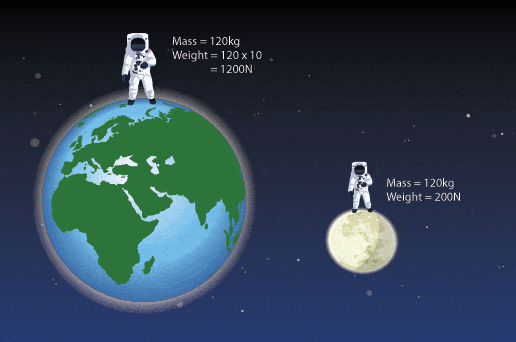
Which of the following will not be changed by gravity in different gravitational fields?
weight
force
mass
pounds

Which model has the greater or stronger gravitational attraction?
Model A
Model B
Both Model A and Model B (same gravity)


Rough surfaces have _________
greater friction
less friction
the same level of friction

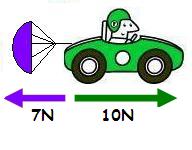
Calculate the net force of the object in the image shown.
20N Left
35N Left
5N Left
5N Right
Which of these is not one of Newton's Laws of Motion?
the law of inertia where objects keep doing what they're doing
momentum where objects keep doing what they're doing
force = mass x acceleration
every action has an equal and opposite reaction
A person not paying attention while skateboarding hits a rock. The skateboard stops, the person does not. Which law explains why the person did not stop?
1st Law: The Law of Inertia
2nd Law: F=ma
3rd Law: Every action has an equal and opposite reaction

Rockets are launched into space using jet propulsion. The exhaust coming out from the rocket pushes down on the ground. The ground pushes up on the rocket with an equal, but opposite force. Which law is being demonstrated by this?
1st Law: The Law of Inertia
2nd Law: F=ma
3rd Law: Every action has an equal and opposite reaction.

