
Font size
 Worksheets
Comprehension October 23, 2020
Total questions: 42
Worksheet time: 56mins
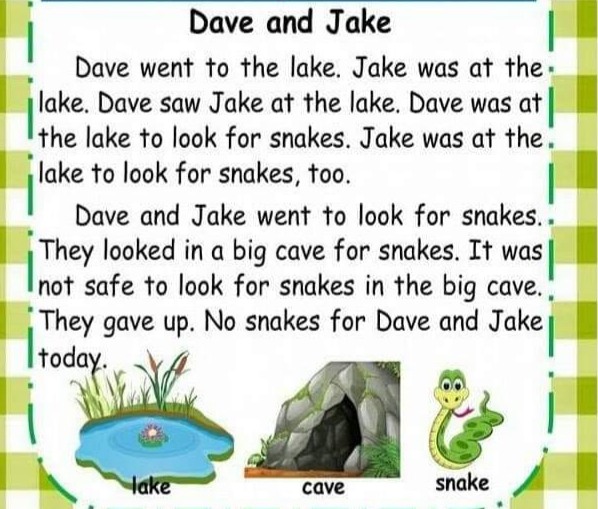
Who went to the lake?
David
Dave
Jack
Jade
Dave and Jake is looking for what?
snakes
snail
snack
star
Who are the characters in the story?
snake and cave
Dave and Jake
Jake and Cave
Dave and Lake
Where did they look to search for snakes?
cage
cave
lake
bake
How will you describe the cave?
small
green
blue
big
How many snakes they get?
3
2
1
0
Where did Dave see Jake?
at the snake
at the cave
at the lake
at the pool
Why did they stop searching for snakes?
because it is not safe
because they are hungry
because they are scared
because they love snakes
Which describes a snake?
it has wings
it has legs
it can jump
it can crawl
Lake is made up of what?
water
rock
soil
bubbles
When you go to sleep at night, you probably think that you are not doing much. Your body is in one place, your eyes are closed, and you don’t talk to people. But your body is doing more than you think it is! Scientists have used special, sophisticated machines to study the way people sleep. They have found that your brain is actually very busy when you sleep. There are several stages of sleep in a sleep cycle. You go through the sleep cycle multiple times each night. Your brain’s activity level is a little different in each stage. The final stage of the cycle is called rapid eye movement (REM) sleep. During REM, your eyes are moving even though you are asleep. That is how this stage got its name. Most of your dreams occur during REM sleep.
What is your brain doing while you are sleeping?
It is not able to work.
It is only a little busy.
It is also asleep.
It is very busy.
When you go to sleep at night, you probably think that you are not doing much. Your body is in one place, your eyes are closed, and you don’t talk to people. But your body is doing more than you think it is! Scientists have used special, sophisticated machines to study the way people sleep. They have found that your brain is actually very busy when you sleep. There are several stages of sleep in a sleep cycle. You go through the sleep cycle multiple times each night. Your brain’s activity level is a little different in each stage. The final stage of the cycle is called rapid eye movement (REM) sleep. During REM, your eyes are moving even though you are asleep. That is how this stage got its name. Most of your dreams occur during REM sleep.
What is true about people during REM sleep?
They dream.
They are awake.
They talk a lot.
They feel sick
When you go to sleep at night, you probably think that you are not doing much. Your body is in one place, your eyes are closed, and you don’t talk to people. But your body is doing more than you think it is! Scientists have used special, sophisticated machines to study the way people sleep. They have found that your brain is actually very busy when you sleep. There are several stages of sleep in a sleep cycle. You go through the sleep cycle multiple times each night. Your brain’s activity level is a little different in each stage. The final stage of the cycle is called rapid eye movement (REM) sleep. During REM, your eyes are moving even though you are asleep. That is how this stage got its name. Most of your dreams occur during REM sleep
How else could you say asleep?
Slept
Sleep
Sleeping
Sleepwalk
When you go to sleep at night, you probably think that you are not doing much. Your body is in one place, your eyes are closed, and you don’t talk to people. But your body is doing more than you think it is! Scientists have used special, sophisticated machines to study the way people sleep. They have found that your brain is actually very busy when you sleep. There are several stages of sleep in a sleep cycle. You go through the sleep cycle multiple times each night. Your brain’s activity level is a little different in each stage. The final stage of the cycle is called rapid eye movement (REM) sleep. During REM, your eyes are moving even though you are asleep. That is how this stage got its name. Most of your dreams occur during REM sleep
Which is a synonym for occur?
Run
Sleep
Happen
Wake
When you go to sleep at night, you probably think that you are not doing much. Your body is in one place, your eyes are closed, and you don’t talk to people. But your body is doing more than you think it is! Scientists have used special, sophisticated machines to study the way people sleep. They have found that your brain is actually very busy when you sleep. There are several stages of sleep in a sleep cycle. You go through the sleep cycle multiple times each night. Your brain’s activity level is a little different in each stage. The final stage of the cycle is called rapid eye movement (REM) sleep. During REM, your eyes are moving even though you are asleep. That is how this stage got its name. Most of your dreams occur during REM sleep
Which word describes the tone of this text?
Informative
Cautionary
Funny
Serious
Do you ever remember your dreams? You may not remember what you dream, but you probably dream every night—almost everyone does. Why do you have dreams? Scientists disagree on exactly why you dream. Some say it is your brain’s way of processing things. You learn a lot and have a lot of things happen to you, so while you sleep, your brain processes that information. Dreaming might be the way your brain makes sense of what happens to you. Some say that dreams are the way your brain solves problems. Suppose you are upset about something. Dreams may be a way for your brain to help you feel better. People may not agree on why you dream. But everyone agrees that dreaming is very important. You need to dream so that your brain is ready for the next day
What is this text mostly about?
How to fall asleep
Where to find a good bed
How many hours of sleep you need
Dreams
Do you ever remember your dreams? You may not remember what you dream, but you probably dream every night—almost everyone does. Why do you have dreams? Scientists disagree on exactly why you dream. Some say it is your brain’s way of processing things. You learn a lot and have a lot of things happen to you, so while you sleep, your brain processes that information. Dreaming might be the way your brain makes sense of what happens to you. Some say that dreams are the way your brain solves problems. Suppose you are upset about something. Dreams may be a way for your brain to help you feel better. People may not agree on why you dream. But everyone agrees that dreaming is very important. You need to dream so that your brain is ready for the next day
Which statement about dreams is not true?
Nobody knows exactly why people dream.
Only a few people dream.
Dreaming is very important.
There are several ideas about why people dream.
Do you ever remember your dreams? You may not remember what you dream, but you probably dream every night—almost everyone does. Why do you have dreams? Scientists disagree on exactly why you dream. Some say it is your brain’s way of processing things. You learn a lot and have a lot of things happen to you, so while you sleep, your brain processes that information. Dreaming might be the way your brain makes sense of what happens to you. Some say that dreams are the way your brain solves problems. Suppose you are upset about something. Dreams may be a way for your brain to help you feel better. People may not agree on why you dream. But everyone agrees that dreaming is very important. You need to dream so that your brain is ready for the next day
What does the prefix dis– in the word disagree mean?
Large
Not
Water
With
Do you ever remember your dreams? You may not remember what you dream, but you probably dream every night—almost everyone does. Why do you have dreams? Scientists disagree on exactly why you dream. Some say it is your brain’s way of processing things. You learn a lot and have a lot of things happen to you, so while you sleep, your brain processes that information. Dreaming might be the way your brain makes sense of what happens to you. Some say that dreams are the way your brain solves problems. Suppose you are upset about something. Dreams may be a way for your brain to help you feel better. People may not agree on why you dream. But everyone agrees that dreaming is very important. You need to dream so that your brain is ready for the next day
Which is an antonym of remember?
Sleep
Talk
Forget
Recall
Do you ever remember your dreams? You may not remember what you dream, but you probably dream every night—almost everyone does. Why do you have dreams? Scientists disagree on exactly why you dream. Some say it is your brain’s way of processing things. You learn a lot and have a lot of things happen to you, so while you sleep, your brain processes that information. Dreaming might be the way your brain makes sense of what happens to you. Some say that dreams are the way your brain solves problems. Suppose you are upset about something. Dreams may be a way for your brain to help you feel better. People may not agree on why you dream. But everyone agrees that dreaming is very important. You need to dream so that your brain is ready for the next day
What do we process in the same way we process information?
Problems
Socks
Products
Paper
Sleep is a very important part of staying healthy. When you are asleep, your brain uses that time to take care of itself. Some scientists think your brain sorts things out when you sleep and that it also replaces chemicals it needs. The rest of your body needs sleep, too. While you are sleeping, your body stays busy by using that time to heal itself. It also uses that time to build up your immune system, which is the system your body uses to fight off germs. Your body also uses your sleep time to build up muscles, bones, and tissues so that you can grow. Sleep helps you think clearly and stay in a better mood. That helps you to cope better with a busy day
What would be a good title for this text?
How the Brain Helps You Learn
Why Do We Sleep?
Build Up Your Muscles!
How Does the Immune System Work?
Sleep is a very important part of staying healthy. When you are asleep, your brain uses that time to take care of itself. Some scientists think your brain sorts things out when you sleep and that it also replaces chemicals it needs. The rest of your body needs sleep, too. While you are sleeping, your body stays busy by using that time to heal itself. It also uses that time to build up your immune system, which is the system your body uses to fight off germs. Your body also uses your sleep time to build up muscles, bones, and tissues so that you can grow. Sleep helps you think clearly and stay in a better mood. That helps you to cope better with a busy day.
Which of these is not something your body does when you are asleep?
Heals itself
Builds up muscles, bones, and tissues
Helps you feel full
Builds up your immune system
Sleep is a very important part of staying healthy. When you are asleep, your brain uses that time to take care of itself. Some scientists think your brain sorts things out when you sleep and that it also replaces chemicals it needs. The rest of your body needs sleep, too. While you are sleeping, your body stays busy by using that time to heal itself. It also uses that time to build up your immune system, which is the system your body uses to fight off germs. Your body also uses your sleep time to build up muscles, bones, and tissues so that you can grow. Sleep helps you think clearly and stay in a better mood. That helps you to cope better with a busy day.
Which system helps your body fight off germs?
Tissue
Chemical
Sleep
Immune
Sleep is a very important part of staying healthy. When you are asleep, your brain uses that time to take care of itself. Some scientists think your brain sorts things out when you sleep and that it also replaces chemicals it needs. The rest of your body needs sleep, too. While you are sleeping, your body stays busy by using that time to heal itself. It also uses that time to build up your immune system, which is the system your body uses to fight off germs. Your body also uses your sleep time to build up muscles, bones, and tissues so that you can grow. Sleep helps you think clearly and stay in a better mood. That helps you to cope better with a busy day.
Which is a synonym for busy?
Active
Asleep
Resting
Absent
Sleep is a very important part of staying healthy. When you are asleep, your brain uses that time to take care of itself. Some scientists think your brain sorts things out when you sleep and that it also replaces chemicals it needs. The rest of your body needs sleep, too. While you are sleeping, your body stays busy by using that time to heal itself. It also uses that time to build up your immune system, which is the system your body uses to fight off germs. Your body also uses your sleep time to build up muscles, bones, and tissues so that you can grow. Sleep helps you think clearly and stay in a better mood. That helps you to cope better with a busy day.
What does the phrase cope with mean?
Manage
Avoid
Fear
Desire
How many hours of sleep do you get each night? What do you do to get sleepy? Write about your bedtime routine.
Direction: Read the text and then answer the questions
Ever since he was six years old, Nick had wanted to get a puppy. His parents always refused. They said he wasn’t capable of taking care of a puppy. “You have no idea how much work a puppy is,” Dad said. “You would have to housebreak the puppy, train the puppy to obey you, and groom it, too.”
“And then there’s taking the puppy to the vet, playing with it, and feeding it,” Mom added. “It’s not that I’m against having a puppy. But a puppy takes up a lot of time.”
Nick couldn’t think of a way that he could convince his parents that he was ready for a puppy. Then, he got an idea. “If I volunteer at the animal shelter,” he thought, “I’ll bet Mom and Dad will see that I’m ready to take care of a puppy!”
Which word tells a reader most about the text while previewing it?
obey
groom
idea
puppy
What is the problem in the text?
Nick’s parents think that he is not capable of taking care of a puppy
Nick is allergic to puppies.
Nick’s parents think that puppies are not a lot of work.
Nick’s parents think that the family should get a puppy right away.
A person who volunteers is someone who
studies for tests.
does no work at all.
gets a raise.
does work without being paid.
Nick’s parents say he isn’t capable of taking care of a puppy. Which word or phrase means capable?
interested
angry about
afraid of
able to
What does the phrase have no idea mean?
do not understand
can’t think
ran out of ideas
have an active imagination
Nick wanted a puppy, so he decided to become a volunteer at the animal shelter. He was hoping to convince his parents that he was ready to take care of a puppy. He volunteered at the shelter twice each week, on Tuesdays after school and on Saturdays.
While he was there, Nick did several things. He walked the dogs and washed and brushed them. Grooming the long-haired dogs took a long time! He cleaned up the dogs’ kennels, too. He also played with the puppies to help get them used to people. Sometimes he gave them baths as well. Once in a while, Nick spent time with the kittens and cats, but he preferred working with the dogs. There was always plenty to do at the shelter, so Nick was never bored.
- What does the first sentence tell about this text?
This text is about volunteering at an animal shelter.
This text is about taking shelter during a storm.
This text is about adopting an animal.
This text is about different animals.
What detail does the author include to explain why Nick plays with the puppies?
to help them learn to eat and drink
so he can stop being afraid of dogs
to help them get used to people
so he can learn about the different breeds of dog
To which word can the suffix –ing be added?
also
dogs
care
plenty
What is a kennel?
place for animals
kind of food
piece of clothing
helper
Which word means once in a while?
often
never
occasionally
daily
Which word means once in a while?
often
never
occasionally
daily
Nick volunteered at the animal shelter for three months. He learned a great deal about raising puppies and training them. Every time he learned something new, he practiced it. He also told his parents about what he was learning. He wanted to persuade them that he could be trusted with a puppy of his own. One afternoon, Dad picked Nick up from volunteering and asked him how the day went.
“Oh, it went great,” Nick answered enthusiastically. “They even let me help introduce the dogs to people who want to adopt them!”
“That’s terrific!” Dad answered with a grin. “I’m so glad you’re getting this experience. You’ll need it for our new puppy!”
“We’re getting a puppy?” Nick practically shouted. “That’s awesome! I can’t wait!”
Which question would help readers monitor their reading and understand the text?
Does Nick have a sister?
What do cats eat?
Will Nick get to have a puppy of his own?
What is the weather outside?
Why is Nick so interested in telling his parents what he is learning?
He does not want to volunteer at the shelter.
He wants to stay home from school.
He wants to persuade them to volunteer at the shelter.
He wants to persuade them that he can be trusted with a puppy.
Which word from the text makes a new word by adding the prefix re–?
grin
about
glad
told
Which is a synonym for convince?
practice
volunteer
trust
persuade
Which word helps to explain Nick’s behavior and mood at the end of the text?
learned
persuade
enthusiastic
help

