Wayground logo

Free Printable Worksheets

Font size

S
M
L
XL
Worksheets

SSEF1 Fundamentals Summative Assessment

Total questions: 25

Worksheet time: 26mins

Name
Class
Date
1.
In economics, rational decisions occur when
                                                             SSEF2b
a)
suppliers lower their prices to increase demand
b)
marginal benefits of an action equal or exceed the marginal costs
c)
a budget is used for spending and saving decisions
d)
command economies answer the three basic questions
2.
Which is a human resource that Ms. Johnson could use for her art gallery?
SSEF1b
a)
Light fixtures to help display the artwork.
b)
A security system to protect the artwork.
c)
Knowledge of trends in modern art.
d)
A series of paintings by a prominent local artist.
3.
Which is a fundamental questions every society must answer?
SSEF1a
a)
What goods and services are to be produced?
b)
How are the goods and services to be produced?
c)
Who will get the goods and services that are produced?
d)
All of the above
4.
A and B both wash cars and change oil. Currently, each man washes and changes oil by himself, but the process takes lots of time. they would MOST LIKELY improve their efficiency if
SSEF2b
a)
A & B wash a car and chang eoil together
b)
A washes car while B changes oil
c)
A washes B car while B washes A's car
d)
A and B reduce the number of cars they wash
5.
Susan offers to trade her old iPod for Claudia's cell phone and Claudia accepts. Assuming both products work perfectly, we can conclude that
SSEF3b
a)
Claudia is now happier than Susan.
b)
neither party has gained because the exchange was fraudulent
c)
both people have gained because the exchange was voluntary and non-fraudulent
d)
Susan places the same value on cell phones as she does for iPods
6.
Which provides the greatest incentive for entrepreneurs to take risks?
SSEF1c
a)
prices
b)
inflation
c)
profits
d)
interest
7.
A production possibilities curve shows
SSEF6d
a)
the technological changes that improve production
b)
choices a person makes between items
c)
all of society’s resources
d)
the combination of goods that can be produced with a set of resources
8.
If the producer in the PPC seen here is producing at point X, moving to point Z would mean an opportunity cost of
SSEF1d
a)
3 pounds of cheese
b)
7 pounds of cheese
c)
10 gallons of milk
d)
20 gallons of milk
9.

Scarcity means:

a)

Too much of something you wanted

b)

The exact amount of something you wanted

c)

Not enough of something you wanted

10.

What is an economic want?

a)

Things people need in order to survive.

b)

Things people would like to have.

c)

Things people don't want anymore.

11.

If 3 people want a candy bar, is there a scarcity?

a)

Yes, there is a scarcity.

b)

No, there is not a scarcity.

12.

If 2 people want a soccer ball, is there a scarcity?

a)

Yes, there is a scarcity.

b)

No, there is not a scarcity.

13.

If 4 people want a bike, is there a scarcity?

a)

Yes, there is a scarcity.

b)

No, there is not a scarcity.

14.
What is the fundamental problem of every society?
a)
labor costs
b)
scarcity
c)
economic interdependence
d)
market fluctuation
15.
True or False: Everything that is scarce requires a choice, and these choices always involve a tradeoff.
a)
True
b)
False
16.

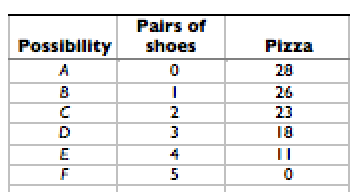
The table shows the production possibilities for a country. Based on the table, which of the following production combinations is a possibility?

a)

28 pizzas and 5 pairs of shoes

b)

3 pairs of shoes and 23 pizzas

c)

2 pairs of shoes and 20 pizzas

d)

4 pairs of shoes and 15 pizzas

17.
Based on the table, if the country is currently producing at point B and decides to produce at point C, the opportunity cost for the additional pair of shoes is ____ pizzas.   
a)
26
b)
23
c)
3
d)
2
18.
What is the production possibilities curve?
a)
a graph that shows how much an economy can produce between 2 goods
b)
how much money something is
c)
the opportunity one has to give up in order to gain something else
d)
land, labor, capital, entrepreneurs
19.
What is opportunity cost?
a)
a graph that shows how much an economy can produce between 2 goods
b)
how much money something is
c)
the opportunity one has to give up in order to gain something else
d)
land, labor, capital, entrepreneurs
20.
Land, Labor, Capital, and Entrepreneurship 
a)
Diversification
b)
Deductions
c)
Portfolio
d)
Factors of Production 
21.
Movement down the PPF curve indicates that the opportunity cost of more capital goods is producing more consumer goods
a)
True
b)
False
22.
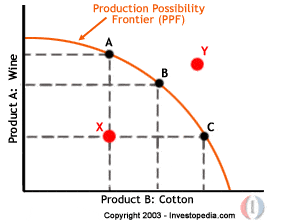
What do points inside the PPF indicate?
a)
The combination of goods that employ goods efficiently
b)
The combination of goods that employ resources fully
c)
The combination of goods that do not employ resources fully
23.
An increase in the labor force would cause the PPF to 
a)
Shift inward
b)
Shift outward
c)
Do nothing
d)
Turn into a straight line
24.
What does point Y represent on the PPC?
a)
Efficiency
b)
Unattainable / impossible
c)
Inefficency
d)
Nothing
25.
What does point B represent?
a)
Production at greater than the country's minimum potential
b)
Production is less than the country's minimum potential
c)
Productive inefficiency
d)
Productive efficiency