
Font size
 Worksheets
Geometry Honors Chapter 2 Review
Total questions: 49
Worksheet time: 51mins

Conclusion: Pepito will be hungry
The previous statements are examples of __ ?
Which is a counterexample to the following statement?
If an angle is obtuse, then it is 125° .
90°
57°
160°
180°
What is a counterexample?
A generalism that cannot be applied to a specific case
A specific case that help to prove a conjecture
A general case that is supported by specific examples
A specific case for which a conjecture is false
Given the conditional;
"If Ty'Shawn is late then he will get a tardy"
What is the inverse?
If Ty'Shawn is on time, then we won't get a tardy.
If Ty'Shawn gets a tardy, then he is late.
If Ty'Shawn is late then he won't get a tardy.
If Ty'Shawn doesn't get a tardy, then he is on time.
Given the conditional;
"If our class earns ten trucks, then we get a treat."
What is the contrapositive?
If our class doesn't earn ten trucks then we don't get a treat.
If our class doesn't get a treat, then we didn't earn ten trucks.
If out class earns ten trucks then we don't get a treat.
Trucks!
Given the conditional;
"If it is a duck then it has a beak."
Which is the converse?
If isn't not a duck, then it doesn't have a beak.
If it is a duck, then it quacks.
If it doesn't have a beak, then it's not a duck.
If it has a beak, then it is a duck.
Given the conditional "If I study, then I will do well on the quiz" and what is the statement "If I don't study then I won't do well on the quiz"?
Converse
Inverse
Contrapositive
Contrainverse

What is the name of the following format of logical argument?
If A, then B.
If B, then C
Therefore, if A then C.
Modus Ponens
Modus Tollens
Law of Syllogism
Disjunctive Syllogism
What is the name of the following format of logical argument?
Either A or B.
Not B.
Therefore A.
Modus Ponens
Modus Tollens
Law of Syllogism
Disjunctive Inference
What is the name of the following format of logical argument?
Either A or B.
Not A.
Therefore B.
Modus Ponens
Modus Tollens
Law of Syllogism
Disjunctive Inference
What is the name of the following format of logical argument?
If A, then B.
A.
Therefore B.
Modus Ponens (Law of Detachment)
Modus Tollens
Law of Syllogism
Disjunctive Syllogism
The first premise of an argument is "If your leg is broken, then you cannot walk." Which of the following second premises would allow you to make a valid conclusion? (Check all that apply.)
You cannot walk.
You can walk.
Your leg is broken.
Your leg is not broken.
Choose the correct conclusion, or NVC for "No valid conclusion."
All dogs eat canned dog food or dog chow.
Milton the dog eats canned dog food.
Therefore, Milton eats dog chow.
Therefore, Milton does not eat dog chow.
NVC
Check the statements that are logically equivalent to "~X implies W".
X implies ~W
~W implies X
W implies ~X
If ~X then W.
~X if and only if W.
The two premises of an argument are given. Select the correct conclusion and reason.
Either J or K.
K.
~J by Law of Disjunctive Syllogism
J by Law of Disjunctive Syllogism
~J by Modus Tollens
J by Modus Ponens
NVC (No Valid Conclusion)
The two premises of an argument are given. Select the correct conclusion and reason.
H then K.
not H.
~K by Law of Disjunctive Syllogism
~K by Law of Detachment
~K by Modus Tollens
K by Modus Ponens
NVC (No Valid Conclusion)
6c + 8b = 2(3c + 4b)
If ∠A≅∠B and ∠B≅∠C, then ∠A≅∠C
If PQ = RS then RS = PQ
∠B≅∠B
DE=ED
Transitive Property
Symmetric Property
Reflexive Property

GH + HI = GI is an example of which property
Addition Property
Transitive Property
Sum of the Parts = Whole (Segment Addition Property)
Multiplication Property
Name the property described
If CD = 4, then CD + 12 = 4 + 12
Addition Property
Subtraction Property
Substitution Property
Division Property

What kind of angles are these? (Choose all that apply)
complementary
supplementary
right
linear pair

What is our reason for knowing that these angles are supplementary?
They add up to 180 degrees
Linear Pair Theorem
Definition of a Linear Pair
Definition of Supplementary Angles

Find the m∠2 and state the reason
56, linear pair theorem
124, vertical angle theorem
56, definition of supplementary angles
124, definition of vertical angles
What are supplementary angles?
Angles that add up to 180°
Angles that add up to 90°
Angles that are equal to each other
Angles that are opposite of each other when lines intersect
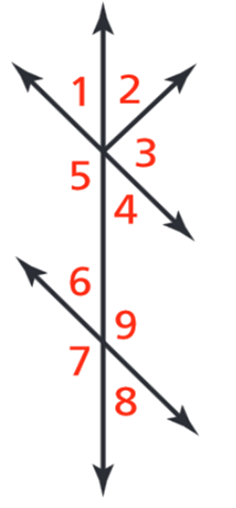
Which angle is a linear pair with ∠1 ?
∠2
∠3
∠4
∠5
∠6
Which angle is a vertical angle to with ∠7 ?
∠1
∠5
∠3
∠6
∠9
Which property, definition, postulate, or theorem justifies the following statement?
If ∠A and ∠B form a linear pair, then ∠A and ∠B are supplementary.
Linear Pair Theorem
Definition of Supplementary Angles
Congruent Supplements Theorem
Definition of Congruence
Which property, definition, postulate, or theorem justifies the following statement?
If ∠A is a right angle and ∠B is a right angle, then ∠A and ∠B are congruent.
Linear Pair Theorem
Definition of Supplementary Angles
Right Angle Theorem
Definition of Congruence

