
 Worksheets
DP014_Topic 6 : Circular Motion
Total questions: 25
Worksheet time: 50mins

Centripetal force is an acceleration of an object moving in circular path whose direction is _________________________of the circular path and whose magnitude is equal to the square of the speed divided by the radius.
towards the tangent
towards the centre
towards the minimum point
towards the maximum point
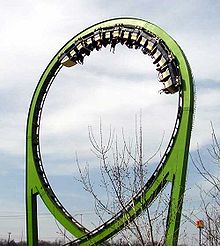
Where is the net force when the rollercoaster is at the top of the loop?
Towards the sky
Towards the Right
Towards the left
Towards the center of the circle
In uniform circular motion, the magnitude of the _______________________of an object is constant but the __________ is continually changing.
speed, acceleration
speed, direction
acceleration, speed
acceleration, velocity
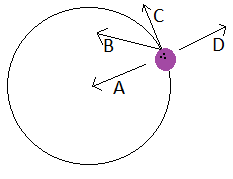
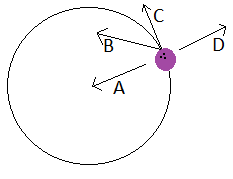
Why does an object experiencing uniform circular motion have an acceleration?
because it ir changing speed
because it is changing direction
because it is moving n a straight line
because it has mass

In this diagram, what do the red arrows represent?
the acceleration vector
the velocity vector
the centripetal force vector
the force of gravity

The _______________________ supplies the centripetal force requirement for the car to move in a horizontal circle. Without it, the car would turn its wheels but would not move in a circle (as is the case on an icy surface).
friction force
centrifugal force
normal force
applied force
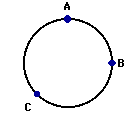

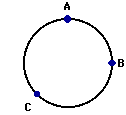

What is the direction of the velocity at point A, if the ball is revolving clockwise?
up
right
down
left

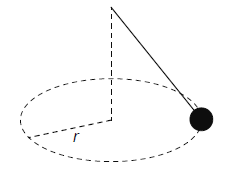
The mass at the end of a pendulum is made to move in a horizontal circle of radius r at constant speed. The magnitude of the net force on the mass is F.
What is the direction of F during half a revolution?
towards the centre of the circle
away from the centre of the circle
along a tangent to the circle
in a circle
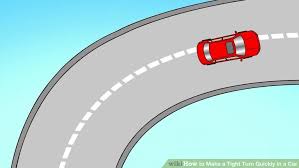
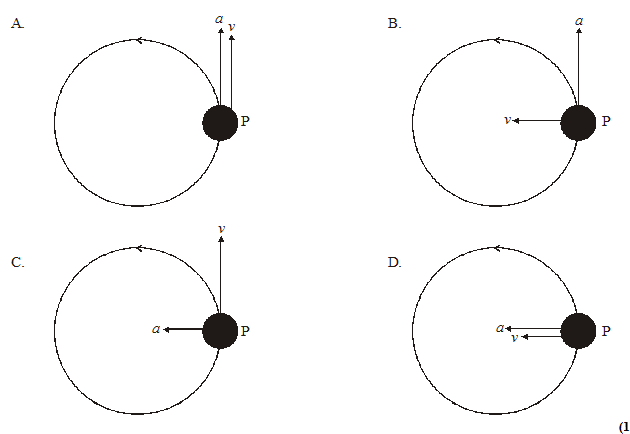
A 10kg car travels at a constant speed of 20.0 m/s around a horizontal circular track. Which diagram correctly represent the direction of the car's velocity (v) and the direction of the centripetal force (Fc) acting on the car at a particular moment?


Centripetal acceleration is ...
Acceleration toward the center of a curved or circular path
Acceleration toward the outside of a circle
Vertical motion instead of horizontal motion
along a tangent to the circle
What type of acceleration does an object moving with constant speed in a circular path experience?
free fall
constant acceleration
linear acceleration
centripetal acceleration
Is it possible for an object moving with a constant speed to accelerate? Explain.
No, if the speed is constant then the acceleration is equal to zero.
No, an object can accelerate only if there is a net force acting on it.
Yes, although the speed is constant, the direction of the velocity can be changing.
Yes, if an object is moving it can experience acceleration

