
NEW
Font size
 Worksheets
Oral Communication in Context First Summative Test
Total questions: 20
Worksheet time: 24mins
Which of the following explains difference of the Linear Communication Model from the other communication model?
Aliyah didn’t get a feedback.
Elisha uses an interpreter to decode the message.
Ben speaks to his friend about different topics until the event ends.
Avrielle uses a transmitter like a radio to transmit the message.
Which of the following communication situations may NOT be represented by the transactional model of communication?
The interviewer and the interviewee are actively exchanging information and evaluating each other's communication skills and qualifications.
A one-way broadcast, such as a television commercial or a radio announcement. The sender transmits a message to a large, passive audience without immediate feedback.
A face-to-face conversation, where both parties are actively involved in sending and receiving messages, and influencing each other's communication.
A negotiation, where both parties are working towards a common goal and exchanging information to reach an agreement.
The sender sends an instant message to the receiver, then the original sender has to wait for the instant message from the original receiver to react. What is the communication model that is best applied to the given situation and why?
Interactive model, there is a feedback but it is not simultaneous.
Transactional model, because both parties becomes a sender-receiver.
Shannon and Weaver, because like a telephone, they used a medium to transmit the message.
Linear model, because it consists of the sender encoding a message and channeling it to the receiver.
Which of the following explains difference of the Interactive Model from the other communication model?
Aliyah didn’t get a feedback.
Elisha uses an interpreter to decode the message.
Avrielle uses a transmitter like a phone or radio to transmit the message.
Ben sends a message and wait for the feedback before they provide a new message.
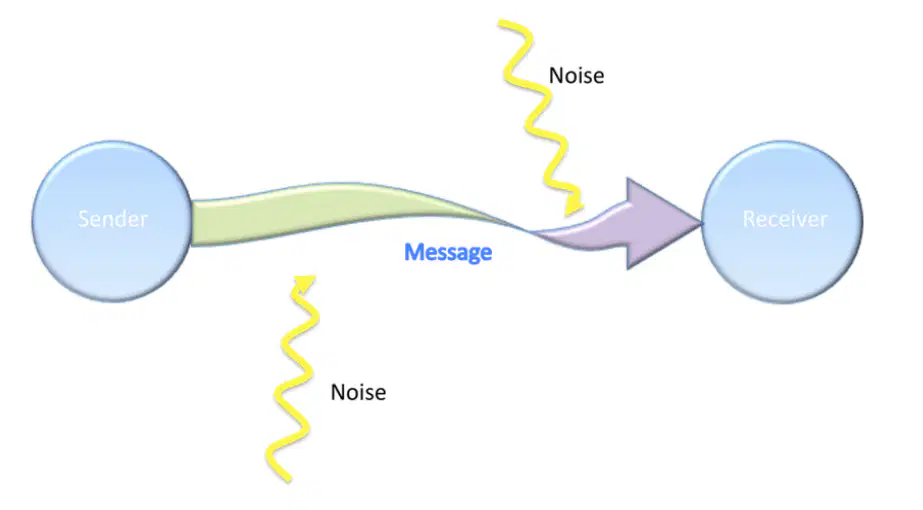
What is the communication model represented by the illustration?
Linear
Transactional
Interactive
Educational
According to the Transactional model of communication, which of the following influences the understanding and interpretation of the message?
Nothing
Their experiences, values, and social background
The environment
The channel through which they transmit messages
Which of the following is a disadvantage of Transactional model of communication?
It is very complex.
There can only be two sources
Communicating feedback is for mass communication only.
Message sent and received might be interpreted differently than intended
What is communication model is considered to be a one-way communication?
Linear
Interactive
Transactional
Barlund’s
Model
What noise is caused by external factors that disrupt the communication process?
Physical
Psychological
Physiological
Semantic
Talia is running a website in which she posts her artwork and literary pieces. Through her site, she is able to share her thoughts and ideas with others. She also put up a comment box on her site so she can get a feedback. What is communication model observed?
Linear Communication Model
Schramm’s Model of Communication
Interactive Communication Model
Transactional Communication Model
Which of the following is NOT a semantic noise?
Loud background noises
Using jargon or technical terms that are unfamiliar to the receiver
Cultural differences in language or interpretation
Misunderstandings due to vague or ambiguous language
The new employee speaks in a soft whisper when responding to his new boss. What is the type of context observed in the given situation?
Physical Context
Psychological Context
Cultural Context
Social Context
What is the correct arrangement for the following events in the order that they would occur in the process of communication?
1. Aliyah would call her friend
2. Aliyah wants to ask her friend about their assignment
3. Aliyah friend remembered the assignment and told her what was it
4. Aliyah friend got her message and try to remember what was the assignment
2-4-3-1
2-4-1-3
2-3-1-4
2-1-4-3
Mich messaged Lyn to ask where will they meet and Lyn said that they would meet in shell expressway. The next day, instead of meeting up in Shell NLEX, Mich went to shell SLEX. What is the problem in this situation?
inappropriate channel used
failure to provide feedback
errors in decoding the message
encoding the message errors
What process of communication is observed in the example situation? Justin and Rachel were supposed to talk about their problem but they failed to do that because of the loud music in party.
Decoding
Encoding
Feedback
Noise/Barrier
What is the kind of noise observed when you are unable to concentrate on what your mother is saying because you are upset about something that happened with a friend?
Physical noise
Physiological noise
Psychological noise
Semantic noise
Which of the following is an example of a Psychological noise?
Preconceived ideas
Jargons used by the doctors
Talking too slow or too fast
Loud music in the neighborhood
What is the kind of noise that may result from individuals’ personal discomfort?
Physical noise
Physiological noise
Psychological noise
Semantic noise
Which of the following is TRUE about communication?
It is not possible to communicate without using words.
The receiver of a message may choose not to respond
Communication is a process that involves several steps.
Communication may only be done with the use of verbal cues.
What is the process by which the receiver interprets the symbols used by the source of the message by converting them into concepts and ideas?
Decoding
Encoding
Sharing
Listing

