wayground logo

Free Printable Worksheets

NEW

Font size

S
M
L
XL
Worksheets

Unit 3 - Taxonomy & Intro to Animals - PRACTICE

Total questions: 61

Worksheet time: 2hrs 39mins

Name
Class
Date
1.

Which list of characteristics describes organisms classified as animals?

a)

autotrophic, multicellular, prokaryotic

b)

multicellular eukaryotic, heterotrophic

c)

unicellular, eukaryotic, heterotrophic

d)

multicellular, eukaryotic, autotrophic

2.
Cell with a nucleus, DNA is found in the nucleus of this cell. 
a)
Prokaryotic 
b)
Eukaryotic
c)
Unicellular
d)
Multicellular 
3.
Which organisms are most closely related?
a)
Equus caballas (Horse) & Equus burchellii (Zebra)
b)
Cyanea artica (Jellyfish) &
Ctenodiscus crispatus (Mud Starfish)
c)
Naja naja (cobra) & Glycine max (soya bean)
d)
Ophiocomina nigra (black brittle star) & Brassica nigra (black mustard)
4.
The science of describing, classifying, and naming living things is called:
a)
Geology
b)
Biology
c)
Taxonomy
d)
Chemistry
5.
The scientific name for an organism is made from the:
a)
class and family name
b)
genus and species name
c)
domain and kingdom name
d)
kingdom and phylum name
6.
The 8 levels of classification, broadest to most specific.
a)
Domain, Genus, Family, Order, Class, Phylum, Kingdom, Species
b)
Domain, Species, Kingdom, Genus, Phylum, Family, Class, Order
c)
Domain, Kingdom, Phylum, Class, Order, Family, Genus, Species
d)
Order, Kingdom, Species, Domain, Phylum, Family, Class, Genus
7.
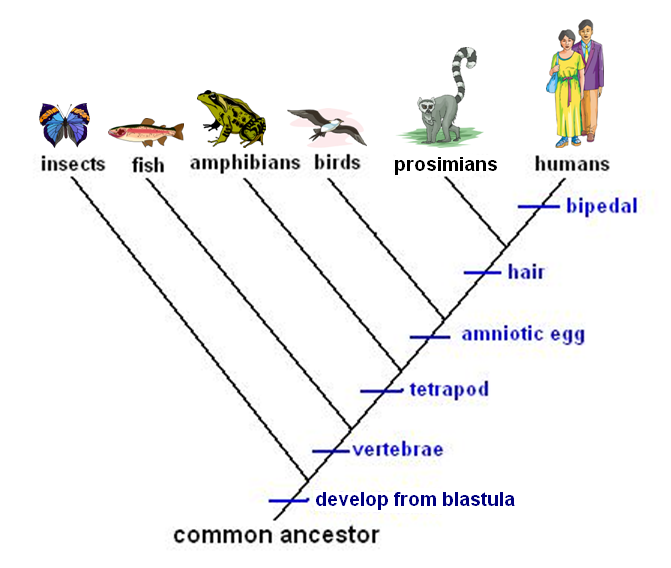
Which organisms pictured on the cladogram have hair?
a)
prosimians only
b)
prosimians and humans
c)
humans only
d)
prosimians and birds
8.
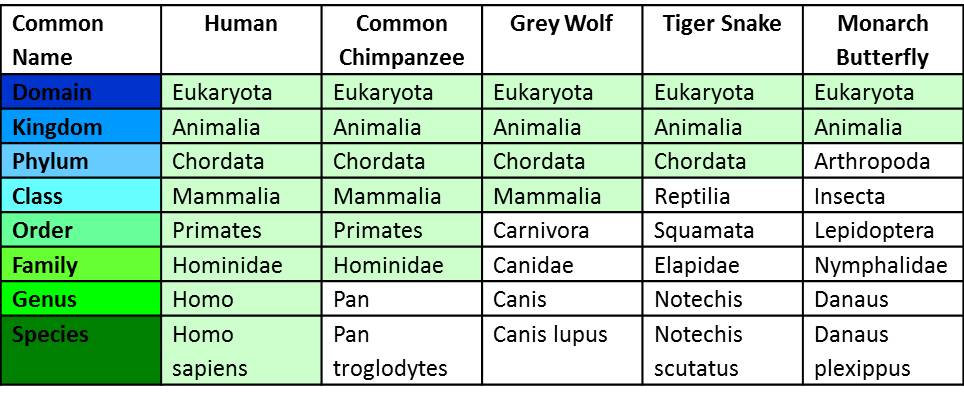
Which organism in the table is least closely related to the chimpanzee?
a)
human
b)
grey wolf
c)
tiger snake
d)
monarch butterfly
9.
Which organism in the table shown is most closely related to the common dolphin?
a)
human
b)
killer whale
c)
giant kelp
d)
bat star
10.
An illustration and a dichotomous key are given. What is the correct classification for this organism?
a)
Class Insecta
b)
Order Amblygygi
c)
Order Araneae
d)
Order Scorpiones
11.

Which 2 organisms would be able to reproduce and produce fertile offspring?

a)

2 organisms in the same class

b)

2 organisms in the same family

c)

2 organisms in the same genus

d)

2 organisms in the same species

12.
A heterotroph means?
a)
feeds itself
b)
feeds on other organisms
c)
2 word name
d)
8 legged
13.
Kingdom, Phylum, Class, _______
a)
Family 
b)
Order
c)
Genus 
d)
Species
14.
The taxon with the largest amount of organisms grouped together...
a)
Species
b)
Phylum
c)
Kingdom
d)
Domain
15.
Which of the following is not true when comparing scientific and common names?
a)
Scientific names vary from place to place.
b)
Common names can vary from place to place.
c)
Scientific names are written in Latin.
d)
Common names can inaccurately describe the organism and be confusing.
16.
Which group(s) of organisms do not have vertebrae?
a)
lampreys and lancelets
b)
lampreys and tuna
c)
lancelets only
d)
salamanders, tuna, and lampreys
17.

Organisms in this smallest taxonomic group share many characteristics.

a)

domain

b)

kingdom

c)

species

d)

class

18.
Who developed the method of classification in the 18th century?
a)
Aristotle
b)
Plato
c)
Linnaeus
d)
Darwin
19.
List the names of classification in order (Letters are given)
a)
K P C F O G S
b)
K F O C G S
c)
K P C O F G S
d)
S G F O C P K
20.
Which taxon is broader (more organisms included)?
a)
Phylum
b)
Family
c)
Order
d)
Class
21.
Which of the following organisms are LEAST closely related?
a)
organisms that share a domain
b)
organisms that share a family 
c)
organisms that share a genus 
d)
organisms that share a species 
22.
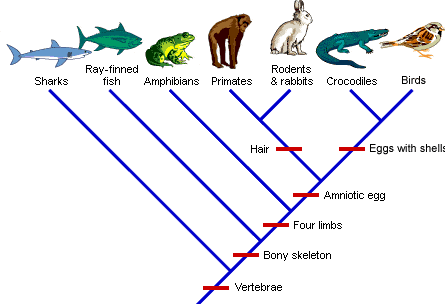
What traits do crocodiles and amphibians have in common?
a)
Vertebrae and hair
b)
Four limbs and amniotic eggs
c)
Bony skeleton and vertebrae
d)
Amniotic eggs and hair
23.
Most recently evolved trait?
a)
Amniotic egg
b)
Walking legs
c)
Jaws
d)
Hair
24.

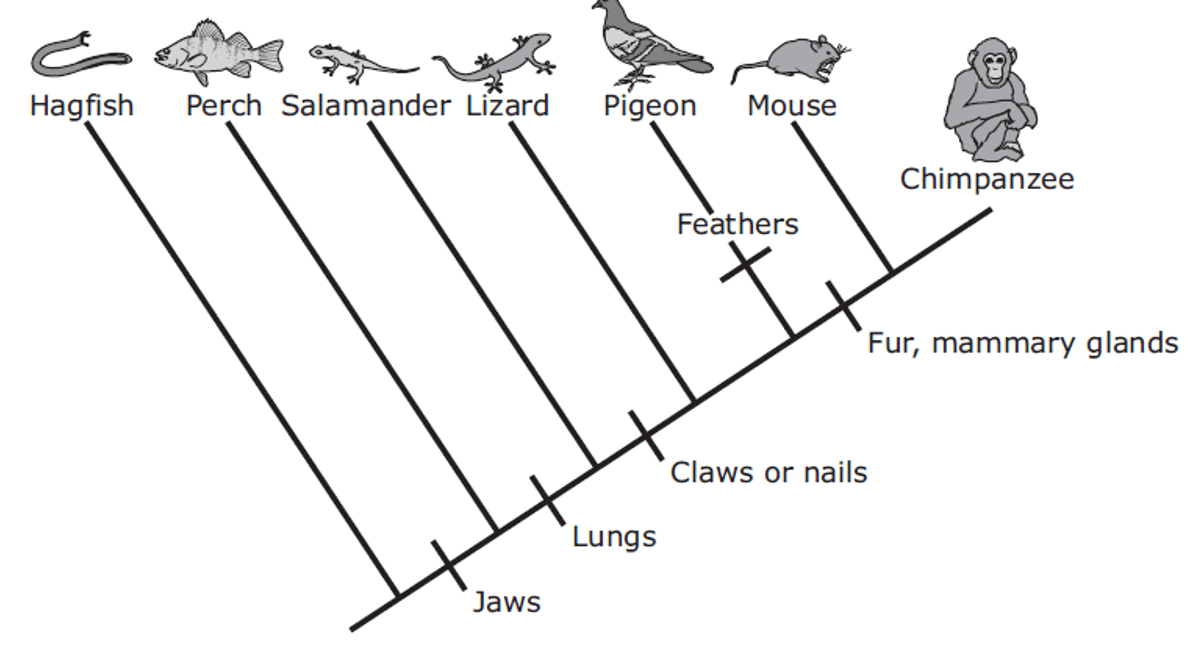
All the animals to the right of the salamander would have the common characteristic of...

a)

Fur

b)

Claws or nails

c)

Lungs

d)

Jaws

25.

According to this image, which two domains of life are most related?

a)

Bacteria & Archaea

b)

Archaea & Eukarya

c)

Eukarya & Bacteria

26.

Which classifies and names organisms based on their physical characteristics?

a)

Genetic material

b)

Linnaean taxonomy

c)

Cladograms

d)

Molecular clocks

27.

Which gets the “final say” in our modern classification system?

a)

DNA

b)

Physical traits

c)

common ancestory

d)

binomial nomenclature

28.

A group of organisms in a classification system

a)

claudistics

b)

taxon

c)

phylongeny

d)

cladogram

29.

Trait that differs in structure or function from their ancestors in a group of species; used in

constructing cladograms

a)

derived character

b)

genus

c)

node

d)

appendage

30.
Which trait do only humans have, according to the cladogram?
a)
jaws
b)
mammary glands & hair
c)
terrestrial during all life stages
d)
opposable thumbs
31.
According to this cladogram, birds are LEAST related to: 
a)
Amphibians
b)
Sharks
c)
Ray Finned Fish
d)
Crocodiles
32.

Which phrase best describes the Linnaean classification system?

a)

The taxa are interchangeable

b)

There is only one kingdom

c)

Each level includes the more specific levels below.

d)

Each genus contains one species.

33.

One limitation of the Linnaean classification system is that it

a)

organizes organisms into groups.

b)

allows scientists to discuss organisms.

c)

does not use organisms’ common names.

d)

is based on physical characteristics alone.

34.

The animals have what kind of symmetry?

a)

Bilateral symmetry

b)

Radial symmetry

c)

No symmetry

d)

Asymmetry

35.

Plants and animals get energy in different ways. Plants are ____ and animals are _____.

a)

heterotrophs / autotrophs

b)

solartrophs / carnivores

c)

autotrophs / heterotrophs

d)

cannibals / vegan

36.

Which animal shows radial symmetry?

a)
b)
c)
d)
37.

Which of the following organisms belong to phylum echinoderm?

a)

Snails, octopus, squid, and slugs

b)

Insects, crustaceans, and spiders

c)

Jelly fish, corals, and sea anemones

d)

Brittle stars, sea cucumbers, sea stars, and sea urchins

38.
Which of the following is/are true of animals?
a)
They are multicellular.
b)
They are eukaryotic.
c)
They are heterotrophs.
d)
All choices are correct.
39.
What type of symmetry is pictured?
a)
bilateral symmetry
b)
radial symmetry
c)
asymmetry
d)
cellular respiration
40.
Organisms, like sponges, lacking body tissues and body symmetry belong to which of the following phyla?
a)
Cnidaria
b)
Mollusca
c)
Nematoda
d)
Porifera
41.
Mollusks include which of the following?
a)
Octopus, Squid, Slugs, Snails
b)
Fish, Squid, Jellyfish, Sea cucumbers
c)
Sea stars, Sea cucumbers, sea urchins
d)
Oysters, Fish, Whales, Sponges
42.

This phylum is made of segmented worms

a)

Annelida

b)

Mollusca

c)

Arthopoda

43.

Which Phylum?

a)

Echinodermata

b)

Mollusca

c)

Cnidaria

44.

Which phylum includes hookworms, pinworms, and heart worms? They are also known as roundworms, and many are parasites.

a)

Platyhelminthes

b)

Nematoda

c)

Annelida

45.

What phyla contains earthworms?

a)

Invertebrates

b)

Mollusca

c)

Anthropoda

d)

Annelida

46.

Birds, Reptiles, Mammals, Amphibians and Fish all belong to which phylum?

a)

Annelida

b)

Chordata

c)

Nematoda

d)

Arthropoda

47.

Which phylum?

a)

Cnidaria

b)

Mollussca

c)

Echinodermata

48.
Mollusks include which of the following?
a)
Octopus, Squid, Slugs, Snails
b)
Fish, Squid, Jellyfish, Sea cucumbers
c)
Sea stars, Sea cucumbers, sea urchins
d)
Oysters, Fish, Whales, Sponges
49.
Which of the following are examples of echinoderms?
a)
Jellyfish, Hydrozoa, Squid
b)
Slugs, Snails, Mussels
c)
Sea stars, sea urchins, sea cucumbers
d)
bony fish, cartilaginous fish
50.

Flatworms phylum:

a)

Porifera

b)

Cnidaria

c)

Platyhelminthes

d)

Nematoda

51.

Spongebob and Patrick are from which Phyla?

a)

Cnidaria and Mollusca

b)

Porifera and Echinodermata

c)

Mollusca and Porifera

d)

Chordata and Arthropoda

52.

Round, unsegmented worms that are responsible for heartworms in dogs and cats.

a)

Platyhelminthes

b)

Nematodes

c)

Annelida

d)

Ctenophora

53.

Triploblastic refers to....

a)

Having four germ layers: ectoderm, endoderm, mesoderm, and placoderm.

b)

Having three germ layers; ectoderm, endoderm, and mesoderm.

c)

Having three germ layers; cephaloderm, ectoderm, and mesoderm.

d)

Having no germ layers.

54.

Protostome development sees the blastopore become....

a)

the anus

b)

the nervous system

c)

the mouth

d)

muscle tissues

55.

Deuterostome development sees the blastopore become the....

a)

Anus

b)

Mouth

c)

Nervous tissue

d)

Muscle tissue

56.
An animal with three tissue layers is...
a)
a diploblast
b)
a coelomate
c)
a triploblast
d)
an endoderm
57.

Which type of body symmetry involves animals that have roughly mirror-image right and left halves?

a)

asymmetry

b)

radial symmetry

c)

bilateral symmetry

58.

Which of these best describes a germ layer?

a)

a primary layer of cells that forms during embryonic development, from which all tissues will develop

b)

the layers that build up to form the immune system

c)

the cells in an embryo that go on to be recycled into nutrients as the embryo develops

59.

How do protostomes and deuterostomes differ?

a)

Based on which end of the digestive cavity opens first

b)

Based on which germ layer develops first

c)

Based on presence or absence of a coelom

d)

Based on whether they're bilaterally or radially symmetrical

60.

The layer of tissue that develops into specific tissues during embryonic development is the

a)

Germ layer

b)

Diploblast layer

c)

Triploblast layer

d)

Epithelial layer

61.

The type of animal where the mouth develops from the first opening; includes arthropods, mollusks, and annelids is

a)

Protostome

b)

Deuterostome

c)

Blastopores

d)

Blastocoels