
 Worksheets
Forces, Friction, and Momentum Practice
Total questions: 33
Worksheet time: 32mins

What type of force helps slow down a moving car?
normal force
gravitational force
electrical force
frictional force
The unit of measurement for force is
meter
Newton
Kilogram
Joule
When an unbalanced forces acts on an object
the inertia increases
the object accelerates
the weight decreases
the motion stays the same
You push a cereal box across a table, the sliding friction action on the box
acts in the direction opposite of the motion
is usually greater than static friction
equals the weight of the box
acts in the direction of motion
What kind of friction would a swimmer in water experience?
sliding
rolling
static
fluid
The forces acting on a falling object are
gravity and static friction
gravity and air resistance
weight and rolling friction
air resistance and fluid friction
An object's resistance to changes in its motion is called
friction
weight
inertia
gravity
An orange might roll off your cafeteria tray when you stop suddenly because of
the centripetal force acting on the orange.
the friction forces acting on the orange
the orange's inertia
the balanced forces acting on the orange
According to Newton's second law of motion, the acceleration of an object equals the force acting on the object divided by the object's
weight
momentum
mass
velocity
If a force of 12 N is applied to an object with a mass of 2 kg, the object will accelerate at
0.17 m/s2
24 m/s2
6 m/s2
12 m/s2
Weight equals
mass
mass times speed
mass times the acceleration due to gravity
mass divided by the net force on the object
Newtons 3rd Law of Motion describes
balanced forces
net force
centripetal forces
action and reaction forces
Friction is a force that
opposes an objects motion
decreases with larger mass
does not exist when surfaces are very smooth
If three balls of different materials were dropped at the same time from the same height, which would hit the ground first? (Assume their is no air resistance.)
a tennis ball
a solid steel ball
a solid rubber ball
All three balls hit the ground at the same time
What force is necessary to accelerate a 1,250 kg car at a rate of 40 m/s/s?
31.25 N
1,250 N
40 N
50,000 N
Forces in the same direction add together. Forces in opposite directions subtract from one another. The net force is the overall force acting on an object.
True
False
Jimmy combines all the forces acting on a tennis ball. He is finding the
net force
inertia force
gravitational force
frictional force
Identify which of Newton’s laws apply: First (1), Second (2) or Third (3)?
When you are standing up on a bus, and the bus suddenly stops, your body continues forward.
1st
2nd
3rd
Identify which of Newton’s laws apply: First (1), Second (2) or Third (3)?
A pitched baseball goes faster than one that is gently thrown.
1st
2nd
3rd
Identify which of Newton’s laws apply: First (1), Second (2) or Third (3)?
A balloon rocket gets pushed along a string as air gushes out from the back of the balloon.
1st
2nd
3rd

The equation to calculate momentum is
p = m x v
p = 1/2 m x v2
p = m x g x h
p = m x g
What is the unit for momentum?
m/sec
kg/sec
kg/m
kg x m/sec
What is the unit for velocity?
m/sec
kg/sec
kg/m
kg x m/sec
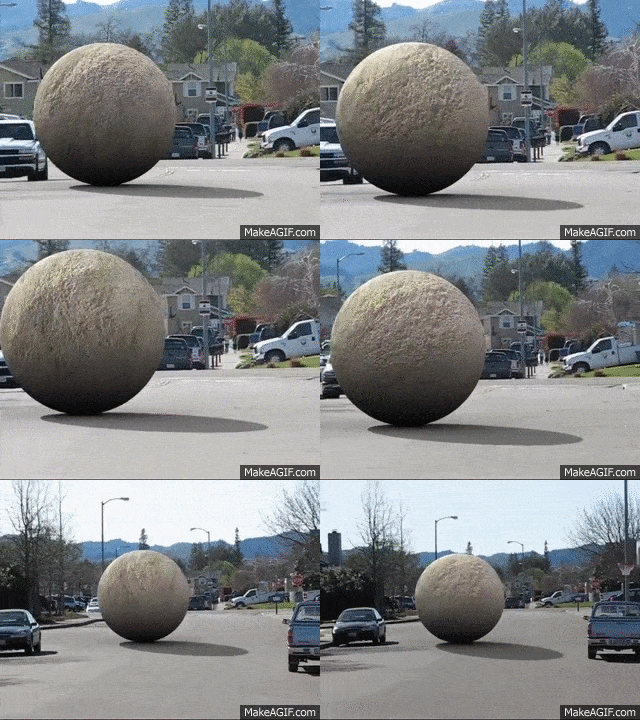
Which of the following has the MOST momentum? (they are all rolling at the same velocity)
rolling ping-pong ball
rolling bowling ball
rolling soccer ball
rolling basketball
If an object has a momentum of 40 kg x m/s and a mass of 60 kg, what is it's velocity?
2400 m/s
1.5 m/s
240 m/s
.67 m/s
In order for an object to have momentum it must be ________
moving
motionless
alive
asleep

