
 Worksheets
Atomic Radius & Bonding
Total questions: 15
Worksheet time: 10mins
As you move down the periodic table atoms get bigger (a larger atomic radius). This is because ____________.
The atoms have more mass.
The atoms have more protons.
The atoms have more energy levels
The atoms have more neutrons

Look at Group 1, Which of the following atoms has the largest atomic radius?
potassium (K)
rubidium (Rb)
francium (Fr)
cesium (Cs)

Look at Period 4, Which of the following atoms is the SMALLEST following the predicted atomic radius trend??
Potassium (K)
Manganese (Mn)
Iron (Fe)
Copper (Cu)
1.When is an atom stable?
a.when its electrons are evenly distributed through its energy levels
a.when its lowest occupied energy level is filled with electrons
a.when its highest unoccupied energy level is filled with electrons
when its highest occupied energy level is filled with electrons
3.How do sodium and chlorine both achieve stable electron configurations when they react?
a.An electron is transferred from the sodium atom to the chlorine atom.
a.An electron is transferred from the chlorine atom to the sodium atom.
a.Both atoms gain one electron.
Both atoms lose one electron.
When the outermost energy level of an atom is filled with electrons, the atom is stable and not likely to react.
true
false
An ionic bond is when electrons are transferred from a metal atom to a nonmetal atom.
True
False

Beryllium (Be) in in group 2 and it will ____ valence electrons when forming an ionic bond.
lose 4
gain 4
lose 2
gain 2

Sulfur (S) is in group 16 and will ____ valence electrons when forming an ionic bond.
gain 1
lose 1
gain 2
lose 2
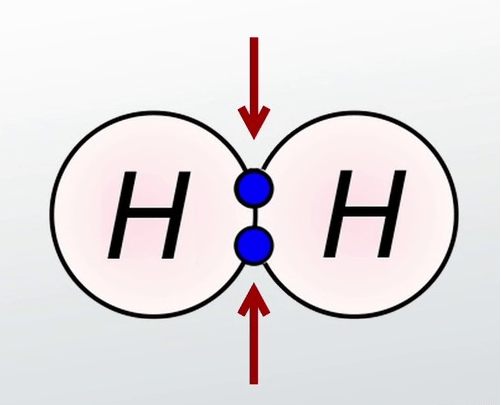
What type of bond is shown in this image?
Ionic Bond
Metallic Bond
Covalent Bond
Van der Waals Force
How do metallic bonds occur?
the attraction of neutral atoms.
When a nonmetals shares its valence electrons with another nonmetal.
When a metal transfers a valence electron to a nonmetal
When a metal bonds with another metal and share a sea of free floating electrons.

