
 Worksheets
CP midway Unit 1 Review Econ
Total questions: 35
Worksheet time: 31mins

Candy, a new car, owing the most expensive pair of shoes are examples of
Wants
Needs
Resources
Factors of Production

A lemon flavored snow cone is an example of. .
Consumer Good
Capital Good
Finished Product
Technological Resource

The opportunity cost of moving from point B to point C is
10 tons of steal
10 tons of wheat
30 tons of steal
30 tons of wheat
What is the difference between positive and normative economics?
Positive is opinion while normative is fact
Fact is normative while opinion is positive
Everyone can have an opinion and that is a fact
Normative is opinion while positive is a fact
Which of the following is physical capital?
a college degree
a factory building
learning to sew
playing the violin
Which would a company do to increase its human capital?
build a company cafeteria
hire more part-time workers
pay for employees’ education
lease cars for employees
Why does every decision involve trade-offs?
Incomes are not equal.
Resources are limited.
Decisions are all different.
What term means not enough to satisfy unlimited wants?
Goods
Scarcity
Services
Opportunity Cost
Trade-Offs
What term means the second best alternative that must be given up to get something
Goods
Scarcity
Services
Opportunity Cost
Trade-Offs
A firm operating at 'X' produces 70 whips and 60 saddles. It changes production to 'Y' producing 20 whips and 90 saddles. The opportunity cost of this production change is
20 whips
30 saddles
50 whips
60 saddles
The production possibility curve shows
alternative combinations of two goods that an economy is capable of producing.
the actual levels of production of two goods that the economy is achieving.
alternative combinations of productive resources that can be used to produce two goods.
the total value of two goods produced in one time period.
If an economy is producing at a point inside its production possibility frontier/curve, then
consumption is greater than production.
productive resources are not used to their full potential.
production of capital goods is inadequate.
it cannot benefit by specialisation and trade.
What are land/natural resources?
People who make and sell your products.
Things found in nature used to make a product.
Goods made and used to produce other goods and services.
Nature is a beautiful place.
What is an example of a need?
TV
video game
bike
food
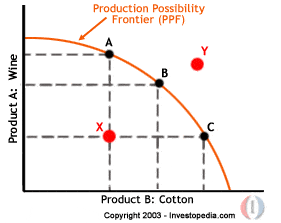
What does point Y represent on the PPC?
Efficiency
infeasible / impossible
Inefficency
Nothing
If there is improved technique of Production in both the goods , how will the PPC be affected?
Leftward shift of PPC
Rightward shift of PPC
Rotation of PPC
None of the above

The table shows the production possibilities for a country. Based on the table, which of the following production combinations is a possibility?
28 pizzas and 5 pairs of shoes
3 pairs of shoes and 23 pizzas
2 pairs of shoes and 20 pizzas
4 pairs of shoes and 15 pizzas
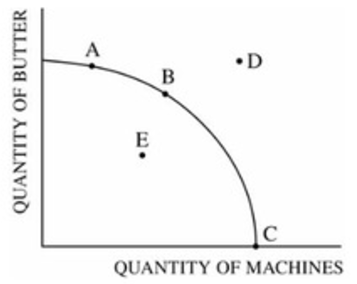
Why must we always make choices?
unlimited wants/unlimited resources
limited wants/unlimited resources
limited wants/limited resources
unlimited wants/limited resources
Economics is the study of
money
stocks
choices
graphs
When I considered the positives and negatives of something I am thinking of the
incentive
cost/benefit
tradeoff
opportunity cost
Which of the following is scarce?
Time
Kindness
Common sense
Everything is scarce

This image represents which concept
invisible hand
marginal thinking
scarcity
future consequences

You buy a book from a bookstore. You buy a _____.
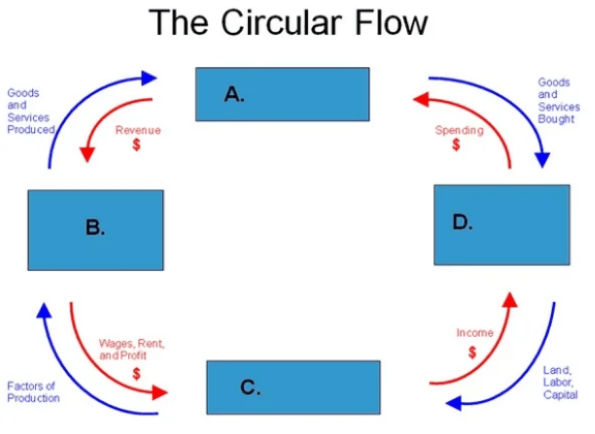
Point B represents
Product Market
Factor Market
Individuals
Businesses
A person stocks shelves at a grocery store and receives a wage. They have completed an exchange in which part of the circular flow model?
Individuals
Businesss
Factor Market
Product Market
What are the four main parts of the circular flow diagram?
Product Market, Stock Market, Factor Market, Fish Market
Product Market, House Market, Factor Market, Good Market
Factor Market, Product Market, Households, Firms
Factor Market, households, Stock Market, super market
Where do factors of production (land, labor, etc) come from in the circular flow model?
Factor Market
Product Market
Firms
Individuals

