
 Worksheets
AS Physics Unit 3/4 Massive MC
Total questions: 257
Worksheet time: 64hrs 15mins
Which of the following best describes Max Planck's contribution to the development of quantum physics?
Max Planck combined the quantised wave and particle models of light.
Max Planck analysed the photoelectric effect and described light as quantised energy packets.
Max Planck explained that black body radiation and the photoelectric effect using quantised energy
Max Planck hypothesised that the radiation emitted and absorbed by the walls of a black body cavity is quantised

A charged particle, q, enters a uniform magnetic field B at velocity v. The particle follows a circular path of radius r as shown. If the magnitude of the field were doubled and the other variables were kept constant, determine the new radius.
r/4
r/2
2r
4r
Calculate the energy of a photon with wavelength of 1000 nm.
1.99 x 10^-19 J
3.00 x 10^14 Hz
6.626 x 10^-34 J
0 J
Calculate the wavelength of a photon which is emitted when an electron in a hydrogen atom moves from energy level n = 4 to n = 2.
2.057 x 10^6 m
4.86 x 10^-7 m
3.22 x 10^6 m
6.34 x 10^-7 m
Calculate the velocity of an electron that has a wavelength of 3.33 x 10^-10 m
2184182 m/s
35678666 m/3
0.2184141987 m/s
0.3567866 m/s
Calculate the energy of a photon with wavelength 580 nm.
3.43 x 10^-19 J
3.43 x 10 ^-28 J
3.85 x 10^-31 J
3.85 x 10^-40 J

A student set up an experiment to determine the resistance of a wire, called Wire X. The graph and trend line for the potential difference (V) and the current (A) is shown. Calculate the resistance of Wire X.
2.7 Ohms
0.37 Ohms
8.1 Ohms
3 Ohms

In the graph shown, one data point was considered inconsistent and was disregarded when drawing the trend line for calculating its resistance. Suggest a physical reason why this data point is inconsistent with the trend line.
Human error
Meter malfunction
The wire was heated from being in the circuit
Random error

An experiment was conducted in which light of different frequencies was shone onto the surface of four different metals. Electrons were found to be emitted and their kinetic energies were measured. The graph shows the results.
Each of the graphs have the same gradient. Identify the significance of the observation.
The gradient is the work function
The gradient is the kinetic energy
The gradient is Planck's constant
The gradient is insignificant

When electromagnetic radiation shines on metals, photoelectrons may be emitted. The
maximum kinetic energy of emitted photoelectrons is plotted against radiation frequency
for four metals as shown in the graph.
Electromagnetic radiation of wavelength 187 nm shines upon an unknown metal and the
maximum kinetic energy of the photoelectrons is found to be 2.5 eV.
Based on this information, determine the unknown metal.
Al
Be
Ca
Fe

Identify which graph is consistent with predictions resulting from Planck’s hypothesis regarding radiation from hot objects.
A
B
C
D

The diagram shows a current-carrying conductor in a magnetic field. Calculate the magnitude of the force on the conductor.
0 N
0.05 N
0.09 N
0.10 N

The diagram shows an electric circuit in a magnetic field directed into the page. The graph shows how the flux through the conductive loop changes over a period of
12 seconds.
Calculate the maximum magnetic field strength within the stationary loop during the 12-second interval.
0 T
1.2 T
2.1 T
4.41 T
A photon is emitted when an electron in a hydrogen atom transitions from n = 3 excited state to the ground state.
Calculate the wavelength of the photon.
102.7 nm
740 nm
449.7 nm
500 nm

Two charged plates are initially separated by a distance as shown in the diagram.
The potential difference between the two plates remains constant.
Identify which graph best represents the change in electric field strength as the distance between the two plates is increased.
A
B
C
D

P, Q and R are straight current-carrying conductors.
Conductors P and R are fixed and unable to move. Conductor Q is free to move.
Determine the direction that conductor Q will move as a result of the current flow in P and R.
Left
Right
Into the page
Out of the page

Calculate the magnitude of the of the force experienced by Q as a result of currents through P and R.
4.8 x 10^-4 N
3.2 x 10^-4 N
9.6 x 10^-4 N
8.0 x 10^-4 N

The diagram represents the electric field around a negative charge.
If the magnitude of the charge were doubled, identify the diagram that best represents the new electric field.
A
B
C
D
Which law best applies to the operation of an electrical transformer?
Conservation of Mass
Conservation of Energy
Conservation of Charge
Conservation of Momentum
Why is a high voltage used to transmit electric energy from power stations to users?
It helps to protect the system from lightening strikes
It allows for the supporting structures to have smaller insulators.
It minimises the effects of the electrical resistance of the wires.
It ensures that, even with the voltage losses, 240 V will still reach the user.

A circuit with two resistors is shown below. Determine the equivalent resistance of the circuit
6 Ohms
3 Ohm
1.3 Ohms
8 Ohms

A circuit with three resistors is shown below. Determine the equivalent resistance of the circuit.
1.1 Ohms
4 Ohms
48 Ohms
12 Ohms
Two identical charges of 1.6 micro Coulumbs are separated by a distance of 190 mm. Determine the magnitude of force (F) acting between them.
1.0 N
0 N
0.64 N
1.5 N

Select the correct circuit diagram for an ammeter.
A
C
D
B
A 200 g metal object was heated from 40 °C to 80 °C using 1000 J of heat. Calculate the specific heat capacity of the metal.
100 Jkg^-1K^-1
0.125 Jkg^-1K^-1
125 Jkg^-1K^-1
5000 Jkg^-1K^-1
Determine the value of 282 degrees Kelvin, in Celsius
9
-9
555
-555

The diagram shows an energy level diagram for the hydrogen atom. Determine the energy of a photon emitted when an electron transitions from n = 3 to n = 1 in a hydrogen atom.
1.93 x 10^-18 J
19.3 x 10^-18 J
1.03 x 10^-18 eV
19.3 x 10^-18 eV

A clarinet is a wind instrument that can be modelled as a tube closed at one end. Assume that the pressure nodes and anti-nodes occur exactly at the end of the tube. The clarinet has a fundamental frequency of 130 Hz. Calculate the length (L) of a tube that models the clarinet. The speed of sound in air is 340 m/s.
0.654 m
654 m
1.3 m
130 m

Identify which of the following transitions (A-D) as indicated on the energy level diagram, represents a change in atomic energy levels for the emission of a photon of energy 1.65 eV?
A
B
C
D
Determine the temperature in °C that would produce radiation with a peak wavelength of 1.0 μm.
2898 degrees Celsius
2625 degrees Celsius
250 degrees Celsius
500 degrees Celsius

A current-carrying wire is placed perpendicular to a magnetic field. Determine the graph that shows the correct relationship between magnetic field strength (B) and current (I) if the force is to remain constant.
A
B
C
D

A galvanometer is an electromechanical instrument used for detecting and indicating an electric current. A greater deflection occurs in response to a greater current flowing through a coil in a constant magnetic field.
The diagram shows an ideal transformer. When the switch is closed, the pointer on the galvanometer deflects. How could the size of the deflection be increased?
Decrease the number of primary coils
Decrease the number of secondary coils
Replace the iron core with a copper core
Place a resistor in series with the galvanometer

The diagram represents a simple DC motor. A current of 1.0 A flows through a square loop ABCD with 5 cm sides in a magnetic field of 0.01 T.
Determine the force acting on section AB due to the magnetic field, when the loop is in the position shown.
5 x 10^-4 N
5000 N
50 N
0.005 N

The diagram shows a magnet moving upward into a coil. Which row of the table correctly identifies the direction of the induced coil as viewed from the top, and the direction of the magnetic field inside the coil.
Anticlockwise, downwards
Anticlockwise, upwards
Clockwise, upwards
Clockwise, downwards
Why is an iron core used in a transformer?
To limit eddy currents
To reduce the heat generated
To separate the magnetic fields
To increase the linkage of the flux

The diagram shows two experiments, in Experiment 1, the magnet is moved away from the coil. In experiment 2, the coil is moved away from the magnet.
Why is the same electromotive force (emf) produced in both experiments?
Energy is conserved.
The motor effect generates the same force.
The relative motion between the coil and the magnet is the same.
Both the direction of the magnetic field and the direction of the motion change.

The diagram shows a generator circuit connected with a switch. The generator is rotated by one revolution in the first second with the switch open. It is then rotated by one revolution in the next second with the switch closed.
Identify the graph which shows the current produced by this generator for these two seconds.
A
B
C
D
Two charges have a Coulumb's force of 12 N between them. If the distance between the masses is doubled, what would be the new electrostatic force between them?
3 N
6 N
12 N
24 N

The diagram shows an alpha particle and a proton, placed at equal distances from two large charged metal plates. Determine the answer that best describes the motion of the particles.
Both particles move with the same acceleration.
The alpha particle moves with half the acceleration of the proton.
The alpha particles moves with twice the acceleration of the proton.
The alpha particle moves with a quarter of the acceleration of the proton.
Calculate the energy of a photon of wavelength 415 nm.
415 J
4.79 x 10^-19 J
200 J
4.5 x 10^-18 J
Students doing a Physics practical investigation use a step-down transformer with 240 V AC to
12 V AC. Determine the ratio of the number of turns on the primary to secondary coil.
1 : 4
1 : 20
4 : 1
20 : 1
The correct definition of a period is:
the amount of time one cycle or one event takes to occur
the amount of time half of one cycle or event takes to occur
the distance travelled by an object in uniform circular motion
the distance travelled by a wave when one whole wavelength passes a given point
According to one model of the atom, the electron in the ground state of a hydrogen atom moves around the stationary proton in a circular orbit with a radius of 53 pm (53 × 10^–12 m).
Determine the magnitude of the force acting between the proton and the electron at this separation
distance. The magnitude of the electron and proton charges is 1.6 × 10^–19 C.
Provide your answer in scientific notation including units of measurement.
8.2 x 10^-8 C
8.255 x 10^-8 N
8.2 x 10^-8 N
8 x 10^-8 N

The diagram shows a schematic diagram of a simple DC motor.
It consists of two magnets, a single 9.0 V DC power supply, a split-ring commutator and a rectangular coil of wire consisting of 10 loops. The total resistance of the coil of wire is 6.0 Ω. The length of the side JK is 12 cm and the length of the side KL is 6.0 cm. The strength of the uniform magnetic field is 0.50 T.
Determine the size and the direction (A–F) of the force acting on the side JK.
0.9 N, down
0.9 N, up
0 N
0.5 T

The alternator has a rectangular coil with sides of 0.30 m × 0.40 m and 10 turns. The coil rotates four times a second in a uniform magnetic field. The magnetic flux through the coil in the position shown is 0.20 Wb.
Calculate the magnitude of the magnetic field. Include appropriate units of measurement.
1.7 T
0.2 Wb m^-2
0 T
1.7 Wb

A light ray from a laser passes from a glucose solution (n = 1.44) into the air (n = 1.00), as shown in the diagram. Calculate the critical angle (total internal reflection) from the glucose solution to the air.
44
0
0.025
0.017
A Physics teacher intends to demonstrate wave phenomena to her students. She takes her students to the school oval to listen to a 680 Hz sound. The speed of sound in air is 340 m s^-1. Calculate the wavelength of the sound.
100 nm
0.5 m
2 m
340 m
Standing waves are formed on a string of length 4.0 m that is fixed at both ends. The speed of the waves is 240 ms^–1. Calculate the wavelength of the lowest frequency resonance.
0.5 m
4 m
2 m
8 m
Standing waves are formed on a string of length 4.0 m that is fixed at both ends. The speed of the waves is 240 ms^–1. Calculate the frequency of the second-lowest frequency resonance
It doesn't create a frequency
60 Hz
8 Hz
240 Hz
The correct definition of Coulomb’s law is:
the total electric charge of an isolated system remains constant regardless of changes within the system
the direction of an induced electric current always opposes the change in the circuit or the magnetic field that produces it
when the magnetic flux linking a circuit changes, an electromotive force (EMF) is induced in the circuit proportional to the rate of change of the flux linkage.
like electric charges repel and opposite electric charges attract, with a force proportional to the product of the electric charges and inversely proportional to the square of the distance between them.

Identify which of the following correctly shows the electric field between two parallel, charged plates.
A
B
C
D
A laser emits light of wavelength 550 nm. Calculate the frequency of this light.
0 Hz
5.45 x 10^14 Hz
5.45 x 10^14 N
550 Hz
Some mobile phones are recharged at a power point using a charger that contains a transformer. Identify the the purpose of the transformer.
To convert AC to DC at the power point
To convert DC to AC at the power point
To increase the AC voltage at the power point
To decrease the AC voltage at the power point
The definition of interference is a phenomenon in which waves
overlap in space
change direction and speed
return in to the same medium
superimpose to form a resultant wave

A magnet passes through a copper tube at constant velocity along the path shown. A current is induced in the tube by the motion of the magnet.
Describe the forces acting between the tube and the magnet at points P and Q.
P: Attraction; Q: Repulsion
P: Repulsion; Q: Attraction
P: Attraction; Q: Attraction
P: Repulsion; Q: Repulsion

The diagram shows a label on a transformer used in an appliance.
Explain why the information provided on the label is not correct. Support your answer with calculations.
The power in is not consistent with household electricity supply
This is not consistent with law of conservation of energy as there is more energy in then out
The units are incorrect
The output should be in DC

The diagram represents a simple DC motor. A current of 1.0 A flows through a square loop ABCD with 5 cm sides in a magnetic field of 0.01 T.
Determine the force acting on section AB, when the loop is in the position shown.
5 x 10^-4 N into page
5 x 10^-4 N out of page
0 N
5 x 10^-4 N right

The following diagram shows a ray of light, travelling in a vacuum, incident on a glass object. Calculate the velocity of the refracted light in the glass.
1.5 x 10^8 m/s
2.2 x 10^8 m/s
3 x10^8 m/s
1.96 x 10^8 m/s
What is Young's Double Slit Experiment?
An experiment that developed understanding of the structure of the atom
A demonstration that light and matter can display characteristics of both classically defined waves and particles
A demonstration that relates frequency of sound to wavelength in a pipe
An example of convection, conduction and radiation

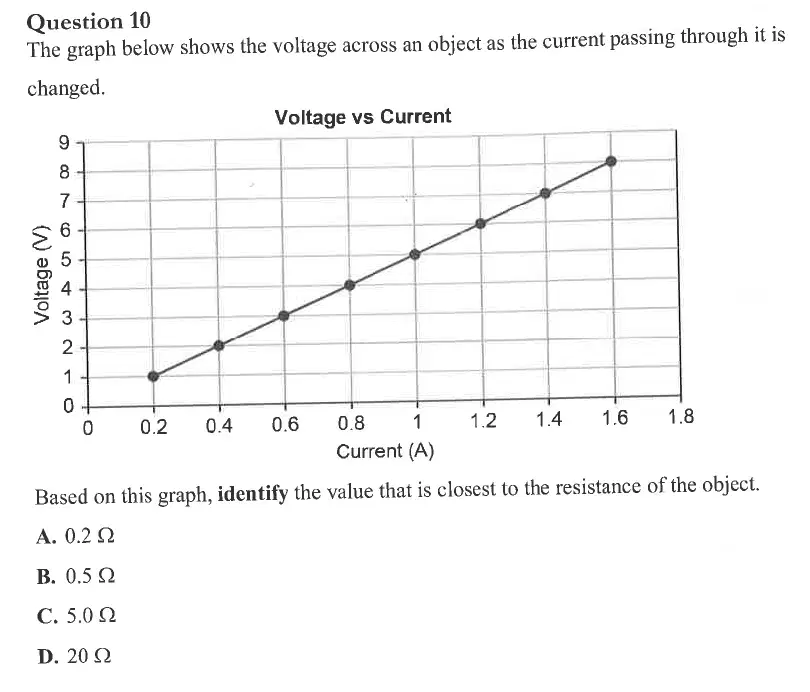
An experiment was conducted to calculate the resistance of a resistor, R. The graph below shows the resultant current passing through the resistor when a potential difference was applied across it. Calculate the resistance of the resistor.
0.21 Ohms
4.8 Ohms
2.1 Ohms
0.4 Ohms

A 200 g metal cube with a specific heat capacity of 900 J kg –1 K–1 is placed in a 500 g water bath. The following graph shows the temperature of the water with respect to time.
Calculate the initial temperature of the metal cube, assuming that there is no heat loss
297
22
255
42

A student must choose between the two closed ended pipes shown. The standing wave formed in each pipe travels at the speed of sound. Determine which pipe will produce a note with a frequency of 265 Hz.
A
B
Neither
Both

A 250 g sample of lead at an initial temperature of 275 °C is dropped into a bucket containing 1.5 kg of water at an initial temperature of 25 °C. The thermodynamic properties of lead are presented in this table.
Calculate the temperature at which the lead and water come to thermal equilibrium, assuming no thermal energy is lost from the system.
200
11
26.3
150
When measured in °C, what temperature is 296 K?
-23
23
25
569
In the equation 𝐸k=ℎ𝑓−𝑊, the physical quantity represented by 𝑊 is the
maximum kinetic energy of an ejected photoelectron
wavelength of a photon required to eject a photoelectron
minimum energy required to remove an electron from a solid
minimum energy required to ionise an electron from a single atom
Heat transfer by radiation is described as heat transfer
by electromagnetic waves
by moving subatomic particles
directly through a solid material
through a fluid influenced by gravity

The diagram shows an electric current-carrying wire. Calculate the magnitude of the magnetic field at point Y.
4 x 10^-8 T
4 x 10^-6 T
4 T
40 T
A 100 g metal object was heated from 40 °C to 90 °C using 1000 J of heat. Calculate the specific heat capacity of the metal.
0.2 J kg^-1 K^-1
200 J kg^-1 K^-1
500 J kg^-1 K^-1
5000 J kg^-1 K^-1
A mechanical system has an input of 200 kW of power. Which of the following options is a realistic scenario for its output?


The quantity defined as the rate at which work is done or the rate at which energy is transferred or transformed is:
Power
Current
Resistance
Potential Difference
Select the circuit diagram symbol for a light bulb.


Determine the direction of the magnetic field inside the solenoid at point X.
into page
out of page
left to right
right to left
Select the correct definition of electromagnetic radiation.
Emissions of energy as electromagnetic waves or moving subatomic particles, especially high-energy particles, that cause ionisation
The production of an electromotive force or voltage across an electrical conductor due to its dynamic interaction with a magnetic field
Radiant energy consisting of synchronised oscillations of electric and magnetic fields, or electromagnetic waves, propagated at the speed of light in a vacuum
The process by which heat or electricity is directly transferred or transmitted through the material of a substance when there is a difference of temperature or of electrical potential between adjoining regions, without movement of the material

The diagram below shows two charges (𝑞1 and 𝑞2), separated by a distance (𝑑). Calculate the magnitude of the force (𝐹) acting between the two charges.
1.0 N
1.0 x 10^6 N
1.0 x 10^-6 N
15 x 10^-4 N
Which of the diagrams below is the correct representation of the magnetic field around an electric current-carrying wire?


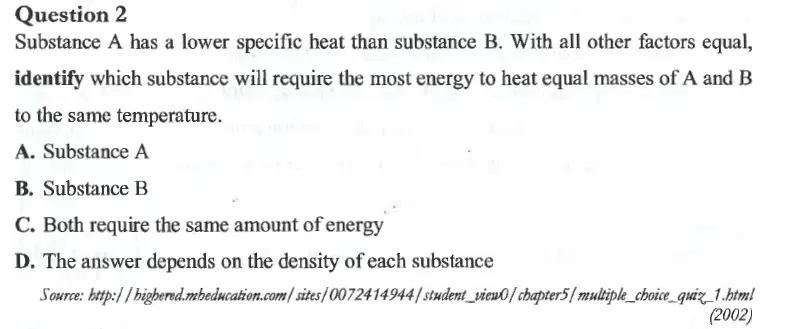
Substance A has a lower specific heat than Substance B. With all other factors equal, identify which substance will require the most energy to heat equal masses of A and B to the same temperature.
Substance A
Substance B
Both require the same amount of energy
The answer depends on the density of each substance
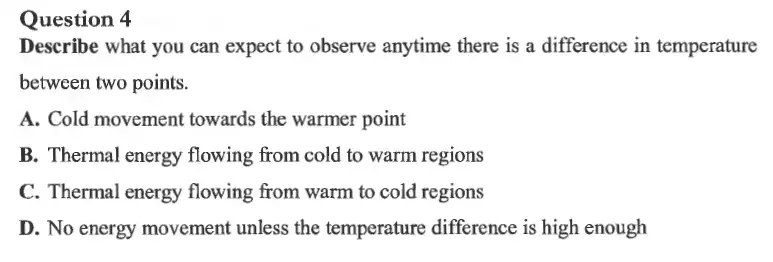
Describe what you can expect to observe anytime there is a difference in temperature between two points
Cold movement towards the warmer point
Thermal energy flowing from cold to warm regions
Thermal energy flowing from warm to cold regions
No energy movement unless the temperature difference is high enough
Recall the definition of latent heat of fusion
The energy required to heat 1kg of a solid to melting point
The energy required to melt 1kg of a solid to melting point
The energy required to heat 1 kg of a liquid to boiling point
The energy required to evaporate 1kg of a liquid at boiling
If 48 000 J of heat energy is released when a 2kg block of metal cools by 12 degrees, calculate the specific heat of the metal
1152000
0.0005
2000
8000
Calculate the energy required to melt 750g of ice at 0 degrees. (Latent Heat of Fusion for Water= 334 kJ kg^-1)
250.5 kJ
250500 kJ
25.05 kJ
250500000 kJ
Calculate the equilibrium temperature when a 100g piece of iron at 150 degrees is added to 200mL of water at 20 degrees.
(Specific heat capacity of water= 4200 J kg^-1 K^-1)
(Specific heat capacity of iron= 450 J kg^-1 K^-1)
90 degrees
840 degrees
26.6 degrees
14 degrees
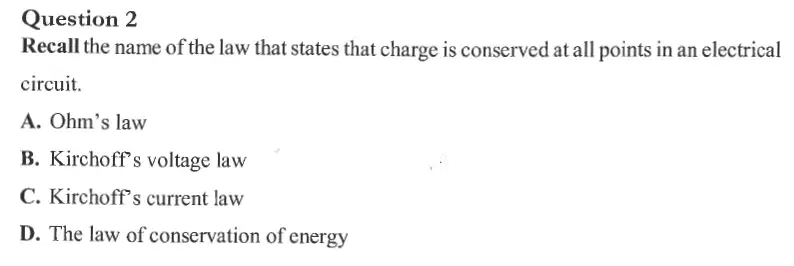
What is the name of the law that states that charge is conserved at all points in an electrical circuit?
Ohm's Law
Kirchoff's Voltage Law
Kirchoff's Current Law
The Law of Conservation of Energy
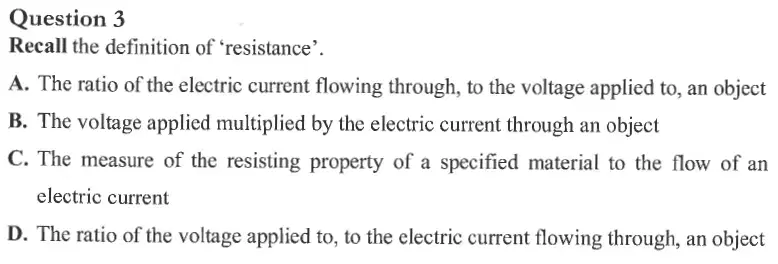
recall the definition of resistance
The ratio of the electric current flowing through, to the voltage applied, an object
The voltage applied multipled by the electric current through an object
The measure of the resisting property of a specified material to the flow fo the electric current
The ratio of the voltage applied to, to the the electric current flowing through, an object
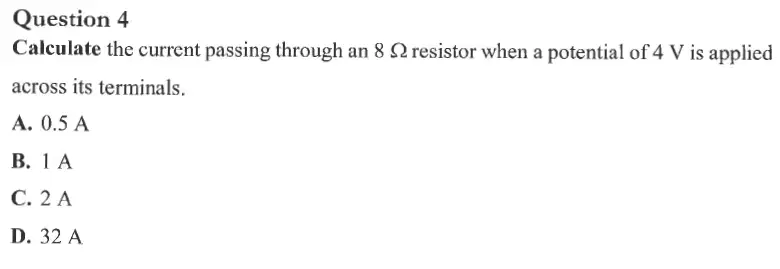
Calculate the current passing through an 8 Ohm resistor when a potential of 4V is applied across its terminal
0.5 A
1 A
2 A
32 A
Calculate the equivalent resistance of a 10 Ohm, 20 Ohm and 30 Ohm resistor in parallel
3 Ohm
5.5 Ohm
20 Ohm
60 Ohm
Calculate the emf of a power supply if it causes 0.4A in a circuit that consists of a 10 Ohm and 30 Ohm resistor in series
3V
16V
18.75V
100V
A split system air conditioner in a typical Australian house operates on a 240V circuit and draws about 20A of current. Calculate the power rating of the air conditioner.
12 W
0.083 W
12 P
4800 W
Identify which of the following waves is not a mechanical wave.
Light
Water
Sound
Seismic
Identify which of the following measurements remains constant when a wave crosses the boundary from one medium to another.
Amplitude
Frequency
Velocity
Wavelength
A wave travels along a string towards a fixed boundary. Describe the properties of the reflected wave.
Lower frequency and smaller amplitude
Smaller amplitude, inverted and same frequency
Higher frequency, smaller wavelength and the same velocity
Smaller amplitude, non inverted and the same frequency
Polarised light waves are best described as
light waves that are longitudinal instead of transverse
light waves in which the electric field and magnetic field are perpendicular to each other
light waves in which the direction of field vibrations cannot be determined
light waves in which the vibrations occur in a single plane
Calculate the speed of light in water, n=1.33
2.26 x 10 ^8 m/s
3.00 x 10^8 m/s
4.00 x 10^8 m/s
4.31 x 10*8 m/s
A ray of light in air is approaching the boundary with water at an angle of 52 degrees. Determine the angle of refraction of the light rays. The index of refraction for water is n=1.33
52 degrees
36.3 degrees
38 degrees
0.5925 degrees

Calculate the total resistance of the whole circuit
2.25 Ohms
8.25 Ohms
18 Ohms
144 Ohms
Determine how many seconds it would take a kettle with a power rating of 1800 W to produce 36 000 J
0.05 sec
20 sec
20 hours
64800000 sec

Which is the best statement of the arrangement shown?
2 Ω, 4 Ω and 6 Ω are in series
2 Ω and 4 Ω are in series and the combination is in parallel with 6 Ω
2 Ω, 4 Ω and 6 Ω are in parallel
2 Ω and 4 Ω are in parallel and 6 Ω is in series

The circuit symbol, B, is a
battery
cell
gap in the circuit
resistor

The circuit symbol, A, is a
cell
battery
rheostat
open switch

Calculate the amplitude in cm.
80 cm
60 cm
30 cm
Can't be determined by the graph
The speed of light is 3.0 × 10^8 m/s. If the wavelength of red light is 5.0 × 10^-7 m, calculate its frequency.
6.0 x 10^14 Hz
1.66 x 10^-15 Hz
150 Hz
3 x 10^8 Hz

A heavy spring and a light spring are joined together as shown in the figure. A pulse is generated at the end of one spring and travels along towards the boundary. At the boundary, some of the energy is transmitted and some reflected.
Which one of the diagrams below shows the position and orientation of the pulse shortly afterwards?
A
B
C
D

Calculate the refractive index of the material shown.
0.45
0.577
1.44
1.81
A small 2.0 cm high candle is placed 50 cm in front of a 20 cm focal length convex lens. Sketch a ray diagram to find the location of the image.
34 cm behind
34 cm in front
50 cm behinf
There is no image
An object 4.0 cm high is located 15 cm in front of a plane mirror. Which one of the following best describes the characteristics and the location of the image?
virtual, 4 cm high, upright, 15 cm behind the mirror
virtual, 4 cm high, inverted, 15 cm behind the mirror
real, 4 cm high, upright, 15 cm behind the mirror
real, < 4 cm high, upright, <15 cm behind the mirror
The refractive indices of flint glass and turpentine are 1.65 and 1.5 respectively. If the angle of incidence in the turpentine is 49°, calculate the angle of refraction in the flint glass.
0.686
2.33
43.3
55.03
Determine the value of the refracted angle when the incident ray of light is at the critical angle.
360 degrees
0 degrees
90 degrees
180 degrees
Standing waves are produced by the superposition of two waves with
the same amplitude, frequency and direction of propagation
the same amplitude and frequency, and opposite propagation directions
the same amplitude and direction of propagation, but different frequencies
the same amplitude, different frequencies and opposite directions of propagation
The fundamental frequency of a certain string is 100 Hz. Which of the following frequencies is the next harmonic?
50 Hz
200 Hz
300 Hz
400 Hz
What topic have we not studied this year?
Nuclear
Heat
Circuits
Waves
Heat transfer by radiation is described as heat transfer
by electromagnetic waves
by moving subatomic particles
directly through a solid material
through a fluid influenced by gravity
A
B
C
D
A
B
C
D
A
B
C
D
A
B
C
D
A
B
C
D
A
B
C
D

A
B
C
D

A
B
C
D

A
B
C
D
A
B
C
D

A
B
C
D
A
B
C
D
A
B
C
D
A
B
C
D
A
B
C
D

A
B
C
D

A
B
C
D

A
B
C
D

A
B
C
D

A
B
C
D
A
B
C
D
A
B
C
D
A
B
C
D
A
B
C
D

A
B
C
D

A
B
C
D

A
B
C
D

A
B
C
D
A
B
C
D
A
B
C
D
A
B
C
D
A
B
C
D

A
B
C
D
A
B
C
D
A
B
C
D
A
B
C
D
A
B
C
D
A
B
C
D
A
B
C
D
A
B
C
D
A
B
C
D
A
B
C
D
A
B
C
D
A
B
C
D

A
B
C
D

A
B
C
D

A
B
C
D

A
B
C
D
A
B
C
D
A
B
C
D

A
B
C
D

A
B
C
D

A
B
C
D

A
B
C
D

A
B
C
D

A
B
C
D

A
B
C
D

A
B
C
D

A
B
C
D

A
B
C
D

A
B
C
D

A
B
C
D

A
B
C
D

A
B
C
D

A
B
C
D

A
B
C
D

A
B
C
D

A
B
C
D

A
B
C
D

A
B
C
D

A
B
C
D

A
B
C
D

A
B
C
D

A
B
C
D

A
B
C
D

A
B
C
D

A
B
C
D

A
B
C
D

A
B
C
D

A
B
C
D

A
B
C
D

A
B
C
D

A
B
C
D

A
B
C
D

A
B
C
D

A
B
C
D

A
B
C
D

A
B
C
D

A
B
C
D

A
B
C
D

A
B
C
D

A
B
C
D

A
B
C
D

A
B
C
D

A
B
C
D

A
B
C
D

A
B
C
D

A
B
C
D

A
B
C
D

A
B
C
D

A
B
C
D

A
B
C
D

A
B
C
D

A
B
C
D

A
B
C
D

A
B
C
D

A
B
C
D

A
B
C
D

A
B
C
D

A
B
C
D

A
B
C
D

A
B
C
D

A
B
C
D

A
B
C
D

A
B
C
D

A
B
C
D

A
B
C
D

A
B
C
D

A
B
C
D

A
B
C
D

A
B
C
D

A
B
C
D

A
B
C
D

A
B
C
D

A
B
C
D

A
B
C
D

A
B
C
D

A
B
C
D

A
B
C
D

A
B
C
D

A
B
C
D

A
B
C
D

A
B
C
D

A
B
C
D

A
B
C
D

A
B
C
D

A
B
C
D

A
B
C
D

A
B
C
D

A
B
C
D

A
B
C
D

A
B
C
D

A
B
C
D

A
B
C
D

A
B
C
D

A
B
C
D

A
B
C
D