
 Worksheets
Unit Theory Units 1-6 Final Exam
Total questions: 70
Worksheet time: 23mins
What is a staff?
a group of 4 lines and 5 spaces
a group of 5 lines and 4 spaces
a group of 4 lines and 4 spaces
a group of 5 lines and 5 spaces

What is this symbol called?
Treble Clef
Bass Clef
And Sign
Money Sign

What is this symbol called?
Treble Clef
Bass Clef
Repeat Sign
Cent Sign
What is a grand staff?
A big staff
ledger lines
indicates a page turn
the treble and bass staff together
What are ledger lines for?
to make the notes longer
to extend the range of the staff for higher or lower notes
to make the notes louder
to make the staff shorter


What is the sentence we use to remember the LINES of the treble clef?
Every Good Boy Does Fine
Little Boys Always Eat Chocolate
Girls Always Like Buying Shoes
Boys And Girls Eat Fudge
What is the sentence we use to remember the LINES of the bass clef?
Good boyfriends don't eat fries
Good boyfriends don't forget anniversaries
Good boyfriends are hard to find
Good boyfriends don't forget
What is the sentence we use to remember the SPACES of the bass clef?
All Cows Are Cows
All Grass Eat Cows
FACES
All Cows Eat Grass


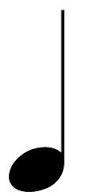


What is the name of this note?
Quarter Note
Half Note
Sixteenth Note
Whole Note

What type of rest is this?
Whole Rest
Half Rest
Quarter Rest
Eighth Rest

How many beats is this worth?
4
1
2
3

What kind of rest is this?
quarter rest
half rest
eight rest
whole rest
How many beats does a dotted half note get in 4/4 time?
1
2
3
4
What does a bar line do?
makes beverages
divides the music into measures
makes you stop playing
nothing
The top number of the time signature tells you how many beats there are in a measure?
true
false
The bottom number of the time signature tells you what note equals one beat.
true
false
How many beats are there per measure in 2/4 time?
1
2
3
4

Identify the articulation:
Tie
Slur
Marcato
Accent

What is the name of the symbol that tells us to connect two different pitches. They are performed legato.
Tie
Accent
Slur
Staccato

This symbol tells us to hold the note until the conductor cuts us off. What is it called?
Tie
Fermata
Slur
Legato

What does this symbol mean?
The song is over
Go back and repeat
Skip a line
Keep going

What is this symbol called?
Repeat
First Ending
Coda
Segno

What is this symbol called?
Capo
Dal Segno (DS)
S Percent
Ending

This is a
Dal Segno
Da Capo
District of Columbia
Don't Count

This symbols means.....
something is great
go to the Coda
the end
loud

What is this symbol called?
Medium Loud
Sforzando
Mezzo Piano
Forte
How are staccatos played?
Long
Loud
Short
Soft


This means
Pianissimo
Piano
Forte
Fortissimo

This means
Pianissimo
Piano
Forte
Fortissimo

harmony
decrescendo
crescendo
timbre
what does mezzo piano mean?
medium loud
very loud
silent
medium soft
Mezzo forte means
medium loud
loud
medium soft
very soft
Very soft is
mezzo piano
piano
mezzo forte
pianissimo

What does this dynamic marking stand for?
Mezzo Forte
Piano
forte
Fortissimo
What does Dynamics mean in music?
To play fast or slow
To play loud or soft
To play high or low
To play happy or sad
What does Tempo mean in music?
to play fast or slow
to play loud or soft
to play high or low
to play happy or sad
What tempo marking means at a moderate pace?
adagio
moderato
presto
allegro
What does BPM stand for in music?
beats per metronome
bpm
beats per moment
beats per minute
What tempo marking means at a walking pace?
allegro
prestissimo
andante
adagio
Gradually Slowing Down
PRESTO
ADAGIO
Accelerando
Ritardando
Largo means
Very Slow
Very Fast
Very Large
Very Long
What is the difference between D.S. & D.C.
D.S. means repeat from the sign, D.C. means repeat from the beginning.
D.S. means repeat from the beginning., D.C. means repeat from the sign.
D.S. is nice and D.C. is not
D.S. means play softly, D.C. means play with conviction.
What does Coda mean?
a secret code
an added ending
play louder
repeat
True or False: Articulation words tell us how to play different notes
True
False

This is called a
sharp
natural
flat
repeat

This is called a
natural
flat
coda
sharp

This is called a
B
sharp
flat
staccato
The flat sign does what to the pitch of a note?
raises it a whole step
lowers it a whole step
raises it a half step
lowers it a half step
The sharp sign does what to the pitch of a note?
raises it a whole step
lowers it a whole step
raises it a half step
lowers it a half step
A natural sign does what?
raises the note more than sharp
cancels a previous sharp or flat
lowers the note more than a flat
means to rest and not play the note
Flat, Sharp and Natural signs are called
accents
accidentals
dentals
a cappella
Notes that sound the same but are written differently are called
Weird
Half Steps
Pitches
Enharmonic
Half steps are bigger than whole steps
true
false
MISS HERTZNER IS YOUR FAVORITE TEACHER!
TRUE
FALSE

