
NEW
Font size
 Worksheets
Orthographic Projections & Alphabet of Lines
Total questions: 31
Worksheet time: 34mins

Which orthographic view is the arrow pointing to? Be sure to pay close attention to the direction of the arrow.


Which orthographic view is the arrow pointing to? Be sure to pay close attention to the direction of the arrow.


Which orthographic view is the arrow pointing to? Be sure to pay close attention to the direction of the arrow.


Which orthographic view is the arrow pointing to? Be sure to pay close attention to the direction of the arrow.


Which orthographic view is the arrow pointing to? Be sure to pay close attention to the direction of the arrow.


Which orthographic view is the arrow pointing to? Be sure to pay close attention to the direction of the arrow.


Which orthographic view is the arrow pointing to? Be sure to pay close attention to the direction of the arrow.


Which orthographic view is the arrow pointing to? Be sure to pay close attention to the direction of the arrow.


Which orthographic view is the arrow pointing to? Be sure to pay close attention to the direction of the arrow.


Which orthographic view is the arrow pointing to? Be sure to pay close attention to the direction of the arrow.


Which is the correct right side view of the figure provided?


Recognize the view for the given isometric figure.
Top view
Right side view
Left side view


The HEIGHT is shown in which view(s)?
Both Front & Right
Top Only
Right Only
Front Only
The DEPTH is shown in which view(s)?
Both Front & Right
Top Only
Top & Right Views
Front Only
The WIDTH is shown in which view(s)?
Front View
Top & Front Views
Right View
You're giving me a headache

How many views do you need when you draw a cylinder?
2
3
4
1


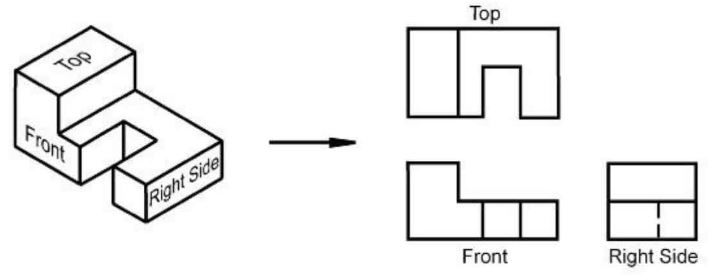
What type of projection is shown on the right?
First Angle Orthographic Projection
Isometric Projection
Third Angle Orthographic Projection
Oblique Projection
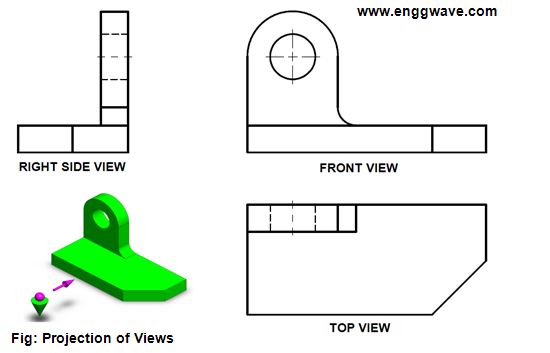
What is the type of projection shown here?
Half Angle
Third Angle
Second Angle
First Angle

Identify the top view of this isometric object.
The arrow indicates the viewing direction.



