wayground logo

Free Printable Worksheets

Font size

S
M
L
XL
Worksheets

Art 2 end of 9 weeks

Total questions: 46

Worksheet time: 24mins

Name
Class
Date
1.

a line in an artwork that is not physically there but suggested by points in the artwork

a)

Random

b)

Gestual

c)

Implied

d)

contour

2.

A line that goes straight up and down is called what?

a)

horizontal

b)

vertical

c)

broken

d)

curvy

3.

A line that goes left to right is:

a)

Analogous

b)

Emphasis

c)

Horizontal

d)

Movement

4.

This picture is a type of what line?

a)

wavy

b)

circle

c)

zig-zag

d)

spiral

5.

Which is an example of diagonal lines?

a)
b)
c)
d)
6.
What element is represented here?
a)
form
b)
line
c)
value
d)
texture
7.

Which shading technique is this?

a)

hatching

b)

blending

c)

cross-hatching

d)

stippling

8.

Which shading technique is this?

a)

stippling

b)

blending

c)

cross-hatching

d)

hatching

9.

The artist adds shading and value to make an object look _________.

a)

3-D

b)

lighter

c)

brighter

d)

2-D

10.

These are 3-D forms.

a)

True

b)

False

11.

value =

a)

large and small

b)

up and down

c)

left and right

d)

light and dark

12.

The lightness and darkness of an object.

a)

Color

b)

Value

c)

Balance

d)

Line

13.

A series of spaces filled with the tints and shades of one color, starting white white or the lightest tint on one end, and gradually changing into the darkest shade or black on the other.

a)

Major scale

b)

Fish scale

c)

Pentatonic scale

d)

Value scale

14.

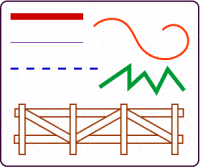
What kind of line is this?

a)

vertical

b)

broken

c)

zig zag

d)

curved

15.

What type of line is the following:

a)

horizontal

b)

diagonal

c)

straight

d)

curved

16.
What type of drawing is this?
a)
contour drawing
b)
3D drawing
c)
realistic drawing
d)
gesture drawing
17.
When lines are spaced closely and parallel to each other, this is called
a)
Hatching
b)
Cross Hatching
c)
Scubbling
d)
Margins
18.
What is a contour line?
a)
line of contour
b)
slowly drawn shape, that's very accurate
c)
outer edge of something, not shading
d)
A blind line
19.

The lines that define the form are called?

a)

cross contour

b)

contour

c)

line

d)

line quality

20.

This type of line is:

a)

cross contour

b)

contour

c)

blind contour

d)

continuous

21.

What types of lines make up the shapes in this drawing?

a)

Organic Lines

b)

Geometric Lines

c)

Cross Hatching Lines

d)

Stippling

22.

When we spread the material with our finger/Q-tip/blending stump we are __________.

a)

Rendering

b)

Stippling

c)

Rubbing

d)

Blending

23.

These types of lines can add motion and emotion to a work of art.

a)

Contour Lines

b)

Geometric Lines

c)

Diagonal Lines

d)

Expressive Lines

24.

When we use dots to create our image it's called ___________.

a)

Hatching

b)

Cross Hatching

c)

Stippling

d)

Blending

25.

What technique do we use when create a series of parallel lines to create a tone?

a)

Hatching

b)

Cross Hatching

c)

Stippling

d)

Blending

26.

What is it called when when use a series of perpendicular lines to create different tones?

a)

Cross Hatching

b)

Hatching

c)

Stippling

d)

Blending

27.

Lines that follow no rules and can be found in natures are what?

a)

Geometric Lines

b)

Organic Lines

c)

Hatch Lines

d)

Cross Hatching Lines

28.

What is it called when we give the illusion that something feels a certain way?

a)

Shape

b)

Blending

c)

Rendering

d)

Texture

29.

Check all of the items we can use to blend when sketching?

a)

Finger

b)

Q-tip

c)

Blending Stump

d)

Napkin

30.

The _______ of Art are what artists use to create their artworks.

a)

Principles

b)

Laws

c)

Elements

d)

Regulations

31.

This is a good example of what type of value contrast? Check all that apply.

a)

Low Contrast

b)

High Contrast

c)

Chiaroscuro

d)

Tony Stark Contrast

32.

This is a good example of what type of value contrast? Check all that apply.

a)

Low Contrast

b)

High Contrast

c)

Chiaroscuro

d)

Grey Contrast

33.

An element of art that refers to the lightness and darkness of an object/color.

a)

hue

b)

value

c)

movement

d)

contrast

34.
What is the first step in the four-step critique process?
a)
Analyze
b)
Interpret
c)
Judgement
d)
Describe
35.
What is the second step in the four-step critique process?
a)
Analyze
b)
Describe
c)
Interpret
d)
Judgment
36.
What is the third step in the four-step critique process?
a)
Judgement
b)
Describe
c)
Analyze
d)
Interpret
37.
What is the fourth step in the four-step critique process?
a)
Describe
b)
Analyze
c)
Judgment
d)
Interpret
38.
What happens in the describe stage?
a)
Subjective information is listed
b)
Objective information is explained
c)
Only the size of the work is written down
d)
The critic makes a claim of the work's merit
39.
What happens in the analysis stage?
a)
The critic makes a hypothesis about the art
b)
The critic determines the merit of the art
c)
The critic explains how the elements are arranged
d)
The critic explains the art's historical relevance 
40.
What happens in the interpretation stage?
a)
The critic makes a hypothesis pertaining to the art
b)
The critic lists the artist name, title, size of the art and media
c)
The critic sells the work
d)
The critic determines how much the art would sell for
41.
What happens in the judgment stage?
a)
The critic determines the merit of the art
b)
The critic describes objective facts
c)
The critic explains if the work is legal
d)
The critic forms a hypothesis pertaining to the art
42.
The four-step critique process allows for effective creating and understanding of visual sources.
a)
True
b)
False
43.
How many steps are in the critique process?
a)
2
b)
4
c)
6
d)
7
44.
True or False:
The Rule of Thirds can help to create a pleasing asymmetry in your images.
a)
True
b)
False
45.
Composition is:
a)
The way stuff looks.
b)
The placement or arrangement of all visual elements in an image.
c)
Random and uncontrollable.
d)
Made up of only Pattern and Rhythm.
46.
This photo is an example of...
a)
backlighting
b)
Macro
c)
Rule of thirds
d)
Framing