
NEW
Font size
 Worksheets
Characteristics of chemical reactions
Total questions: 25
Worksheet time: 13mins

How many carbon atoms will be present in the product?
1
2
3
4
How many hydrogen atoms will be present in the product?
1
2
3
4
How many oxygen atoms will be present in the product?
1
2
3
4
How many molecules of CO2 will be present in the product?
1
2
3
4
How many molecules of H2O will be present in the product?
1
2
3
4
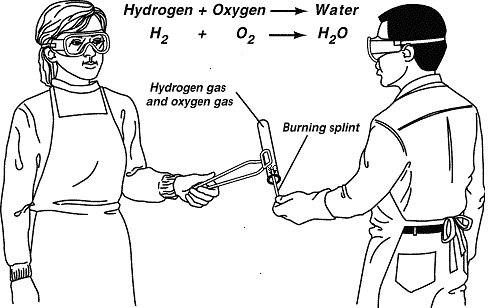
Using the photo above the items on the left of the arrow are called
reactants
products
Using the photo above the items on the right of the arrow are called
reactants
products
In a chemical process, atoms that make up a substance are regrouped into different __________ to form new substances with different properties.
molecules
color
precipitate
light
gas
A ___________ increase or decrease and the production of light are both signs that a chemical reaction may have occurred.
light
temperature
odor
precipitate
molecule
A __________ is a solid substance that forms and separates from a solution and may indicate that a chemical reaction has occurred.
light
color
gas
precipitate
molecule
An unexpected change in ____________ is a sign that a chemical reaction may have occurred.
molecule
color
light
precipitate
Substances giving off a smell (____________) while being combined is also an indicator of a chemical reaction.
light
odor
molecule
precipitate

Calcium Chloride was mixed with water and WHAT OTHER REACTANT to have a product that increases in temperature and produces a gas.
Baking Soda
Vinegar
Cornstarch
Phenol Red
A reaction in which energy is released by matter.
endothermic
exothermic
chemical reaction
A reaction in which energy is absorbed by matter.
endothermic
exothermic
chemical reaction
Which of the following is not an example of a chemical reaction? Select only one!
Rust on a steel object.
Mixing sugar in water.
Vinegar and baking soda.
Burning logs in a fireplace.
Production of light, production of gas, color change, change in temperature, and formation of precipitation are characteristics of a chemical reaction.
True
False
A student notices that sugar, when heated over a flame, turns black. How does the student know that a new substance is being formed?
A temperature of the sugar increases.
The color of the sugar changes to black.
Sugar began to melt within the test tube.
Sugar started as white crystals.
All of the following are evidence of a chemical change EXCEPT -
change in state of matter.
formation of a gas.
color change.
precipitate forms.
A student mixes two clear liquids together. After a few minutes, a white powder can be seen settling on the bottom of the test tube. Which of the following is a conclusion that the student can draw based on these observations? The two clear liquids -
have combined to produce a new substance.
were pure substances before they were mixed.
are toxic and should be handled with extreme caution.
have been stored too long and are no longer good.
A granular substance is added to a liquid. Which of the following would provide evidence to suggest a chemical change has taken place?
The liquid gives off heat.
The granules dissolve completely.
The volume of the liquid increases.
The granules seem to get smaller.
H2 + O --> H2O

