
NEW
Font size
 Worksheets
Nuclear Reactions
Total questions: 20
Worksheet time: 11mins
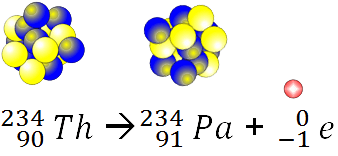



Why does beta decay occur?
The nucleus is too large to be stable
The proton to neutron ratio is unstable
The nucleus is in an excited state. This usually follows other types of decay.
Which of the following types of radioactive decay emits 2 protons and 2 neutrons?
Alpha
Beta
Gamma
Which force holds protons and neutrons together in the atom nucleus?
electric force
gravity
strong nuclear force
weak nuclear force

Which best represents nuclear fission?
F
G
H
J

Which of these diagrams represents the type of nuclear reaction that produces energy in the Sun?
A
B
C
D
What is the term for an ongoing series of nuclear reactions?
fission
chain reaction
fusion
nuclear

Nuclear fission of uranium-235 can start a chain reaction by
releasing enough thermal energy to start nuclear fission in neighboring atoms
producing two smaller atoms that can then strike and split neighboring atoms
producing neutrons that can then strike and split neighboring atoms
combining two atoms with low mass to form one large atom
In the Sun, hydrogen atoms fuse together to form _________.
helium
mercury
oxygen
nitrogen
Plutonium (of mass number 240 and proton number 94) decays with the emission of alpha-particle. What is the new proton number and mass number of the new nucleus?
proton number = 92, mass number = 236
proton number = 92, mass number = 240
proton number = 91, mass number = 240
proton number = 91, mass number = 236
The radioactive nucleus Rubidium (of mass number 87 and proton number 37) decays with the emission of a beta-particle. How many protons and neutrons are left in the nucleus?
protons = 37, neutrons = 49
protons = 37, neutrons = 50
protons = 38, neutrons = 49
protons = 38, neutrons = 87
What type of nuclear reaction occurs in the Sun?
nuclear fission
alpha decay
nuclear fusion
beta decay
Nuclear power plants work by
fusion
fission
fusion and fission
coal

