
 Worksheets
Geometry Unit 2 - Similarity and Transformations Review
Total questions: 65
Worksheet time: 2hrs 41mins

Consider the figure, segment MN is parallel to segment RP.
⅔
¾
4/3
3/2

Which can be used to show that the sum of the interior angles of the triangle is 180°.


Which sequence of transformations maps triangle 2 onto triangle 1?
a reflections across the x-axis, a reflection across the y-axis, and a translation left 1
a reflections across the x-axis, a reflection across the y-axis, and a translation right 1
a 180° clockwise rotation and a translation down 1 and left 1
a 180° clockwise rotation and a translation left 1 and up 1
Rectangle 1 is rotated 90° counterclockwise about the origin and then translated left 3 units to form rectangle 2. Which graph represents this scenario?


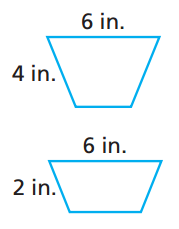
Katherine drew two similar rectangles. What is the area of the larger rectangle?
1.82 cm2
3.38 cm2
3.64 cm2
4.83 cm2

Using a proportion, find the height of the tree.
x = 0.0625 ft.
36 ft.
16 ft.


A(3,3) B(6,6) C(9,3)


Hugh drew similar triangles. What is the value of x in Hugh's drawing?
0.7
0.9
1.2
2.9

Triangle FGH is rotated and then dilated by a scale factor of n to form triangle F'G'H'. If ⊿FGH ∼ ⊿F'G'H', what is the value of n?
n = ¼
n = ⅓
n. = 3
n = 4

In the figure, triangle JKL is dilated about the origin to create triangle NPQ What is the scale factor of the dilation?
¼
½
2
4

Holly claims the two triangles on the coordinate plane are similar. Which is a valid argument to support Holly's claim?
One triangle can be mapped onto the other by a rotation of 180° about the origin.
One triangle can be mapped onto the other by translation 8 units right and 4 units down.
One triangle can be mapped onto the other by a reflection across the y-axis, followed by a rotation of 90° counterclockwise about the origin.
One triangle can be mapped onto the other by a reflection across the x-axis, followed by a translation 10 units right.

35°
55°
59°
66°


a triangle with angle measures 40° and 65°
a triangle with angle measures 45° and 65°
a triangle with angle measures 45° and 135°
a triangle with angle measures 70° and 135°

Yes. The triangles are similar by the SAS postulate
Yes. The triangles are similar by the AA postulate.
No. The triangles are not similar because they have only one equal angle.
No. The triangles are not similar because they have no similar side lengths.
Two angles in a triangle measure 25° and 67°. If a second triangle is similar to the first triangle, what is the measure of the largest angle of the second triangle.
155°
113°
92°
88°
Two angles in a triangle are 50° and 45°. If a second triangle is similar to the first triangle, what is the measure of the largest angle of the second triangle?
45°
50°
85°
180°

m + n + s = 180
m + n = q + r
n = q + s
n = 180° - q - s

a 270° counterclockwise rotation about the origin
a 270° clockwise rotation about the origin
a reflection across the x-axis followed by a 180° rotation about the origin
a reflection across the y-axis followed by a 180° rotation about the origin

True or False.
Triangle 1 is the result of translating Triangle 3 left 6 and up 2.
True
False

True or False.
Triangle 2 is the result of dilating Triangle3 by a scale factor of 2 only.
True
False

True or False.
Triangle 4 is the result of rotating Triangle 5 by 90° counterclockwise about the origin.
True
False

True or False.
Triangle 5 is the result of translating Triangle 1 right 6 and down 6.
True
False

(-4, ½)
(-4, 2)
(0, ½)
(0, 2)

a translation left 5 and down 4
a translation left 10 and down 9
a translation right 5 and up 4
a translation right 10 and up 9
A figure that undergoes a transformation where no point ever maps to itself. Which transformation must this be?
translation
rotation
reflection
dilation

For which shape will a rotation of 90° result in an image that is indistinguishable with respect to orientation.


Which transformation will carry the trapezoid onto itself?
a reflection across the y-axis
a reflection across the x-axis
a rotation of 180° about the origin
a translation of 2 units up

A reflection across the line passing through point Q and point S
a reflection across the line RQ
a rotation 90° clockwise about point Q
a rotation 180° clockwise about the point R
a rotation 360° clockwise about the point T

Which statement is true?
If line segment UV is translated 5 units right, the new line segment lies on the same line as the line segment UV.
If line segment UV is translated 4 units down, the new line segment is parallel to the line segment UV.
If line segment UV is rotated 270° clockwise about the origin, the new line segment is parallel to line segment UV.
If line segment UV is rotated 180° clockwise about the origin, the new line segment is perpendicular to line segment UV.

How many degrees does the wheel need to rotate about its axle so that the image of the wheel is indistinguishable from the original figure?
15°
30°
45°
65°
Which figure has the greatest order of rotational symmetry?









2. How many lines of symmetry does the picture have?
1
2
4
0


Translate the blue shape to the pink shape...
5 Right
2 Down
5 Left
2 Up
3 Right
1 Down
3 Left
1 Up


Work out the size of the missing angle
55
90
125
305

Work out the size of the missing angle
22
202
20
158


-----
10
-----
3
-----------
(2x+4)(4)
------
3.1

Select all the possible names for this plane.
plane CDAB
plane CDB
plane ADC
plane TCB

Which of these groups of points is noncollinear? (select all that apply)
Q, P, V
S, P, T
T, V, R
P, R, Q

Line p is parallel to line q
Lines r and s are not parallel.
What is the relationship between <3 & <10
Alternate Exterior
Alternate Interior
Consecutive Interior
Corresponding

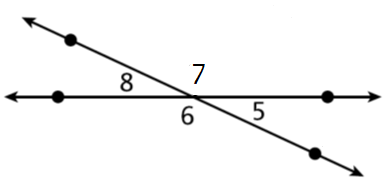
Which angles are vertical angles?
∠8 & ∠7
∠8 & ∠6
∠8 & ∠5
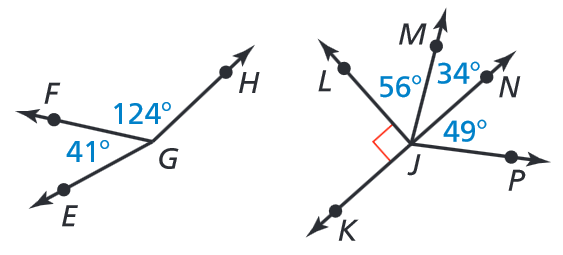
Which angle is complementary to ∠LJM
∠MJN
∠NJP
∠FGE
∠LJK

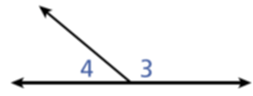
What type of angles are these? (select 2)
Adjacent Angles
Linear Pair
Complementary Angles
Supplementary Angles
Vertical Angles



