
Font size
 Worksheets
Conflict in the Colonies Unit Test Review
Total questions: 45
Worksheet time: 32mins
to refuse to buy certain products or services as protest or punishment
to boycott
to repeal
to veto
to ratify
1766 - this law said that Parliament had the power to make laws for the colonies after outrage over the Sugar Act
Declaratory Act
Intolerable Acts
Townshend Acts
Quartering Act
1774 - this series of laws was also known as the Coercive Acts. This closed Boston Harbor and passed the Quartering Act
Declaratory Act
Intolerable Acts
Townshend Acts
Quartering Act
1764 - this law taxed imported sugar and molasses
The Quartering Act
The Sugar Act
The Tea Act
The Stamp Act
1773 - this law allowed only one company to sell tea in the colonies
The Declaratory Act
The Intolerable Acts
The Tea Act
The Stamp Act
1767 - this law put taxes on glass, lead, paint, paper, and tea and allowed ships to be searched for smugglers.
The Declaratory Act
The Intolerable Acts
The Townshend Acts
The Stamp Act
1774 - this law allowed British soldiers to be housed by colonists
The Declaratory Act
The Intolerable Acts
The Townshend Acts
The Quartering Acts
A group founded by Samuel Adams that encouraged the colonists to boycott British goods and challenged British laws.
Committees of Correspondence
Sons of Liberty
Daughters of Liberty
The Boston Tea Party
On March 5, 1770, an argument between a British soldier and a colonist escalated and led to the deaths of five men. The British soldiers were defended by John Adams at trial.
Committees of Correspondence
Sons of Liberty
Boston Massacre
The Boston Tea Party
A slogan spread throughout the colonies as a statement against Parliament's taxes in the colonies. Colonists were angered that they had to pay taxes but did not have representation in Parliament.
One if by land, two if by sea
No taxation without representation
Don't tread on me
Join or die
The secret society founded by Samuel Adams and John Hancock -that used scare tactics and violence against tax collectors. Organized the Boston Tea Party.
Minute Men
Sons of Liberty
Committees of Correspondence
Daughters of Liberty
law forbidding English colonists to settle west of the Appalachian Mountains
Proclamation of 1763
Intolerable Acts
Townshend Acts
Quartering Act
Which side did Native Americans take in the French & Indian War?
The Bristish
The French
Different groups sided with each country
Native Americans did not fight in the war
What was the central issue in the dispute between Britain and its American colonies?
The restrictions Parliament placed on trade
The presence of British troops in the colonies
The colonists' right to religious freedom
The power to tax the colonists
Idea that reason and logic could improve society
Great Awakening
Enlightenment
Toleration Act of 1649
Middle Passage

What were the 2 main reasons for the French and Indian War?
Control of land and fur trade with Native Americans
Land and Slaves
Gold
Claim to land in Europe

What was the purpose of the Proclamation of 1763?
to avoid war issues with Native Americans
to increase British power in the colonies
to please the French fur traders
to collect fines from settlers who crossed the line
In 1215, a document called the __________ limited
the power of the king.
Mayflower Compact
Magna Carta
Cato's Letters
parliament
“No free man shall be seized or imprisoned, or stripped of his rights or possessions, or outlawed or exiled, or deprived of his standing in any other way, nor will we proceed with force against him, or send others to do so, except by the lawful judgement of his equals or by the law of the land”
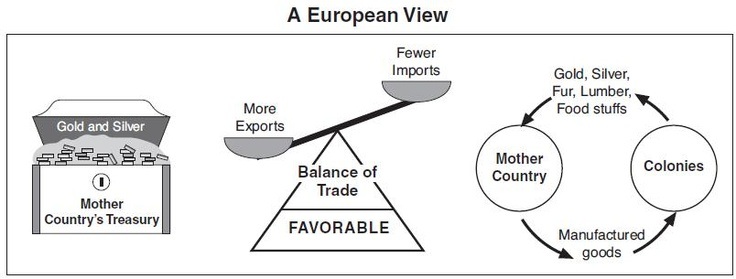
What is mercantilism?
A system where a mother countries gains money and power from natural resources that come from its colonies.
where colonies trade gold and silver with each other.
Wars that start over money.
Plantation colonies trading slaves for money.

According to Enlightenment thinker John Locke, why are governments created?
God gives monarchs a divine right to rule over their people
People are naturally selfish and need a strong ruler to create order
People set up governments to protect their lives and property
Civil government must be established to offset the power of the church
Introduced by Rousseau, people agree with their government to give up some of their freedom in exchange for protection of their rights in the ...
Scientific Revolution
Age of Reason
State of Nature
Social Contract
Under the idea of the "consent of the governed," what happens if government fails to protect the peoples' rights?
Nothing, people must obey the government
The people would have a right to revolt
The people would be returned to a state of nature
People would be forced to enter into a social contract

What was the purpose of the Albany Plan of Union?
To plan an attack on Fort Duquesne.
For the British to join with the Native Americans against the French
For colonies to unite under a central government and prepare for war
For the New England colonies to unite with the Iroquois to fight the French

Who was the first person killed in the Boston Massacre?
Hector
Crispus Attucks
Sam Adams
John Adams
Ideas, information. Distributed for purpose of winning people over, often without truth or fairness.
Propaganda
Debate
Newspaper
Political Cartoons


Who did the King feel should pay for the war?
British
colonists
Spain

How did the colonists protest the Stamp Act?
They burned the stamped paper in the streets.
They boycotted (refused to buy) British goods.
They refused to pay the tax
All of the above.
What was the meeting of the delegates (representatives) to discuss the Stamp Act called?
Stamp Act Congress
Stamp Act Convention
Continental Congress
All of the above
In the Treaty of Paris, after the French and Indian War, who gained control of all the land East of the Mississippi (except New Orleans)?
Britain
France
Spain


Select three ways the Sons of Liberty showed that they disagreed with the British Parliament.
They protested by speaking out against the taxes.
They wrote thank you letters to the King thanking him for the taxes.
They boycotted British good by refusing to them.
They captured British tax collectors and ran them out of town or made them quit their job.
Daughters of Liberty boycotted what items that were taxed?
tea & cloth
berries & juice
water & coffee
What was the purpose for establishing the Committees of Correspondence?
To maintain communication with one another
To start a war
To communicate with King George III
To invent the telephone

