wayground logo

Free Printable Worksheets

Font size

S
M
L
XL
Worksheets

HGEO Ch. 4 Transformations

Total questions: 64

Worksheet time: 1hrs 5mins

Name
Class
Date
1.
Translations, reflections and rotations are all known as ________________________.
a)
Geometry
b)
Transformations
c)
Congruent
2.
A slide is also called a _________.
a)
Translation
b)
Reflection
c)
Rotation
d)
Transformation
3.
A turn is also called a ___________.
a)
Translation
b)
Reflection
c)
Rotation
d)
Transformation
4.

A flip is also called ___________.

a)

Translation

b)

Reflection

c)

Rotation

d)

Transformation

5.

Describe the transformation in the image.

a)

Translation

b)

Reflection

c)

Rotation

6.

Describe the transformation in the image

a)

Translation

b)

Reflection

c)

Rotation

7.

Describe the transformation in the image

a)

Translation

b)

Reflection

c)

Rotation

8.

Describe the transformation in the iamge

a)

Translation

b)

Reflection

c)

Rotation

9.

Describe the transformation in the image.

a)

Translation

b)

Reflection

c)

Rotation

10.

Describe the transformation in the image.

a)

Translation

b)

Reflection

c)

Rotation

11.
Name the transformation.
a)
Translation
b)
Reflection
c)
Rotation
12.
Identify the transformation from ABC to A'B'C'.
a)
90o clockwise rotation
b)
90o counter clockwise rotation
c)
Reflection across the y-axis
d)
Reflection across the x-axis
13.
Identify the transformation.
a)
Reflection across y-axis
b)
90 Rotation counter clockwise
c)
Translation 5 units left, 1 unit up.
d)
Translation 5 units right, 1 unit down
14.
Identify the transformation from ABCD to A'B'C'D'.
a)
Translation
b)
Reflection across the y-axis
c)
Reflection across the x-axis
d)
90o counter clockwise Rotation
15.
Write a rule for the translation.
a)
 (x -1, y  + 2)
b)
 (x -2, y  + 1)
c)
 (x +2, y  - 1)
d)
(x +1, y  -  2)
16.
Identify the transformation.
a)
Reflection across y-axis
b)
90 Rotation counter clockwise
c)
Translation 5 units left, 1 unit up.
d)
Translation 5 units right, 1 unit down
17.
The image shows what type of transformation
a)
Rotation
b)
Translation
c)
Reflection
18.
Identify the transformation from ABC to A'B'C'.
a)
(x+8, y+4)
b)
(x-8, y-4)
c)
(x+4, y+8)
d)
(x-4, y-8)
19.
Is the picture being reflected in the y-axis or x-axis?
a)
y-axis
b)
x-axis
20.
What is this picture an example of? 
a)
An angle
b)
A cat vertex 
c)
Rotation 
d)
Dilation
21.
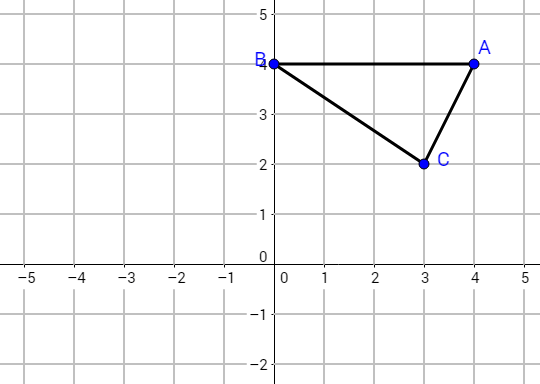
Reflect Point C over the y-axis:
a)
(-3, 2)
b)
(3,2)
c)
(-2,3)
d)
(3,0)
22.
Reflections over the x-axis change the ____-__________. 
a)
y-coordinate
b)
x-coordinate
23.
Which letter does not have symmetry?
G H O E
a)
G
b)
H
c)
O
d)
E
24.
Does the image show a Dilation?
a)
Yes
b)
No
25.
How many lines of symmetry does this shape have?
a)
0
b)
1
c)
2
d)
4
26.
If you were to rotate ABCD 180°  about the origin, what would the coordinate of A' be?
a)
(-5, 5)
b)
(-3, -5)
c)
(-5, 3)
d)
(-3, 3)
27.
If you were to rotate ABCD 90° counterclockwise about the origin, what would the coordinate of A' be?
a)
(-5, 5)
b)
(-3, 5)
c)
(-5, 3)
d)
(-3, 3)
28.
How many degrees was the figure rotated?
a)
90 degrees counterclockwise 
b)
180 degrees
c)
90 degrees clockwise
29.
How is Quadrilateral EFGH translated to E'F'G'H'?
a)
6 down
b)
6 down, 1 right
c)
6 down, 3 left
d)
8 down, 1 right
30.

How is the blue triangle rotated to the red triangle?

a)

90 clockwise

b)

90 counterclockwise

c)

180 clockwise

d)

180 counterclockwise

31.

Identify the transformation performed

a)

Translation

b)

Reflection

c)

Rotation

d)

Dilation

32.

Identify the transformation performed

a)

Translation

b)

Reflection

c)

Rotation

d)

Dilation

33.

Triangle A is rotated 90° clockwise with the origin as the center of rotation to create a new figure. Which triangle shows the new location?

a)

A

b)

B

c)

C

d)

D

34.
Triangle C is rotated 180° clockwise with the origin as the center of rotation to create a new figure. Which triangle shows the new location?
a)
A
b)
B
c)
C
d)
D
35.
If you were to rotate ABCD 90° counterclockwise about the origin, what would the coordinate of A' be?
a)
(-5, 5)
b)
(-3, 5)
c)
(-5, 3)
d)
(-3, 3)
36.

Determine where X' would be if you translated the figure -3 units to the horizontally and -9 units vertically.

a)

(-4, 4)

b)

(-10, 2)

c)

(-4, -5)

d)

(-1, 5)

37.
The point (8, 12) was dilated to become point (2, 3). What was the scale factor?
a)
½
b)
¼
c)
4
d)
2
38.

When you dilate the figure by a scale factor of 3, what is the location of B'?

a)

(12,0)

b)

(12,12)

c)

(4,3)

d)

(0,12)

39.

Translated figures are always __________________.

a)

Congruent

b)

Bigger

c)

Smaller

d)

Rotated

40.

A transformation that “turns” a figure about a fixed point is a _____________________.

a)

rotation

b)

translation

c)

reflection

d)

dilation

41.

A reflection ____________________.

a)

turns a figure around a point.

b)

slides an object form one place to another.

c)

flips or mirrors an object across a line.

d)

changes the size of an object.

42.

A type of transformation where a geometric figure slides horizontally, vertically, or both.

a)

dilation

b)

translation

c)

rotation

d)

reflection

43.

What information do you need to rotate an image?

a)

Center of rotation, reflection line, degrees

b)

Center of rotation, degree of rotation, direction

c)

Distance and Direction

d)

Reflection Line,CW, CCW

44.

What information do you need to translate an image?

a)

Reflection line

b)

Distance and reflection

c)

Distance and Direction

d)

Rotation degrees

45.

What information do you need to reflect an image?

a)

Line of rotation

b)

Line of reflection

c)

Degree of reflection

d)

Counter clockwise

46.

Which way do you rotate if you turn to the right?

a)

Clockwise

b)

Counter-clockwise

c)

upside down

d)

flip-flop

47.

What is the proper term for rotating to the left?

a)

Clockwise

b)

Counter-clockwise

c)

Turn

d)

Spin

48.

If you rotate an image 90 degrees clockwise and then rotate 90 degrees counter-clockwise, what happens to the image?

a)

The image gets flipped

b)

The image will be upside down

c)

The image goes back to its original position

d)

The image enlarges

49.

If an image is 3 units away from the reflection line and the image is reflected over the line, how many units will the new image be from the reflection line?

a)

5 units

b)

4 units

c)

0 units

d)

3 units

50.

If an image is translated down 2 units and to the right 3 units, what would you need to do to get the image back in it's original position?

a)

Translate it to the left 3 units and up 2 units

b)

Translate it down 2 units and to the right 3 units

c)

Reflect it over the x-axis

d)

Rotate the image with the center as the origin

51.

If an image were reflected over the x-axis from quadrant 1 to quadrant 4, what would you need to do to reflect it to quadrant 3?

a)

Translate it two units to the right

b)

Rotate 20 degrees CCW

c)

Reflect it over the x-axis

d)

Reflect it over the y-axis

52.

What is the paper called that you have used to learn about transformations?

a)

Patty Paper

b)

Tracing paper

c)

Foil

d)

Translation paper

53.
When you translate, (x-4,y) will move _____.
a)
4 units right
b)
4 units left
c)
4 units up
d)
4 units down
54.
When you translate, (x,y+6) will move _____.
a)
6 units right
b)
6 units left
c)
6 units up
d)
6 units down
55.
When you reflect a shape, you ______ over an axis or line.
a)
Flip
b)
Rotate
c)
Slide
d)
Expand
56.
Write a rule for the translation.
a)
 (x -1, y  + 2)
b)
 (x -2, y  + 1)
c)
 (x +2, y  - 1)
d)
(x +1, y  -  2)
57.
Point (-5,2) is reflected over the y axis.  Where is the new point located?
a)
(5,2)
b)
(-5,-2)
c)
(-5,2)
d)
(5,-2)
58.
Point (7,2) is translated vertically 2 units and horizontally -5 units.  Where is the new point located?
a)
(9,-3)
b)
(2,4)
c)
(2,0)
d)
12,4)
59.
Apply the following rule to the point (-5,6):
(x,y)-->(y,-x)
a)
(-5,-6)
b)
(5,-6)
c)
(6,5)
d)
(-6,5)
60.
Which rule would result in a translation of 2 units left and 3 units up?
a)
(x, y) → (2x, 3y)
b)
(x, y) → (x - 2, y + 3)
c)
(x, y) → (-x, -y)
d)
(x, y) → (x + 2, y - 3)
61.
Reflect Point C over the y-axis:
a)
(-3, 2)
b)
(3,2)
c)
(-2,3)
d)
(3,0)
62.

Which figure when rotated 90 degrees will carry onto itself

a)

square

b)

hexagon

c)

rectangle

d)

traiangle

63.

What is the lowest degree of rotation greater than 0° that will carry the hexagon onto itself?

a)

90 degrees

b)

180 degrees

c)

270 degrees

d)

360 degrees

64.

Square ABCD is reflected about side BC. Which of the following statements are true?

a)

BC is parallel to AA'

b)

Vertex B is the midpoint of AA'.

c)

The length of CD' is twice the length of DD'

d)

Vertex C and C' are located at 2 different points.