wayground logo

Free Printable Worksheets

Font size

S
M
L
XL
Worksheets

Atmosphere and Hydrosphere

Total questions: 19

Worksheet time: 18mins

Name
Class
Date
1.

The atmosphere is...

a)

The combination of rocks and minerals over the planet.

b)

The combination of gases organized by layers.

c)

The combination of all the lifeforms over the planet.

d)

The combination of all the forms of water in the planet.

2.

The hydrosphere is...

a)

The combination of rocks and minerals over the planet.

b)

The combination of gases organized by layers.

c)

The combination of all the lifeforms over the planet.

d)

The combination of all the forms of water in the planet.

3.

Which one is not a layer of the atmosphere?

a)

Troposphere

b)

Stratosphere

c)

Mantle

d)

Thermosphere

4.

What is the percentage of water in our planet?

a)

1/2

b)

2/3

c)

3/4

d)

4/4

5.

Where is mostly accumulated the gases from the atmosphere?

a)

Troposphere

b)

Stratosphere

c)

Mesosphere

d)

Exosphere

6.

What is the percentage of salty water in the hydrosphere?

a)

93%

b)

5%

c)

1,2%

d)

0,8%

7.

Mark the chemical compounds that form the atmosphere.

a)

Nitrogen

b)

Boron

c)

Gold

d)

Oxygen

8.

Which ones are the energies required for the water cycle to exist?

a)

Fossil fuels

b)

Solar power

c)

Gravity

d)

Wind power

9.
What is the most common state of water?
a)
water vapour
b)
liquid
c)
ice
10.
What are lakes and rivers?
a)
surface water
b)
groundwater
c)
seawater
11.
What type of inland water has very low salt content?
a)
Fresh water
b)
Brackish water
c)
Salt water
12.
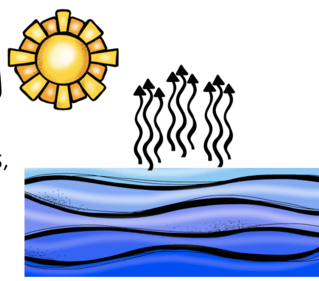
What part of the water cycle does this picture show?
a)
condensation
b)
precipitation
c)
evaporation
d)
transpiration
13.
Evaporation happens when the sun ___________ water and turns it into vapor.
a)
cools
b)
heats up
c)
freezes
d)
lights up
14.
What is the water cycle?
a)
the 3 forms of water
b)
the movement of water on, above, or below the surface of the Earth
c)
when water melts
d)
when clouds form
15.
What is water that flows in rivers and streams into the oceans and lakes?
a)
evaporating
b)
condensing
c)
precipitating
d)
runoff
16.

Global warming is accelerated by the reduction of global snow and ice cover.

a)

True

b)

False

17.

PRECIPITATIONS OCCUR IN THE...

a)

OZONE LAYER

b)

STRATOSPEHRE

c)

TROPOSPHERE

18.
What is condensation?
a)
The part of the water cycle when the sun heats up water, turning it from a liquid into water vapor or steam. It rises from the ground into the air.
b)
The part of the water cycle when the water vapor in the air gets cold. The water turns back into a liquid and forms clouds.
c)
The part of the water cycle when clouds get heavy and can no longer hold the liquid water. This causes the water to fall from the sky to the earth as rain, snow, sleet, or hail.
19.

what are the consequences of air pollution in the human health? (Cuáles son las consecuencias de la contaminación del aire en la salud humana?

a)

fat and baldness

b)

sugar and blindness problems

c)

asthma, heart disease and cancer.

d)

stress problems