
 Worksheets
Unit 2 Review
Total questions: 63
Worksheet time: 16hrs 45mins
Which of the following types of transformations are classified as rigid motions? Select all that apply.
Translation
Reflection
Rotation
Dilation
Point P at (5,2) undergoes a composition of T(3,2)(RO, 90°). What are the coordinates of P'?
(-4, 8)
(-2, 5)
(1, 7)
(5, -3)
What is the inverse of the composition ry=2(T(-2,3)(rx=1))?
rx=1(T(3,-2)(ry=2))
rx=1(T(2,-3)(ry=2))
ry = -2(T(3,-2)(rx = -1))
ry = -2(T(2,-3)(rx = -1))

Given ∆ABC ≅ ∆LMN and the sides lengths of ∆ABC shown below, what is the longest side of ∆LMN?
̅L̅M̅
̅L̅N̅
̅N̅L̅
̅N̅M̅
Given ∆QRS and ∆TUV are congruent right triangles such that ∠R is a right angle and ∠V= 35°. What is the measure of ∠Q?
35°
55°
125°
145°
Select all triangle congruence criteria.
SSS
AAS
SAS
ASA
HL

Describe the transformation in the image.
Translation
Reflection
Rotation

Triangle A is rotated 180° clockwise with the origin as the center of rotation to create a new figure. Which rule describes rotating 180° clockwise?
(x,y)→(y, -x)
(x,y)→(x,y)
(x,y)→(-y,x)
(x,y)→(-x,-y)
Triangle A is rotated 90° counterclockwise with the origin as the center of rotation to create a new figure. Which rule describes rotating 90° counterclockwise?
(x,y)→(y, -x)
(x,y)→(x,y)
(x,y)→(-y,x)
(x,y)→(-x,-y)


What are the coordinates of point A' , the image of point A(-4, 1) after the composite transformation R90°(ry=x) where the origin is the center of rotation?
(-1, -4)
(-4, -1)
(1, 4)
(4, 1)
The coordinates of triangle JRB are ,J(1, -2) , R(-3, 6) and B(4, 5) . What are the coordinates of the vertices of its image after the transformation T(2, -1)(ry-axis)?
(3, 1), (-1, -7), (6, -6)
(3, -3), (-1, 5), (6, 4)
(1, -3), (5, 5), (-2, 4)
(-1, -2), (3, 6), (-4, 5)
If the coordinates of point P are (2, -3) , then R90°(R180°) is
(-2, 3)
(-2, -3)
(3, -2)
(-3, -2)


State if the two triangles are congruent. If they are, state how you know.
A
B
C
D
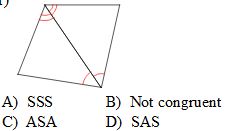


The two triangles are congruent via:
SSS
SAS
AAA
HL
Not enough information
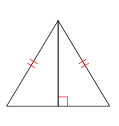

State what additional information is required in order to know that the triangles are congruent for the given reason.
∠V ≅ ∠S
̅V̅W̅ ≅ ̅S̅R̅ or ̅W̅U̅ ≅ ̅R̅T̅
∠U ≅ ∠T or ∠V ≅ ∠S
∠U ≅ ∠T
Given ∆ABC and ∆DEF have ∠A ≅ ∠D, ̅A̅B̅ ≅ ̅D̅E̅ and ̅C̅A̅ ≅ ̅F̅D̅. By which triangle ∆ABC ≅ ∆DEF?
AAS
ASA
SAS
SSA

Determine if the two triangles are congruent. If they are, state how you know.
Not enough
SSS
AAS
SAS

Determine if the two triangles are congruent. If they are, state how you know.
SSS
ASA
AAS
Not enough information

Given ∆ABC and ∆DEF, complete the final row of the proof.
Statement: ∆ABC ≅ ∆DEF Reason: AAA
Statement: ∆ABC ≅ ∆FED Reason: AAA
Statement: ∆ABC ≅ ∆DEF Reason: ASA
Statement: ∆ABC ≅ ∆DEF Reason: ASA

Find the measure of ∠A.
50°
35°
70°
55°

Find the measure of ∠A.
30°
140°
75°
20°

Find the measure of ∠A.
45°
135°
31°
84°

Find the value of x.
13
10
-11
-10
The equations shown below represent two altitudes of a triangle.
y = x + 1
y = -2x - 1
What are the coordinates of the orthocenter of the triangle?
(0, 1)
(2, 3)
(-⅔, ⅓)
(-⅔, -⅓)
Given ∆ABC with centroid E and median AD, find AE if AD = 30.
10
15
20
45

Given ∆ABC with circumcenter P, find BD if BP = 12 and BC = 22.
6
11
12
22
Given ∆ABC with incenter D, find m∠ACD if m∠ACB = 3x + 54 and m∠ACD = x + 31.
39°
78°
116°
147°
What is the corresponding point of concurrency of an altitude?
orthocenter
centroid
circumcenter
incenter
What is the corresponding point of concurrency of a median?
orthocenter
centroid
circumcenter
incenter
What is the corresponding point of concurrency of a perpendicular bisector?
orthocenter
centroid
circumcenter
incenter
What is the corresponding point of concurrency of an angle bisector?
orthocenter
centroid
circumcenter
incenter
Which of the following points of concurrency must be located inside of any triangle? Select all that apply.
orthocenter
centroid
circumcenter
incenter

Find LM.
16
4
2
22

State all possible names for the figure.
parallelogram, rectangle, square
quadrilateral, rhombus, rectangle, square
quadrilateral, parallelogram, rhombus, rectangle, square
parallelogram, rhombus, square

Find the m∠C.
98°
85°
95°
50°

Find the length of the median of the trapezoid.
27
28
33
22

Find the m∠R of this trapezoid.
35°
69°
108°
100°

Find the m∠E of this trapezoid.
65°
130°
85°
50°

DF = 3x + 9
EG = 4x + 5
Find DF.
20
21
23
25

KA = 2x - 18
AM = x - 6
Find KM of this parallelogram.
21
6
11
12

Find m∠SRQ in this parallelogram.
40°
120°
35°
85°
Which of the following is not a sufficient condition to prove a quadrilateral is a parallelogram?
The diagonals bisect each other.
One pair of opposite sides is parallel.
Both pairs of opposite sides are congruent.
Both pairs of opposite angles are congruent.

Which of the following additional pieces of information would allow you to prove that ABCD is a parallelogram?


Each of the following sets of given information is sufficient to prove that ▱SPAR is a rectangle except:
▱SPAR and ∠SPA ≅ ∠PAR
SK = KA = RK = KP
▱SPAR and ∠SKP ≅ ∠PKA
∠RSP ≅ ∠SPA ≅ ∠PAR ≅ ∠ARS
What is the best name for a quadrilateral if the diagonals are congruent and bisect each other?
parellelogram
rectangle
kite
trapezoid

Each of the following sets of given information is sufficient to prove that ▱HOPE is a rhombus except:
HX = XP = XE = XO
OH = OP = PE = HE
▱HOPE and ∠HXO ≅ ∠OXP
▱HOPE and HE = PE
Given quadrilateral SOPH with coordinates S(-8, 0), O(0, 6), P(10, 6), and H(2, 0), what is the best name for this figure?
parallelogram
rectangle
rhombus
square
What is the best name for an equilateral quadrilateral whose diagonals are congruent?
parallelogram
rectangle
rhombus
square
How many right angles can be contained in a quadrilateral? Select all that apply.
0
1
2
3
4
A quadrilateral must be a kite, trapezoid, or a parallelogram.
True
False
What is the sum of the four interior angles of any quadrilateral?
90°
180°
360°
The sum varies based on the type of quadrilateral.

Given: △DTG with centroid I (capital "i")
Given: DH = 4x + 10 and HI = 2x - 4
Find x.
10
11
12
13

