
 Worksheets
Types of Bonds, Counting Atoms, Balancing Equations
Total questions: 36
Worksheet time: 3hrs 0mins
Name
Class
Date
1.
When forming an ionic bond, a metal atom
a)
Gains electrons to form a cation
b)
Loses electrons to form a cation
c)
Gains electrons to form an anion
d)
Loses electrons to form an anion
2.
How many Hydrogen are in 4H2O?
a)
6
b)
8
c)
2
d)
4
3.
2H2 + O2 ----> 2H2O What is the product?
a)
------>
b)
2H2O
c)
2H2+ O2
4.
How many O's are in Al₂(SO₄)₃
a)
4
b)
12
c)
7
d)
24
5.
What is a coefficient?
a)
The small number on the right of the chemical symbol.
b)
The large number to the left of a formula.
6.

Is this equation balanced?
a)
yes
b)
no
c)
Not enough information
7.
The law of conservation of matter states that
a)
chemical reactions change matter.
b)
in chemical reactions, the identity of reactants and products is conserved.
c)
atoms are neither created nor destroyed in chemical reactions.
d)
a chemical equation must be balanced.
8.
Why is the following chemical equation not balanced?
H2 + O2 --> H2O
H2 + O2 --> H2O
a)
each side of the equation has a different number of oxygen atoms
b)
each side of the equation has a different number of hydrogen atoms
c)
each side has the same mass
9.
What is the part of the chemical equation in green called?
Fe + S --> FeS
Fe + S --> FeS
a)
products
b)
reactants
c)
yield
d)
chemical formula
10.
How many total atoms are in the compound C2H8O ?
a)
11
b)
2
c)
8
d)
1
11.
How many Chlorine are in MgCl2?
a)
2
b)
1
c)
3
12.
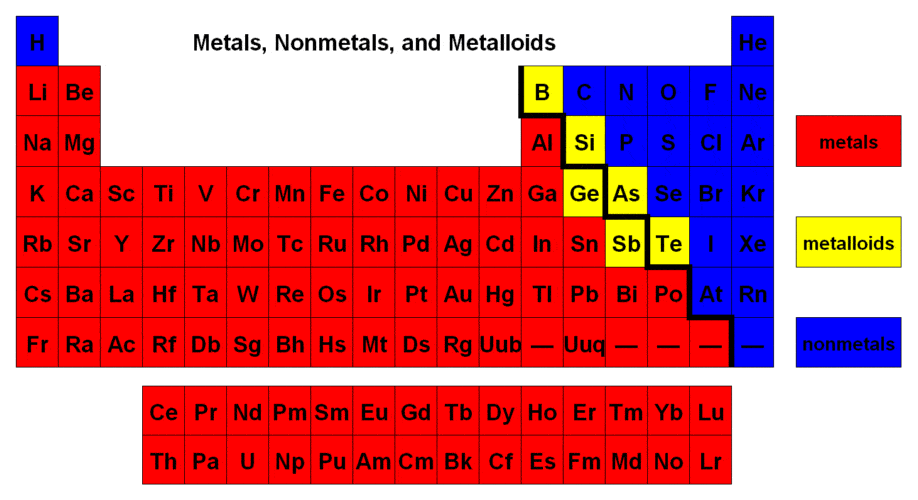
What elements generally make an ionic bond?
a)
metal and nonmetal
b)
2 or more nonmetals
c)
metal
d)
none of the above
13.
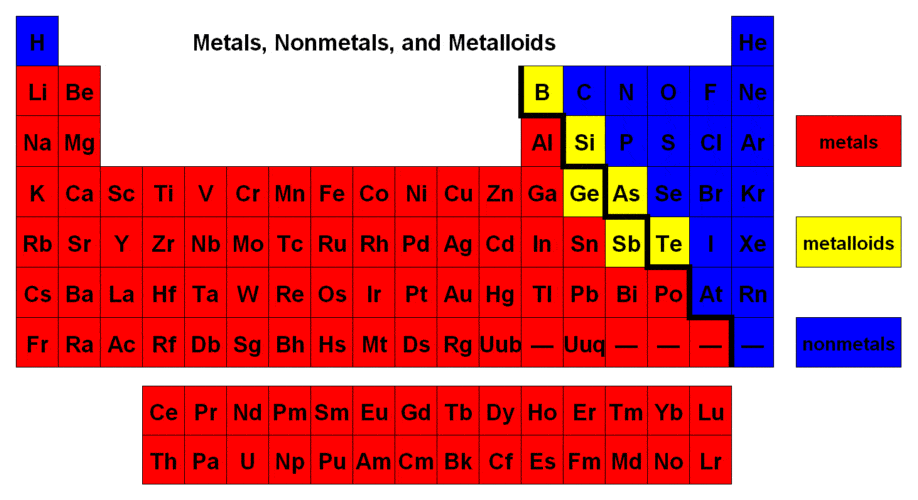
What elements generally make a covalent bond?
a)
metal and nonmetal
b)
2 or more nonmetals
c)
metal
d)
none of the above
14.
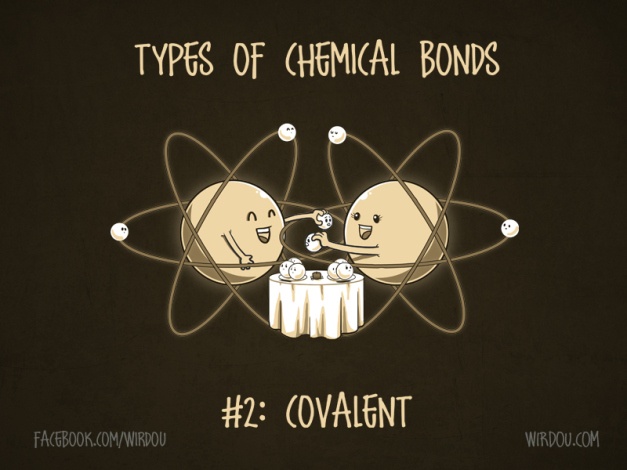
In chemical compounds, covalent bonds form when
a)
the electronegativity difference between two atoms is very large.
b)
electrons are completely transferred between two metals.
c)
pairs of electrons are shared between two nonmetal atoms.
d)
two nonmetal atoms are attracted to each other by opposite charges.
15.
An ionic bond forms when
a)
Valence electrons are shared
b)
a sea of mobile electrons surround the cations
c)
valence electrons are transferred between atoms
d)
none of the above
16.
Predict the bond that will form between Be and F.
a)
Ionic
b)
Covalent
17.
Predict the bond that will form between Se and Cl.
a)
Ionic
b)
Covalent
18.
What is a valence electron?
a)
an electron that is found in the outermost shell of an atom.
b)
an electron found in the innermost shell of an atom.
c)
an electron found in the middle shell.
19.
A positively or negatively charged particle.
a)
covalent bond
b)
compound
c)
ion
d)
chemical bond
20.
A chemical bond formed between shared atoms.
a)
chemical bond
b)
covalent bond
c)
oxidation #
d)
ionic bond
21.
How many Magnesium are in 10MgCl2?
a)
10
b)
5
c)
20
22.
Number of N in (NH₄)₂CrO₄
a)
1
b)
2
c)
8
d)
16
23.
How many atoms of Carbon are in the compound C2H8O ?
a)
8
b)
2
c)
1
d)
11
24.
Is the following equation balanced or unbalanced?
Fe + S --> FeS
Fe + S --> FeS
a)
balanced
b)
unbalanced
25.
Which of the following is an unbalanced equation?
a)
CaCO3 --> CaO + CO2
b)
PbO2 + 2H2-->2Pb + H2O
c)
2Na+ 2H2O-->2NaOH + H2
d)
CS2 + 3O2 --> CO2 + 2SO2
26.
Is this balanced?...
Al + O2 --> 2Al2O3
Al + O2 --> 2Al2O3
a)
Yes!
b)
NO!
27.
Which substance contains bonds that involve a transfer of electrons from one atom to another?
a)
CO2
b)
NH3
c)
KBr
d)
Cl2
28.

Which type of bond involves atoms giving up and gaining electrons?
a)
Ionic bonds
b)
Covalent bonds
c)
Metallic bonds
d)
Electro bonds
29.
In covalent bonds, atoms...
a)
share some of their valence electrons
b)
share some of their protons
c)
form malleable substances
d)
give up or gain some electrons
30.
Metallic bonds join...
a)
Metals to nonmetals
b)
Metals to metals
c)
Metals to metalloids
d)
Metalloids to nonmetals
31.
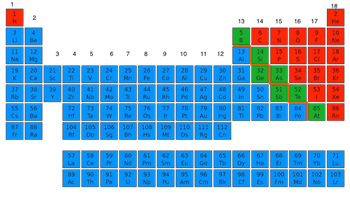
In this periodic table, what type of element is shown in blue?
a)
metals
b)
nonmetals
c)
metalloids
32.
If an atom loses two electrons what charge will it have?
a)
-2
b)
-1
c)
+1
d)
+2
33.
If an atom has no charge, which of the following must be true?
a)
It has more neutrons than protons or electrons.
b)
There are only neutrons inside the atom.
c)
Its number of protons is equal to its number of electrons.
d)
The neutrons in the atom outnumber the electrons and protons.
34.
What type of chemical bond is found in NO2?
a)
Covalent
b)
Ionic
c)
Metallic
d)
Both Covalent and Ionic
35.
Where are the nonmetals located on the periodic table?
a)
Blue
b)
Red
c)
Green
36.
How many valence electrons does calcium have?
a)
2
b)
4
c)
6
d)
7
100 %

