
 Worksheets
All about carbon
Total questions: 39
Worksheet time: 36mins

How many bonds will a C atom form?
1
2
3
4

6 Carbon atoms can form many different compounds.
TRUE
FALSE
Which of the following is not an organic compound?
Sugar
Water
Petrol
Fat
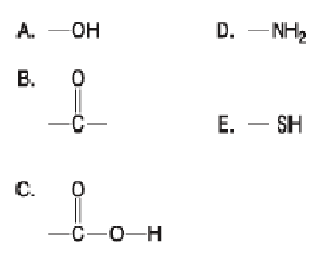
Which of the following is the functional group of alcohols?
CH
CO
OH
H
molecule with the same molecular structure but different structural formula
fats
lipids
fossil fuels
isomers


glucose and fructose have the same chemical formula but different shapes. This makes them
tricky
isomers
functional groups
the same molecule

which functional group is shown in the picture?
hydroxyl group
carbonyl group
carboxyl group
amino group

Which functional group is shown in the picture?
hydroxyl group
carbonyl group
carboxyl group
amino group

which functional group is shown in the picture?
hydroxyl group
carbonyl group
carboxyl group
amino group

alcohols have which functional group?
hydroxyl group
carbonyl group
carboxyl group
amino group

Which function group is on the left side of this amino acid?
hydroxyl group
carbonyl group
carboxyl group
amino group
The four most common elements in living things are
carbon, hydrogen, sulfur, iron
cobalt, helium, nitrogen, oxygen
carbon, hydrogen, nitrogen, oxygen
calcium, lithium, nitrogen, oxygen

An α-helix is an example of which level of protein structure?
Primary
Secondary
Tertiary
Quaternary
DNA utilizes the bases guanine, cytosine, thymine, and adenine. In RNA, _______ is replaced by _____.
adenine; arginine
thymine; uracil
cytosine; uracil
cytosine; arginine
Amino acids are linked together into proteins by which of the following bond types?
Noncovalent bonds
Phosphodiester bonds
Peptide bonds
none of the above
Lipids are composed of
glycerol and amino acids
fatty acids and glycerol
steroid precursors and starch
cholesterol and glycerol
You have isolated a monomer with the following components; a phosphate group, a sugar, and a nitrogen-containing base. Polymers synthesized from this monomer belong to what class of macromolecules?
Carbohydrate
Lipid
Protein
Nucleic Acid
DNA codes for 20 different amino acids. Which of the following is responsible for making each of the amino acids unique from one another?
hydroxyl group
amino group
sulfhydryl group
"R" group
A folded, coiled macromolecule that consists of one or more polypeptide chains describes a
phospholipid molecule
glycogen molecule
protein molecule
cholesterol molecule
Which of the following statements regarding lipids is most accurate?
Saturated fats tend to be solid at room temperature
Lipids are synthesized by ribosomes
Saturated fats tend to be liquid at room temperature due to hydrogen bonds.
Unsaturated fats do not have double bonds.

Which of the following statements is/are true regarding the chemical reaction illustrated in Figure 5.5?
It is a hydrolysis reaction.
It is a hydrolysis reaction and it results in a peptide bond.
It results in a dehydration reaction that is breaking the two amino acids apart.
It is a dehydration reaction that is joining two amino acids together.

Which macromolecule is shown?
a lipid
an amino acid of a protein
a nucleotide of a nucleic acid
a carbohydrate
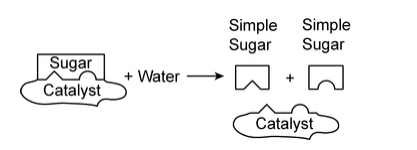
What happens when enzymes are heated to a high temperature?
The enzymes die.
Denaturation occurs meaning that the shape of the enzymes are altered.
The enzymes' amino acid sequence changes.
The enzymes remain the same

What functional group is present on the molecule?
Hydroxyl group
Carboxyl group
phosphate group
Carbonyl Aldehyde
The repeating units of protein are
Amino acids
Glucose
Fatty acid
Peptides



