
 Worksheets
Energy Transfer: Conduction, Convection, Radiation
Total questions: 25
Worksheet time: 39mins
Name
Class
Date
1.
What is the transfer of heat by movement of liquids or gases?
a)
Radiation
b)
Convection
c)
Conduction
d)
Heat
2.
What are waves that can transfer heat through the vacuum of empty space?
a)
Electromagnetic waves
b)
Convection
c)
Conduction
d)
Heat
3.
What is the transfer of heat by direct contact?
a)
Convection
b)
Electromagnetic waves
c)
Radiation
d)
Conduction
4.
What is the measurement of the average kinetic energy of a substance?
a)
Kinetic energy
b)
Temperature
c)
Thermal energy
d)
Potential energy
5.
What is a substance that does NOT conduct heat well?
a)
Conductor
b)
Insulator
c)
Convector
d)
Radiator
6.
What is a substance that DOES conduct heat well?
a)
Conductor
b)
Insulator
c)
Convector
d)
Radiator
7.
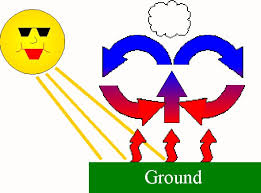
Warm air rises and the cool air sinks. This is...
a)
conduction
b)
convection
c)
radiation
8.

Heat transfers from an area of ________temperature to an area of ______ temperature.
a)
high to low
b)
low to high
c)
high to high
9.

Warm water from the ocean moves to the north while cool waters moves to the south. This is an example of..
a)
Conduction
b)
Convection
c)
Radiation
10.

If an object has particles that are moving very quickly, the object 's temperature is probably _____.
a)
cold
b)
slow
c)
big
d)
hot
11.

When the temperature of matter decreases the particles ...
a)
speed up and move farther apart
b)
speed up and move closer together
c)
slow down and move farther apart
d)
slow down and move closer together
12.
The movement of thermal energy from a warmer object to a cooler object is called:
a)
heat
b)
temperature
c)
motion
d)
momentum
13.
Heat transfer occurs:
a)
in many directions
b)
both from warm objects to colder ones and from cold objects to warmer ones
c)
only from warm objects to colder ones
d)
only from cold objects to warmer ones
14.
A measure of the average kinetic energy of the individual particles in an object is called:
a)
thermal energy
b)
conduction
c)
convection
d)
temperature
15.
When you touch something that feels cold,
a)
heat from your hand moves into the cold substance.
b)
coldness moves from the cold substance into your hand.
c)
it melts.
d)
it freezes.
16.
Energy that moves particles of matter is
a)
temperature
b)
thermal energy
c)
heat
d)
friction
17.
The temperature of a substance increases as___.
a)
the substance expands
b)
the average kinetic energy of its particles increases
c)
the substance's volume increases
d)
the substance's mass increases
18.

The ability to do work or cause change
a)
speed
b)
job
c)
transfer
d)
energy
19.
The law of conservation of energy states that
a)
no energy is destroyed
b)
energy can be destroyed
c)
energy is created
d)
some amount of energy cannot be accounted for
20.
You're holding hands with your best friend. Your friend's hands are REALLY warm and yours are really cold. After a few minutes, this has changed. How might you explain what happened?
a)
The cold energy from your hand transferred to your friend's hand through conduction.
b)
The heat energy from your friend's hand transferred to your hand through conduction.
c)
The cold energy from your hand transferred to your friend's hand through convection.
d)
The heat energy from your friend's hand transferred to your hand through convection.
21.
What is the formula to calculate heat energy required to raise the temperature of any substance?
a)
Q=mc∆t
b)
Q=mc
c)
Q= ½mv
d)
m=QC
22.
What unit do you use to measure Thermal Energy?
a)
J/Kg ºC
b)
Kg
c)
ºC
d)
J
23.
The energy transferred between object's at different temperatures
a)
heat
b)
thermal energy
c)
radiation
d)
convection
24.
How much heat is required to raise the temperature of a sample of copper from 10.0°C to 55.0°C, if its mass is 10.00 g? specific heat of copper is 0.385 J/(g∙°C).
a)
1881 J
b)
250. J
c)
173 J
d)
359 J
25.
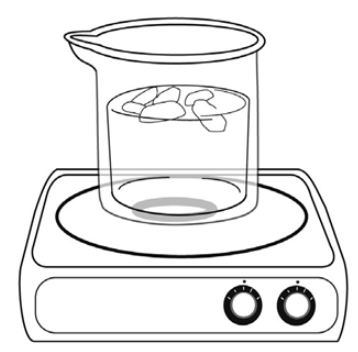
Emerson places a beaker of water on a hotplate and turns the hotplate on. The temperature in the room is 25 ºC. After the water heats to 75 ºC, she adds pieces of ice to the beaker.
Which of the following describes a transfer of heat energy that occurs during this experiment?
a)
from the air to the water
b)
from the ice to the beaker
c)
from the water to the ice
d)
from the water to the hotplate
100 %

