
 Worksheets
7th Homework Quiz 1
Total questions: 28
Worksheet time: 7hrs 0mins
In a damped oscillation, a force acts to change the amplitude of oscillation.
Which of the following statements about the direction of this force is correct?
The force is in the opposite direction to the displacement.
The force is in the opposite direction to the velocity.
The force is in the same direction as the displacement.
The force is in the same direction as the velocity.

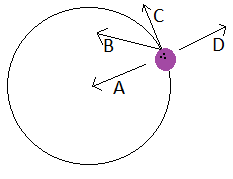
The diagram shows a coin on a horizontal surface which is rotating at a constant angular velocity ω
Which arrow correctly shows the direction of the frictional force on the coin?A
B
C
D

Which graph shows how the electric field strength E due to a negative point charge varies with distance r from the charge?
A
B
C
D

Two charges +Q and –Q are located as shown on the diagram. × is the point halfway between the two charges.
A small positive charge moves from +Q to –Q. Which statement about the resultant force on this charge, as it passes through ×, is correct?
The magnitude of the resultant force is a maximum.
The magnitude of the resultant force is a minimum.
The resultant force changes direction.
The resultant force is zero.


The unit for capacitance is the farad. The farad can also be written as
A s V-1
A s-1 V-1
A-1 s-1 V
A-1 s V


Change Q on a capacitor varies with voltage V . The area of triangle OAB represents
Capacitance
Capacitive reactance
Magnetic field between the plates
Energy stored in the capacitor
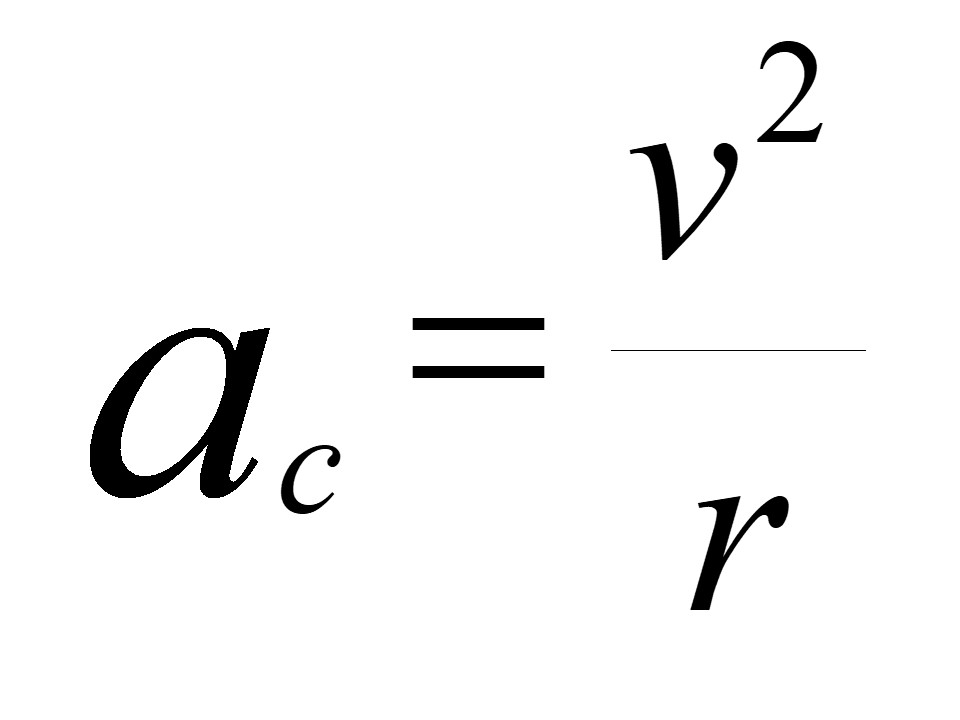
What's the centripetal acceleration of an object traveling 2.3 m/s around a circle of diameter 0.6 m?
5 m/s2
17.63 m/s2
10 m/s2
8.81 m/s2
A ball on a string is spun around in a circle. Which of the following quantities is not constant?
mass
force
velocity
acceleration
In a charged capacitor, the energy resides in
The positive charges
Both the positive and negative charges
The field between the plates
Around the edge of the capacitor plates
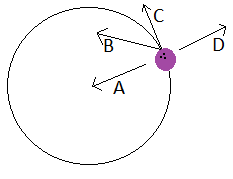
Which of the following depict the speed of the bowling ball?
A
B
C
D
During charging a capacitor variation of potential V of the capacitor with time t is shown as


What would the force between them be if the distance between them were doubled?
The electric field strength between a pair of parallel plates is E. The separation of the plates is doubled and the potential difference between the plates is increased by a factor of four.
What is the new electric field strength?
E
2E
4E
8E

An electron of charge e is introduced between two metal plates a distance d apart.
A potential difference V is applied to the plates as shown in the diagram.
Which expression gives the electric force F on the electron?
deV
eVd
edV
edV
Electric field is dimensionally equivalent to which of the following?
Nm/C
N/C
Nm2/C
N/C2
The beam of electrons that hits the screen of an oscilloscope is moved up and down by:
gravity
varying the electron's charge
electrical charges on deflecting plates
electrical repulsion between electrons

The 0.5 kg ball travelling at 3ms-1 hits the stationary 0.8 kg ball. Afterwards the 0.5 kg ball is travelling at 0.5 ms-1. Calculate the 0.8 kg balls velocity.
2 ms-1
1.85 ms-1
0.25 ms-1
0.1 ms-1
What is the unit of impulse?
N/s
Kg.m/s
N.s
Kg.m/s and N.s
None of the above

