
NEW
Font size
 Worksheets
Enzymes
Total questions: 15
Worksheet time: 14mins


Which of the following correctly describes enzyme structure and function?
The shape of an enzyme is responsible for its function.
All enzymes can bind to all substrates.
The substrate is responsible for the shape of the enzyme.
The location of an enzyme determines its function.
When you have a severe fever, what grave consequence may occur if the fever is not controlled?
destruction of your enzymes' primary structure
removal of amine groups from your proteins
change in the tertiary structure of your enzymes
removal of the amino acids in the active sites of your enzymes

For the enzyme-catalyzed reaction shown in Figure 6.2, which of these treatments will cause the greatest increase in the rate of the reaction, if the initial reactant concentration is 1.0 micromolar?
doubling the activation energy needed
cooling the reaction by 10°C
doubling the concentration of the reactants to 2.0 micromolar
doubling the enzyme concentration

In Figure 6.2, why does the reaction rate plateau at higher reactant concentrations?
Feedback inhibition by product occurs at high reactant concentrations.
Most enzyme molecules are occupied by substrate at high reactant concentrations.
The reaction nears equilibrium at high reactant concentrations.
The activation energy for the reaction increases with reactant concentration.
Enzymes are an example of
Lipids
Carbohydrate
Protein
Nucleic Acid

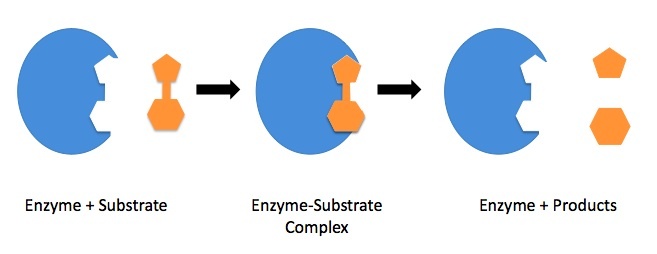
What's going on in this picture?
The enzyme is taking the red substrate and turning it blue
The enzyme's active site is blocked by a competitive inhibitor
The enzyme can't function if too many substrates are trying to bind
This is an example of an anabolic enzyme reaction
An activor or inhibitor binding place that is not the active site, causing the enzyme to change conformation (shape) is an example of ...
competative inhibition
allosteric control
optimum conditions
induced fit

